

The Strategy of Social Responsibility at Universidad Pontificia Bolivariana …
443
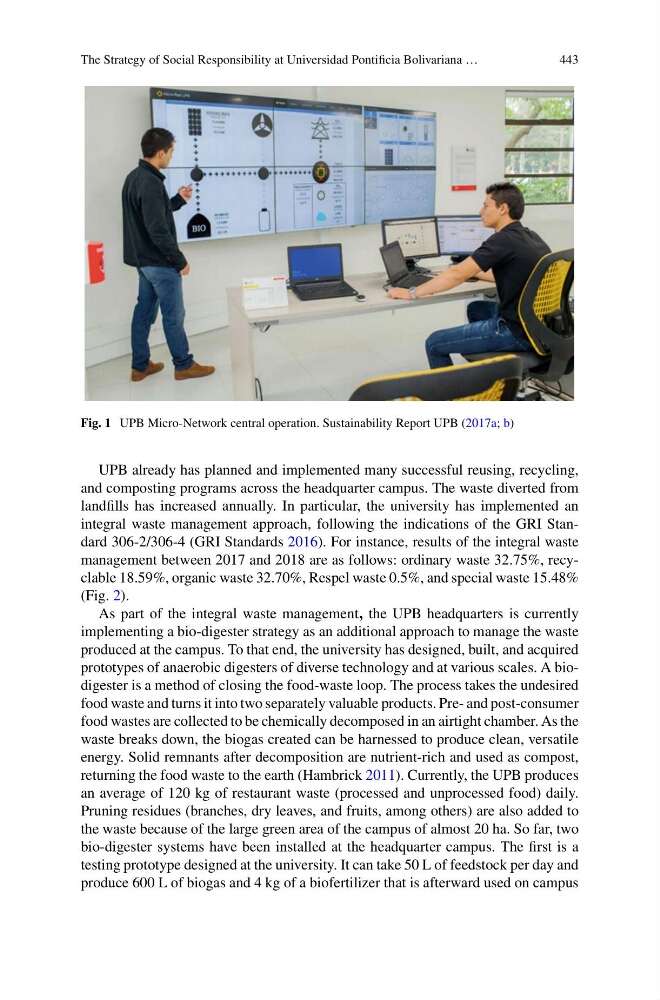
Fig. 1 UPB Micro-Network central operation. Sustainability Report UPB (2017a; b)
UPB already has planned and implemented many successful reusing, recycling,
and composting programs across the headquarter campus. The waste diverted from
landfills has increased annually. In particular, the university has implemented an
integral waste management approach, following the indications of the GRI Standard 306-2/306-4 (GRI Standards 2016). For instance, results of the integral waste
management between 2017 and 2018 are as follows: ordinary waste 32.75%, recyclable 18.59%, organic waste 32.70%, Respel waste 0.5%, and special waste 15.48%
(Fig. 2).
As part of the integral waste management, the UPB headquarters is currently
implementing a bio-digester strategy as an additional approach to manage the waste
produced at the campus. To that end, the university has designed, built, and acquired
prototypes of anaerobic digesters of diverse technology and at various scales. A biodigester is a method of closing the food-waste loop. The process takes the undesired
food waste and turns it into two separately valuable products. Pre- and post-consumer
food wastes are collected to be chemically decomposed in an airtight chamber. As the
waste breaks down, the biogas created can be harnessed to produce clean, versatile
energy. Solid remnants after decomposition are nutrient-rich and used as compost,
returning the food waste to the earth (Hambrick 2011). Currently, the UPB produces
an average of 120 kg of restaurant waste (processed and unprocessed food) daily.
Pruning residues (branches, dry leaves, and fruits, among others) are also added to
the waste because of the large green area of the campus of almost 20 ha. So far, two
bio-digester systems have been installed at the headquarter campus. The first is a
testing prototype designed at the university. It can take 50 L of feedstock per day and
produce 600 L of biogas and 4 kg of a biofertilizer that is afterward used on campus
443
Fig. 1 UPB Micro-Network central operation. Sustainability Report UPB (2017a; b)
UPB already has planned and implemented many successful reusing, recycling,
and composting programs across the headquarter campus. The waste diverted from
landfills has increased annually. In particular, the university has implemented an
integral waste management approach, following the indications of the GRI Standard 306-2/306-4 (GRI Standards 2016). For instance, results of the integral waste
management between 2017 and 2018 are as follows: ordinary waste 32.75%, recyclable 18.59%, organic waste 32.70%, Respel waste 0.5%, and special waste 15.48%
(Fig. 2).
As part of the integral waste management, the UPB headquarters is currently
implementing a bio-digester strategy as an additional approach to manage the waste
produced at the campus. To that end, the university has designed, built, and acquired
prototypes of anaerobic digesters of diverse technology and at various scales. A biodigester is a method of closing the food-waste loop. The process takes the undesired
food waste and turns it into two separately valuable products. Pre- and post-consumer
food wastes are collected to be chemically decomposed in an airtight chamber. As the
waste breaks down, the biogas created can be harnessed to produce clean, versatile
energy. Solid remnants after decomposition are nutrient-rich and used as compost,
returning the food waste to the earth (Hambrick 2011). Currently, the UPB produces
an average of 120 kg of restaurant waste (processed and unprocessed food) daily.
Pruning residues (branches, dry leaves, and fruits, among others) are also added to
the waste because of the large green area of the campus of almost 20 ha. So far, two
bio-digester systems have been installed at the headquarter campus. The first is a
testing prototype designed at the university. It can take 50 L of feedstock per day and
produce 600 L of biogas and 4 kg of a biofertilizer that is afterward used on campus