

“Beira Trilhos”: The Implementation of the Right to Housing …
401
axis, problems and potentialities were diagnosed, guidelines, strategies and intervention proposals were built. The program requirement included allocating the soil of
surrounding urban voids, rearranging operational residences into these urban voids,
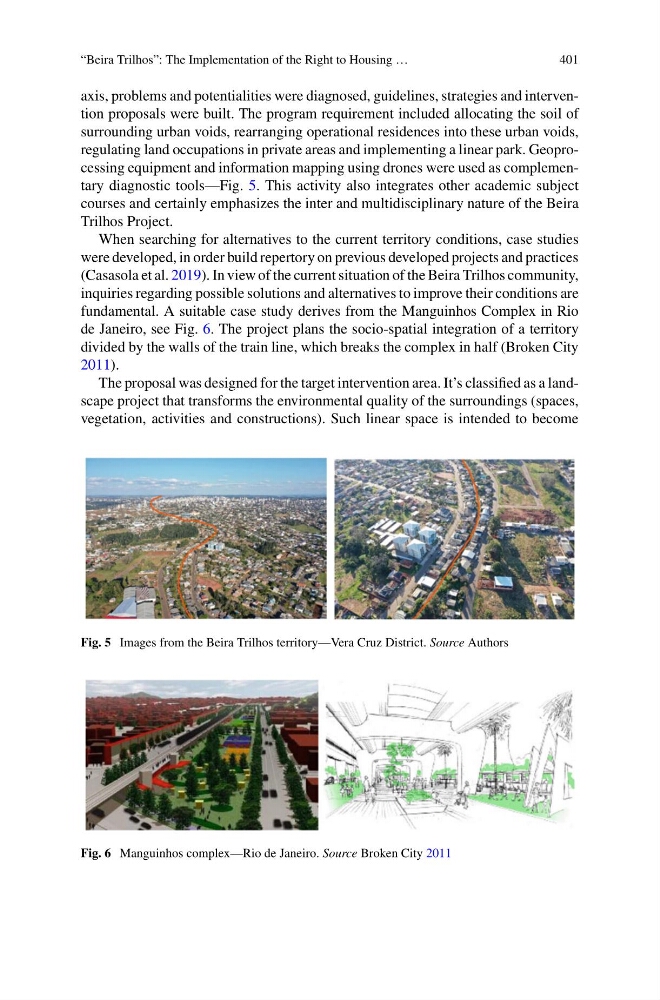
regulating land occupations in private areas and implementing a linear park. Geoprocessing equipment and information mapping using drones were used as complementary diagnostic tools—Fig. 5. This activity also integrates other academic subject
courses and certainly emphasizes the inter and multidisciplinary nature of the Beira
Trilhos Project.
When searching for alternatives to the current territory conditions, case studies
were developed, in order build repertory on previous developed projects and practices
(Casasola et al. 2019). In view of the current situation of the Beira Trilhos community,
inquiries regarding possible solutions and alternatives to improve their conditions are
fundamental. A suitable case study derives from the Manguinhos Complex in Rio
de Janeiro, see Fig. 6. The project plans the socio-spatial integration of a territory
divided by the walls of the train line, which breaks the complex in half (Broken City
2011).
The proposal was designed for the target intervention area. It’s classified as a landscape project that transforms the environmental quality of the surroundings (spaces,
vegetation, activities and constructions). Such linear space is intended to become
Fig. 5 Images from the Beira Trilhos territory—Vera Cruz District. Source Authors
Fig. 6 Manguinhos complex—Rio de Janeiro. Source Broken City 2011
401
axis, problems and potentialities were diagnosed, guidelines, strategies and intervention proposals were built. The program requirement included allocating the soil of
surrounding urban voids, rearranging operational residences into these urban voids,
regulating land occupations in private areas and implementing a linear park. Geoprocessing equipment and information mapping using drones were used as complementary diagnostic tools—Fig. 5. This activity also integrates other academic subject
courses and certainly emphasizes the inter and multidisciplinary nature of the Beira
Trilhos Project.
When searching for alternatives to the current territory conditions, case studies
were developed, in order build repertory on previous developed projects and practices
(Casasola et al. 2019). In view of the current situation of the Beira Trilhos community,
inquiries regarding possible solutions and alternatives to improve their conditions are
fundamental. A suitable case study derives from the Manguinhos Complex in Rio
de Janeiro, see Fig. 6. The project plans the socio-spatial integration of a territory
divided by the walls of the train line, which breaks the complex in half (Broken City
2011).
The proposal was designed for the target intervention area. It’s classified as a landscape project that transforms the environmental quality of the surroundings (spaces,
vegetation, activities and constructions). Such linear space is intended to become
Fig. 5 Images from the Beira Trilhos territory—Vera Cruz District. Source Authors
Fig. 6 Manguinhos complex—Rio de Janeiro. Source Broken City 2011