

“Beira Trilhos”: The Implementation of the Right to Housing …
395
previous research developed in 2005, focusing on the occupations socioeconomic,
urban and geographic data (CDHPF 2005; Kalil et al. 2007).
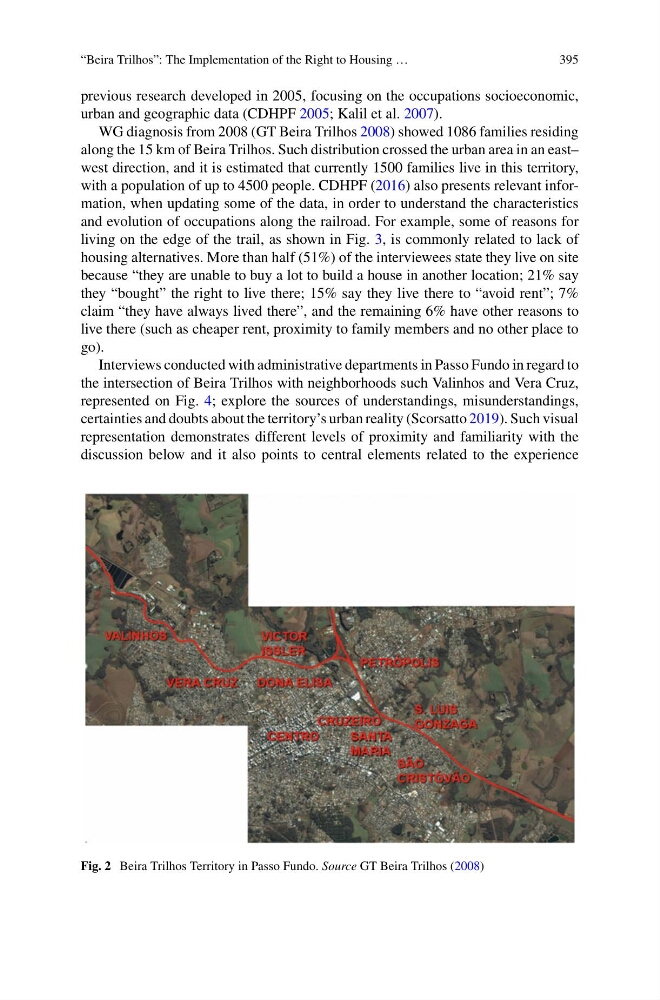
WG diagnosis from 2008 (GT Beira Trilhos 2008) showed 1086 families residing
along the 15 km of Beira Trilhos. Such distribution crossed the urban area in an east–
west direction, and it is estimated that currently 1500 families live in this territory,
with a population of up to 4500 people. CDHPF (2016) also presents relevant information, when updating some of the data, in order to understand the characteristics
and evolution of occupations along the railroad. For example, some of reasons for
living on the edge of the trail, as shown in Fig. 3, is commonly related to lack of
housing alternatives. More than half (51%) of the interviewees state they live on site
because “they are unable to buy a lot to build a house in another location; 21% say
they “bought” the right to live there; 15% say they live there to “avoid rent”; 7%
claim “they have always lived there”, and the remaining 6% have other reasons to
live there (such as cheaper rent, proximity to family members and no other place to
go).
Interviews conducted with administrative departments in Passo Fundo in regard to
the intersection of Beira Trilhos with neighborhoods such Valinhos and Vera Cruz,
represented on Fig. 4; explore the sources of understandings, misunderstandings,
certainties and doubts about the territory’s urban reality (Scorsatto 2019). Such visual
representation demonstrates different levels of proximity and familiarity with the
discussion below and it also points to central elements related to the experience
Fig. 2 Beira Trilhos Territory in Passo Fundo. Source GT Beira Trilhos (2008)
395
previous research developed in 2005, focusing on the occupations socioeconomic,
urban and geographic data (CDHPF 2005; Kalil et al. 2007).
WG diagnosis from 2008 (GT Beira Trilhos 2008) showed 1086 families residing
along the 15 km of Beira Trilhos. Such distribution crossed the urban area in an east–
west direction, and it is estimated that currently 1500 families live in this territory,
with a population of up to 4500 people. CDHPF (2016) also presents relevant information, when updating some of the data, in order to understand the characteristics
and evolution of occupations along the railroad. For example, some of reasons for
living on the edge of the trail, as shown in Fig. 3, is commonly related to lack of
housing alternatives. More than half (51%) of the interviewees state they live on site
because “they are unable to buy a lot to build a house in another location; 21% say
they “bought” the right to live there; 15% say they live there to “avoid rent”; 7%
claim “they have always lived there”, and the remaining 6% have other reasons to
live there (such as cheaper rent, proximity to family members and no other place to
go).
Interviews conducted with administrative departments in Passo Fundo in regard to
the intersection of Beira Trilhos with neighborhoods such Valinhos and Vera Cruz,
represented on Fig. 4; explore the sources of understandings, misunderstandings,
certainties and doubts about the territory’s urban reality (Scorsatto 2019). Such visual
representation demonstrates different levels of proximity and familiarity with the
discussion below and it also points to central elements related to the experience
Fig. 2 Beira Trilhos Territory in Passo Fundo. Source GT Beira Trilhos (2008)