

394
M. A. L. Frandoloso and E. N. Scorsatto
“conditions for sustainable, inclusive and economically sustainable growth, shared
prosperity and decent work for all” (UNIC Rio 2015, pp. 2–3).
The present project derives from the fact Brazil has received large public and
private investments to develop rail passenger and cargo transportation infrastructures. As a result, such investment made the installation and expansion of this type
of mobility possible. However, over time these investments have been redirected
towards road transport. Nowadays, these areas and infrastructures are commonly
occupied by the local community who is often not granted the right to housing, but
people who see such territory as a possibility to access the right to the city (CDHPF
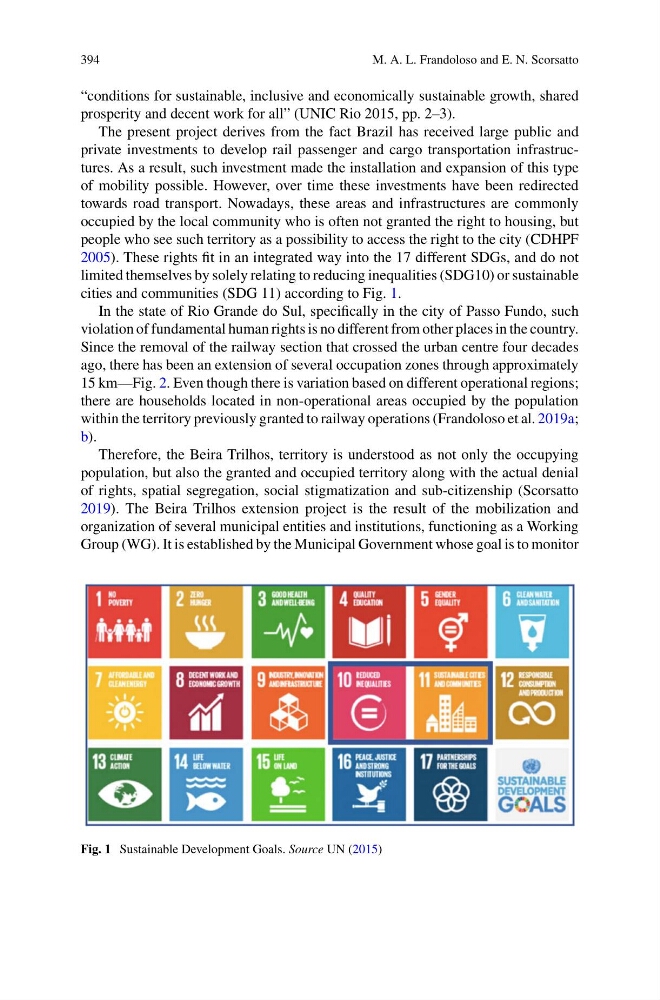
2005). These rights fit in an integrated way into the 17 different SDGs, and do not
limited themselves by solely relating to reducing inequalities (SDG10) or sustainable
cities and communities (SDG 11) according to Fig. 1.
In the state of Rio Grande do Sul, specifically in the city of Passo Fundo, such
violation of fundamental human rights is no different from other places in the country.
Since the removal of the railway section that crossed the urban centre four decades
ago, there has been an extension of several occupation zones through approximately
15 km—Fig. 2. Even though there is variation based on different operational regions;
there are households located in non-operational areas occupied by the population
within the territory previously granted to railway operations (Frandoloso et al. 2019a;
b).
Therefore, the Beira Trilhos, territory is understood as not only the occupying
population, but also the granted and occupied territory along with the actual denial
of rights, spatial segregation, social stigmatization and sub-citizenship (Scorsatto
2019). The Beira Trilhos extension project is the result of the mobilization and
organization of several municipal entities and institutions, functioning as a Working
Group (WG). It is established by the Municipal Government whose goal is to monitor
Fig. 1 Sustainable Development Goals. Source UN (2015)
M. A. L. Frandoloso and E. N. Scorsatto
“conditions for sustainable, inclusive and economically sustainable growth, shared
prosperity and decent work for all” (UNIC Rio 2015, pp. 2–3).
The present project derives from the fact Brazil has received large public and
private investments to develop rail passenger and cargo transportation infrastructures. As a result, such investment made the installation and expansion of this type
of mobility possible. However, over time these investments have been redirected
towards road transport. Nowadays, these areas and infrastructures are commonly
occupied by the local community who is often not granted the right to housing, but
people who see such territory as a possibility to access the right to the city (CDHPF
2005). These rights fit in an integrated way into the 17 different SDGs, and do not
limited themselves by solely relating to reducing inequalities (SDG10) or sustainable
cities and communities (SDG 11) according to Fig. 1.
In the state of Rio Grande do Sul, specifically in the city of Passo Fundo, such
violation of fundamental human rights is no different from other places in the country.
Since the removal of the railway section that crossed the urban centre four decades
ago, there has been an extension of several occupation zones through approximately
15 km—Fig. 2. Even though there is variation based on different operational regions;
there are households located in non-operational areas occupied by the population
within the territory previously granted to railway operations (Frandoloso et al. 2019a;
b).
Therefore, the Beira Trilhos, territory is understood as not only the occupying
population, but also the granted and occupied territory along with the actual denial
of rights, spatial segregation, social stigmatization and sub-citizenship (Scorsatto
2019). The Beira Trilhos extension project is the result of the mobilization and
organization of several municipal entities and institutions, functioning as a Working
Group (WG). It is established by the Municipal Government whose goal is to monitor
Fig. 1 Sustainable Development Goals. Source UN (2015)