

316
L. M. Floriani and E. N. de Moura
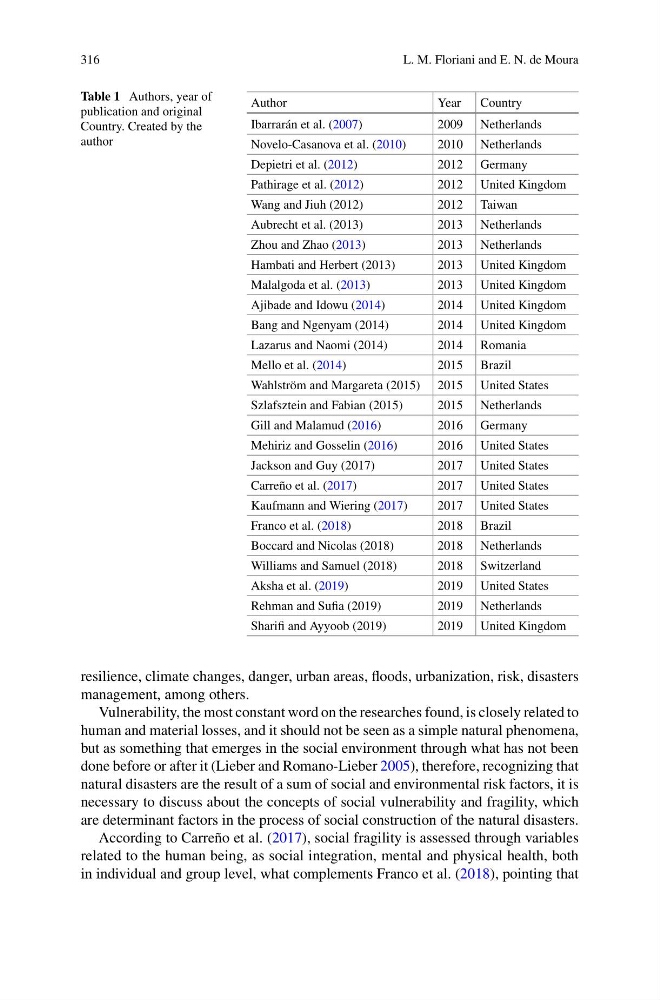
Table 1 Authors, year of
publication and original
Country. Created by the
author
Author
Year
Country
Ibarrarán et al. (2007)
2009 Netherlands
Novelo-Casanova et al. (2010)
2010 Netherlands
Depietri et al. (2012)
2012 Germany
Pathirage et al. (2012)
2012 United Kingdom
Wang and Jiuh (2012)
2012 Taiwan
Aubrecht et al. (2013)
2013 Netherlands
Zhou and Zhao (2013)
2013 Netherlands
Hambati and Herbert (2013)
2013 United Kingdom
Malalgoda et al. (2013)
2013 United Kingdom
Ajibade and Idowu (2014)
2014 United Kingdom
Bang and Ngenyam (2014)
2014 United Kingdom
Lazarus and Naomi (2014)
2014 Romania
Mello et al. (2014)
2015 Brazil
Wahlström and Margareta (2015) 2015 United States
Szlafsztein and Fabian (2015)
2015 Netherlands
Gill and Malamud (2016)
2016 Germany
Mehiriz and Gosselin (2016)
2016 United States
Jackson and Guy (2017)
2017 United States
Carreño et al. (2017)
2017 United States
Kaufmann and Wiering (2017)
2017 United States
Franco et al. (2018)
2018 Brazil
Boccard and Nicolas (2018)
2018 Netherlands
Williams and Samuel (2018)
2018 Switzerland
Aksha et al. (2019)
2019 United States
Rehman and Sufia (2019)
2019 Netherlands
Sharifi and Ayyoob (2019)
2019 United Kingdom
resilience, climate changes, danger, urban areas, floods, urbanization, risk, disasters
management, among others.
Vulnerability, the most constant word on the researches found, is closely related to
human and material losses, and it should not be seen as a simple natural phenomena,
but as something that emerges in the social environment through what has not been
done before or after it (Lieber and Romano-Lieber 2005), therefore, recognizing that
natural disasters are the result of a sum of social and environmental risk factors, it is
necessary to discuss about the concepts of social vulnerability and fragility, which
are determinant factors in the process of social construction of the natural disasters.
According to Carreño et al. (2017), social fragility is assessed through variables
related to the human being, as social integration, mental and physical health, both
in individual and group level, what complements Franco et al. (2018), pointing that
L. M. Floriani and E. N. de Moura
Table 1 Authors, year of
publication and original
Country. Created by the
author
Author
Year
Country
Ibarrarán et al. (2007)
2009 Netherlands
Novelo-Casanova et al. (2010)
2010 Netherlands
Depietri et al. (2012)
2012 Germany
Pathirage et al. (2012)
2012 United Kingdom
Wang and Jiuh (2012)
2012 Taiwan
Aubrecht et al. (2013)
2013 Netherlands
Zhou and Zhao (2013)
2013 Netherlands
Hambati and Herbert (2013)
2013 United Kingdom
Malalgoda et al. (2013)
2013 United Kingdom
Ajibade and Idowu (2014)
2014 United Kingdom
Bang and Ngenyam (2014)
2014 United Kingdom
Lazarus and Naomi (2014)
2014 Romania
Mello et al. (2014)
2015 Brazil
Wahlström and Margareta (2015) 2015 United States
Szlafsztein and Fabian (2015)
2015 Netherlands
Gill and Malamud (2016)
2016 Germany
Mehiriz and Gosselin (2016)
2016 United States
Jackson and Guy (2017)
2017 United States
Carreño et al. (2017)
2017 United States
Kaufmann and Wiering (2017)
2017 United States
Franco et al. (2018)
2018 Brazil
Boccard and Nicolas (2018)
2018 Netherlands
Williams and Samuel (2018)
2018 Switzerland
Aksha et al. (2019)
2019 United States
Rehman and Sufia (2019)
2019 Netherlands
Sharifi and Ayyoob (2019)
2019 United Kingdom
resilience, climate changes, danger, urban areas, floods, urbanization, risk, disasters
management, among others.
Vulnerability, the most constant word on the researches found, is closely related to
human and material losses, and it should not be seen as a simple natural phenomena,
but as something that emerges in the social environment through what has not been
done before or after it (Lieber and Romano-Lieber 2005), therefore, recognizing that
natural disasters are the result of a sum of social and environmental risk factors, it is
necessary to discuss about the concepts of social vulnerability and fragility, which
are determinant factors in the process of social construction of the natural disasters.
According to Carreño et al. (2017), social fragility is assessed through variables
related to the human being, as social integration, mental and physical health, both
in individual and group level, what complements Franco et al. (2018), pointing that