

The Social Construction of Natural Disasters …
315
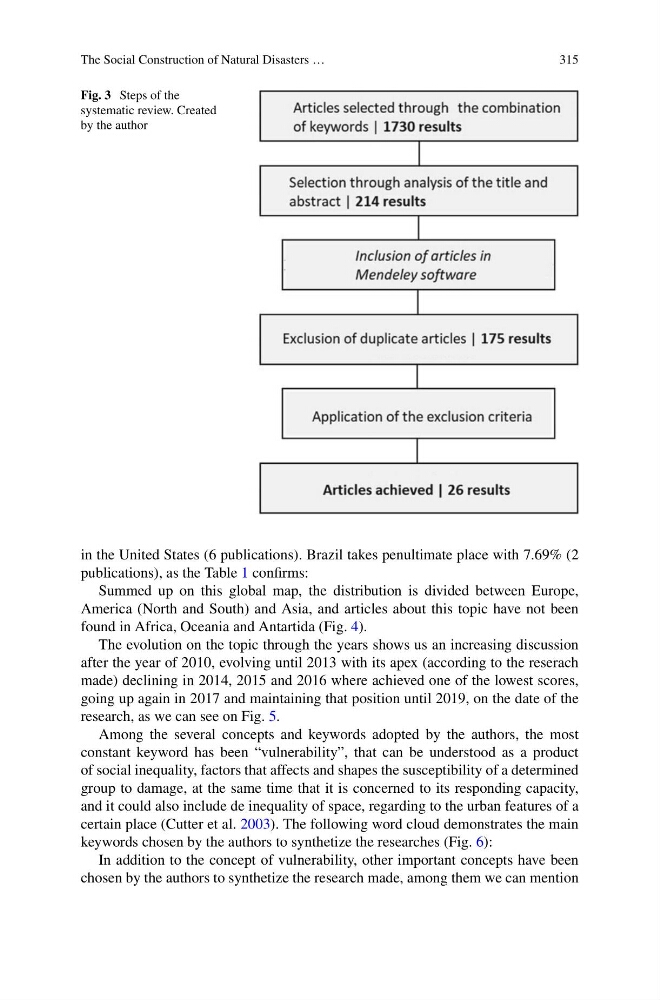
Fig. 3 Steps of the
systematic review. Created
by the author
in the United States (6 publications). Brazil takes penultimate place with 7.69% (2
publications), as the Table 1 confirms:
Summed up on this global map, the distribution is divided between Europe,
America (North and South) and Asia, and articles about this topic have not been
found in Africa, Oceania and Antartida (Fig. 4).
The evolution on the topic through the years shows us an increasing discussion
after the year of 2010, evolving until 2013 with its apex (according to the reserach
made) declining in 2014, 2015 and 2016 where achieved one of the lowest scores,
going up again in 2017 and maintaining that position until 2019, on the date of the
research, as we can see on Fig. 5.
Among the several concepts and keywords adopted by the authors, the most
constant keyword has been “vulnerability”, that can be understood as a product
of social inequality, factors that affects and shapes the susceptibility of a determined
group to damage, at the same time that it is concerned to its responding capacity,
and it could also include de inequality of space, regarding to the urban features of a
certain place (Cutter et al. 2003). The following word cloud demonstrates the main
keywords chosen by the authors to synthetize the researches (Fig. 6):
In addition to the concept of vulnerability, other important concepts have been
chosen by the authors to synthetize the research made, among them we can mention
315
Fig. 3 Steps of the
systematic review. Created
by the author
in the United States (6 publications). Brazil takes penultimate place with 7.69% (2
publications), as the Table 1 confirms:
Summed up on this global map, the distribution is divided between Europe,
America (North and South) and Asia, and articles about this topic have not been
found in Africa, Oceania and Antartida (Fig. 4).
The evolution on the topic through the years shows us an increasing discussion
after the year of 2010, evolving until 2013 with its apex (according to the reserach
made) declining in 2014, 2015 and 2016 where achieved one of the lowest scores,
going up again in 2017 and maintaining that position until 2019, on the date of the
research, as we can see on Fig. 5.
Among the several concepts and keywords adopted by the authors, the most
constant keyword has been “vulnerability”, that can be understood as a product
of social inequality, factors that affects and shapes the susceptibility of a determined
group to damage, at the same time that it is concerned to its responding capacity,
and it could also include de inequality of space, regarding to the urban features of a
certain place (Cutter et al. 2003). The following word cloud demonstrates the main
keywords chosen by the authors to synthetize the researches (Fig. 6):
In addition to the concept of vulnerability, other important concepts have been
chosen by the authors to synthetize the research made, among them we can mention