

Mining Sustainability Practices in Latin America
219
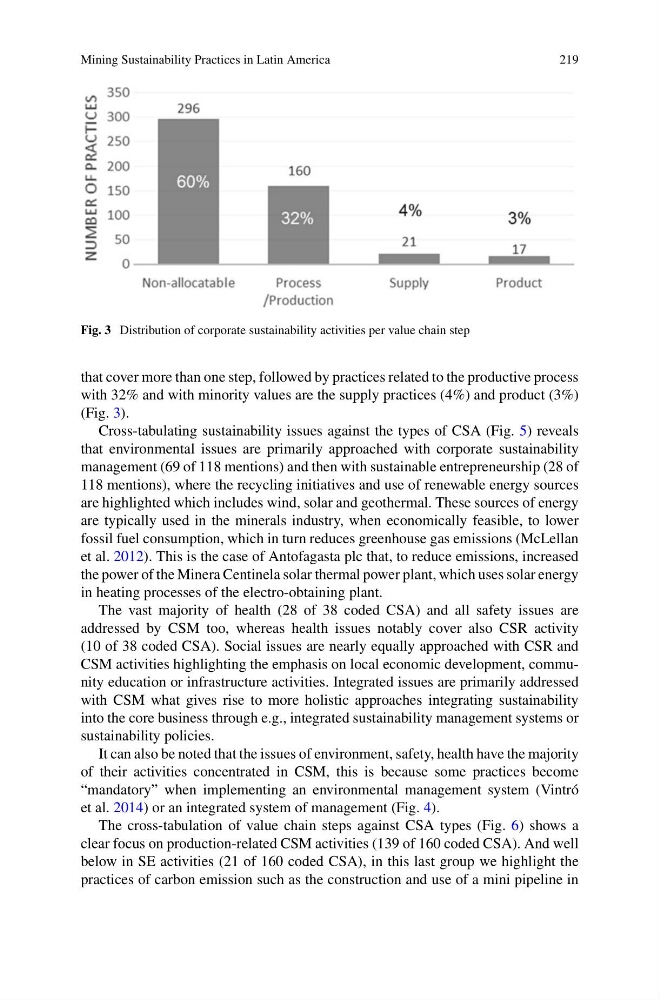
Fig. 3 Distribution of corporate sustainability activities per value chain step
that cover more than one step, followed by practices related to the productive process
with 32% and with minority values are the supply practices (4%) and product (3%)
(Fig. 3).
Cross-tabulating sustainability issues against the types of CSA (Fig. 5) reveals
that environmental issues are primarily approached with corporate sustainability
management (69 of 118 mentions) and then with sustainable entrepreneurship (28 of
118 mentions), where the recycling initiatives and use of renewable energy sources
are highlighted which includes wind, solar and geothermal. These sources of energy
are typically used in the minerals industry, when economically feasible, to lower
fossil fuel consumption, which in turn reduces greenhouse gas emissions (McLellan
et al. 2012). This is the case of Antofagasta plc that, to reduce emissions, increased
the power of the Minera Centinela solar thermal power plant, which uses solar energy
in heating processes of the electro-obtaining plant.
The vast majority of health (28 of 38 coded CSA) and all safety issues are
addressed by CSM too, whereas health issues notably cover also CSR activity
(10 of 38 coded CSA). Social issues are nearly equally approached with CSR and
CSM activities highlighting the emphasis on local economic development, community education or infrastructure activities. Integrated issues are primarily addressed
with CSM what gives rise to more holistic approaches integrating sustainability
into the core business through e.g., integrated sustainability management systems or
sustainability policies.
It can also be noted that the issues of environment, safety, health have the majority
of their activities concentrated in CSM, this is because some practices become
“mandatory” when implementing an environmental management system (Vintró
et al. 2014) or an integrated system of management (Fig. 4).
The cross-tabulation of value chain steps against CSA types (Fig. 6) shows a
clear focus on production-related CSM activities (139 of 160 coded CSA). And well
below in SE activities (21 of 160 coded CSA), in this last group we highlight the
practices of carbon emission such as the construction and use of a mini pipeline in
219
Fig. 3 Distribution of corporate sustainability activities per value chain step
that cover more than one step, followed by practices related to the productive process
with 32% and with minority values are the supply practices (4%) and product (3%)
(Fig. 3).
Cross-tabulating sustainability issues against the types of CSA (Fig. 5) reveals
that environmental issues are primarily approached with corporate sustainability
management (69 of 118 mentions) and then with sustainable entrepreneurship (28 of
118 mentions), where the recycling initiatives and use of renewable energy sources
are highlighted which includes wind, solar and geothermal. These sources of energy
are typically used in the minerals industry, when economically feasible, to lower
fossil fuel consumption, which in turn reduces greenhouse gas emissions (McLellan
et al. 2012). This is the case of Antofagasta plc that, to reduce emissions, increased
the power of the Minera Centinela solar thermal power plant, which uses solar energy
in heating processes of the electro-obtaining plant.
The vast majority of health (28 of 38 coded CSA) and all safety issues are
addressed by CSM too, whereas health issues notably cover also CSR activity
(10 of 38 coded CSA). Social issues are nearly equally approached with CSR and
CSM activities highlighting the emphasis on local economic development, community education or infrastructure activities. Integrated issues are primarily addressed
with CSM what gives rise to more holistic approaches integrating sustainability
into the core business through e.g., integrated sustainability management systems or
sustainability policies.
It can also be noted that the issues of environment, safety, health have the majority
of their activities concentrated in CSM, this is because some practices become
“mandatory” when implementing an environmental management system (Vintró
et al. 2014) or an integrated system of management (Fig. 4).
The cross-tabulation of value chain steps against CSA types (Fig. 6) shows a
clear focus on production-related CSM activities (139 of 160 coded CSA). And well
below in SE activities (21 of 160 coded CSA), in this last group we highlight the
practices of carbon emission such as the construction and use of a mini pipeline in