

138
U. Awan et al.
TG
TRN
H3
H4
H1
H2
SP
RG
SEP
H1a
H2b
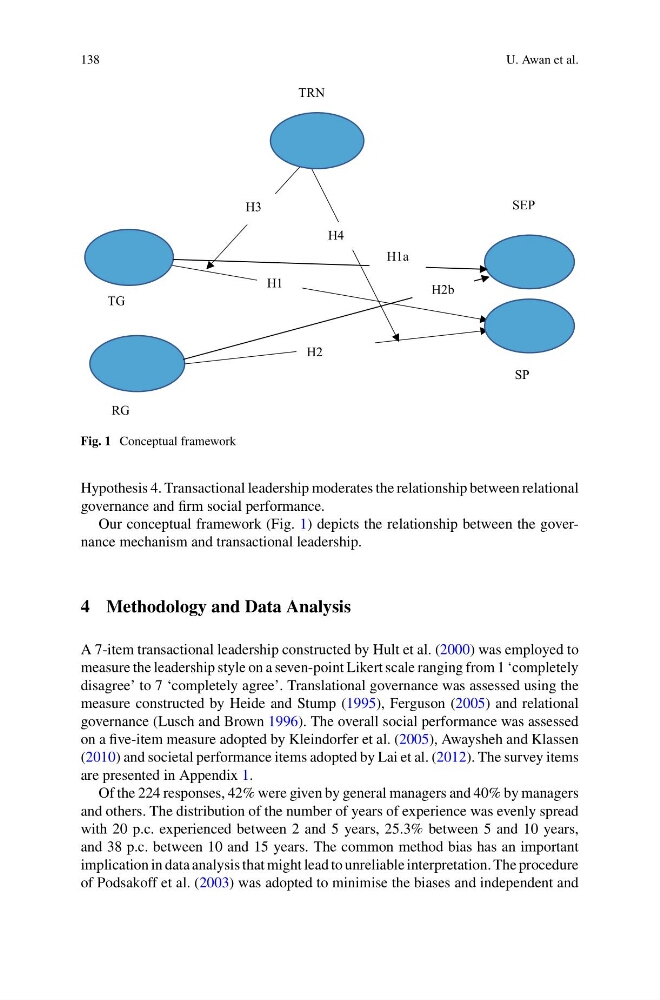
Fig. 1 Conceptual framework
Hypothesis 4. Transactional leadership moderates the relationship between relational
governance and firm social performance.
Our conceptual framework (Fig. 1) depicts the relationship between the governance mechanism and transactional leadership.
4 Methodology and Data Analysis
A 7-item transactional leadership constructed by Hult et al. (2000) was employed to
measure the leadership style on a seven-point Likert scale ranging from 1 ‘completely
disagree’ to 7 ‘completely agree’. Translational governance was assessed using the
measure constructed by Heide and Stump (1995), Ferguson (2005) and relational
governance (Lusch and Brown 1996). The overall social performance was assessed
on a five-item measure adopted by Kleindorfer et al. (2005), Awaysheh and Klassen
(2010) and societal performance items adopted by Lai et al. (2012). The survey items
are presented in Appendix 1.
Of the 224 responses, 42% were given by general managers and 40% by managers
and others. The distribution of the number of years of experience was evenly spread
with 20 p.c. experienced between 2 and 5 years, 25.3% between 5 and 10 years,
and 38 p.c. between 10 and 15 years. The common method bias has an important
implication in data analysis that might lead to unreliable interpretation. The procedure
of Podsakoff et al. (2003) was adopted to minimise the biases and independent and
U. Awan et al.
TG
TRN
H3
H4
H1
H2
SP
RG
SEP
H1a
H2b
Fig. 1 Conceptual framework
Hypothesis 4. Transactional leadership moderates the relationship between relational
governance and firm social performance.
Our conceptual framework (Fig. 1) depicts the relationship between the governance mechanism and transactional leadership.
4 Methodology and Data Analysis
A 7-item transactional leadership constructed by Hult et al. (2000) was employed to
measure the leadership style on a seven-point Likert scale ranging from 1 ‘completely
disagree’ to 7 ‘completely agree’. Translational governance was assessed using the
measure constructed by Heide and Stump (1995), Ferguson (2005) and relational
governance (Lusch and Brown 1996). The overall social performance was assessed
on a five-item measure adopted by Kleindorfer et al. (2005), Awaysheh and Klassen
(2010) and societal performance items adopted by Lai et al. (2012). The survey items
are presented in Appendix 1.
Of the 224 responses, 42% were given by general managers and 40% by managers
and others. The distribution of the number of years of experience was evenly spread
with 20 p.c. experienced between 2 and 5 years, 25.3% between 5 and 10 years,
and 38 p.c. between 10 and 15 years. The common method bias has an important
implication in data analysis that might lead to unreliable interpretation. The procedure
of Podsakoff et al. (2003) was adopted to minimise the biases and independent and