

87
Transient Heat Conduction
x
x
T s
T ∞
Moving boundary
δ(t)
Water
Ice
1
2
0
x =
q s ″
T m
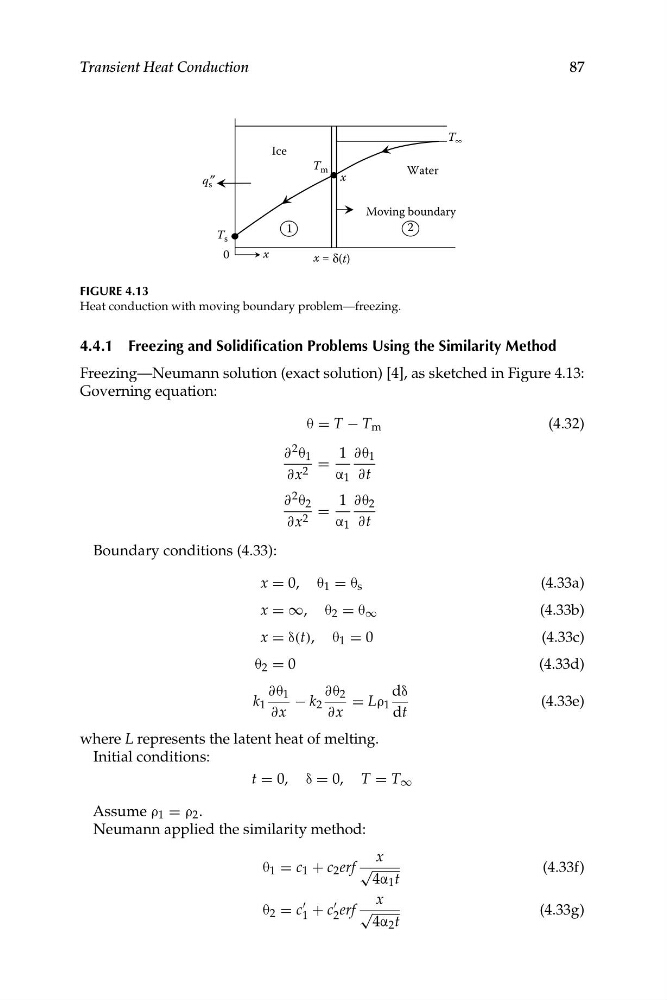
FIGURE 4.13
Heat conduction with moving boundary problem—freezing.
4.4.1 Freezing and Solidification Problems Using the Similarity Method
Freezing—Neumann solution (exact solution) [4], as sketched in Figure 4.13:
Governing equation:
θ = T − T m
(4.32)
∂ 2 θ 1
1 ∂θ 1
=
∂x 2
α 1 ∂t
∂ 2 θ 2
1 ∂θ 2
=
∂x 2
α 1 ∂t
Boundary conditions (4.33):
x = 0, θ 1 = θ s
(4.33a)
x = ∞, θ 2 = θ ∞
(4.33b)
x = δ(t), θ 1 = 0
(4.33c)
θ 2 = 0
(4.33d)
∂θ 1
∂θ 2
dδ
k 1
− k 2
= Lρ 1
(4.33e)
∂x
∂x
dt
where L represents the latent heat of melting.
Initial conditions:
t = 0, δ = 0, T = T ∞
Assume ρ 1 = ρ 2 .
Neumann applied the similarity method:
x
θ 1 = c 1 + c 2 erf √
(4.33f)
4α 1 t
x
"
"
θ 2 = c 1 + c 2 erf √
(4.33g)
4α 2 t
Transient Heat Conduction
x
x
T s
T ∞
Moving boundary
δ(t)
Water
Ice
1
2
0
x =
q s ″
T m
FIGURE 4.13
Heat conduction with moving boundary problem—freezing.
4.4.1 Freezing and Solidification Problems Using the Similarity Method
Freezing—Neumann solution (exact solution) [4], as sketched in Figure 4.13:
Governing equation:
θ = T − T m
(4.32)
∂ 2 θ 1
1 ∂θ 1
=
∂x 2
α 1 ∂t
∂ 2 θ 2
1 ∂θ 2
=
∂x 2
α 1 ∂t
Boundary conditions (4.33):
x = 0, θ 1 = θ s
(4.33a)
x = ∞, θ 2 = θ ∞
(4.33b)
x = δ(t), θ 1 = 0
(4.33c)
θ 2 = 0
(4.33d)
∂θ 1
∂θ 2
dδ
k 1
− k 2
= Lρ 1
(4.33e)
∂x
∂x
dt
where L represents the latent heat of melting.
Initial conditions:
t = 0, δ = 0, T = T ∞
Assume ρ 1 = ρ 2 .
Neumann applied the similarity method:
x
θ 1 = c 1 + c 2 erf √
(4.33f)
4α 1 t
x
"
"
θ 2 = c 1 + c 2 erf √
(4.33g)
4α 2 t