

subject to BC:
θ
θ i
= 2
x
δ
−
( x
δ
) 2 ≡ 2η − η
2
η =
x
δ
, dx = δ dη
Then
⎡ 1
⎤
d
dt
⎣
�
θ i (2η − η
2 )δ dη − θ i δ ⎦ = −
2αθ i
δ
0
dδ 2
− 12α = 0 at t = 0, δ(0) = 0
⇒ dt √
⇒ δ = 12αt
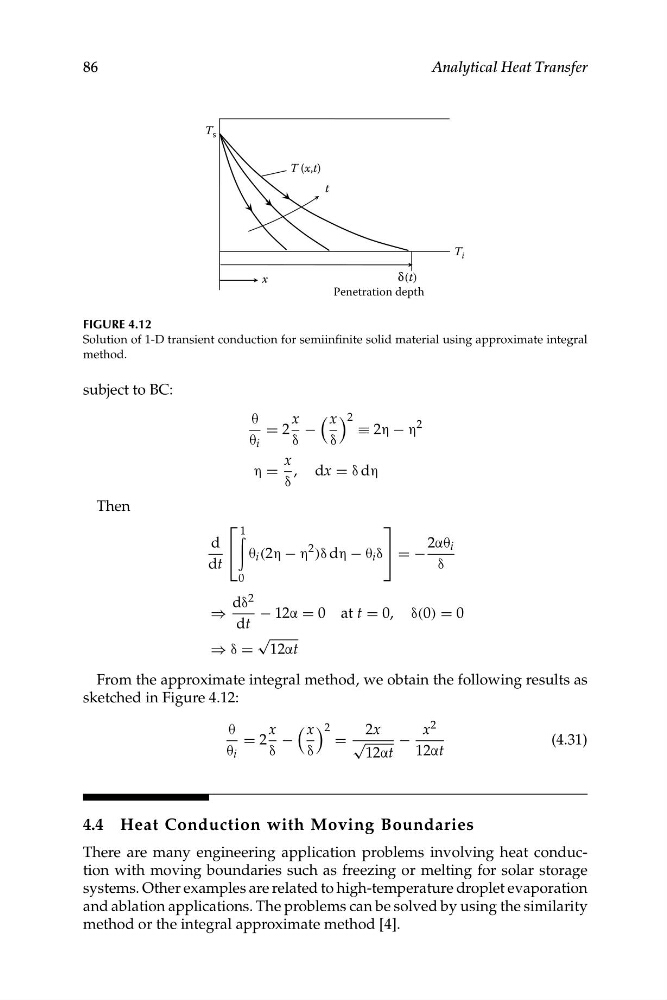
From the approximate integral method, we obtain the following results as
sketched in Figure 4.12:
( ) 2
2
θ
x
x
2x
x
= 2 −
= √
−
(4.31)
θ i
δ
δ
12αt 12αt
86
Analytical Heat Transfer
x
Penetration depth
T (x,t)
t
T i
T s
δ (t)
FIGURE 4.12
Solution of 1-D transient conduction for semiinfinite solid material using approximate integral
method.
4.4 Heat Conduction with Moving Boundaries
There are many engineering application problems involving heat conduction with moving boundaries such as freezing or melting for solar storage
systems. Other examples are related to high-temperature droplet evaporation
and ablation applications. The problems can be solved by using the similarity
method or the integral approximate method [4].
θ
θ i
= 2
x
δ
−
( x
δ
) 2 ≡ 2η − η
2
η =
x
δ
, dx = δ dη
Then
⎡ 1
⎤
d
dt
⎣
�
θ i (2η − η
2 )δ dη − θ i δ ⎦ = −
2αθ i
δ
0
dδ 2
− 12α = 0 at t = 0, δ(0) = 0
⇒ dt √
⇒ δ = 12αt
From the approximate integral method, we obtain the following results as
sketched in Figure 4.12:
( ) 2
2
θ
x
x
2x
x
= 2 −
= √
−
(4.31)
θ i
δ
δ
12αt 12αt
86
Analytical Heat Transfer
x
Penetration depth
T (x,t)
t
T i
T s
δ (t)
FIGURE 4.12
Solution of 1-D transient conduction for semiinfinite solid material using approximate integral
method.
4.4 Heat Conduction with Moving Boundaries
There are many engineering application problems involving heat conduction with moving boundaries such as freezing or melting for solar storage
systems. Other examples are related to high-temperature droplet evaporation
and ablation applications. The problems can be solved by using the similarity
method or the integral approximate method [4].