

� a
(
)
�
�
�� a
nπx
x
1
2nπx
a
sin 2
dx =
−
sin
=
a
2
4nπ
a
2
0
0
2 (−1) n+1 (ca − T 0 ) − 2T 0
⇒ C n =
(
)
nπ sinh (nπb/a)
Hence,
(
)
∞
(
)
(
)
2
(−1) n+1 (ca − T 0 ) − T 0
nπx
nπy
θ x, y =
(
)
sin
sinh
π
n sinh nπb/a
a
a
n=1
b. See the sketch in Figure 3.7.
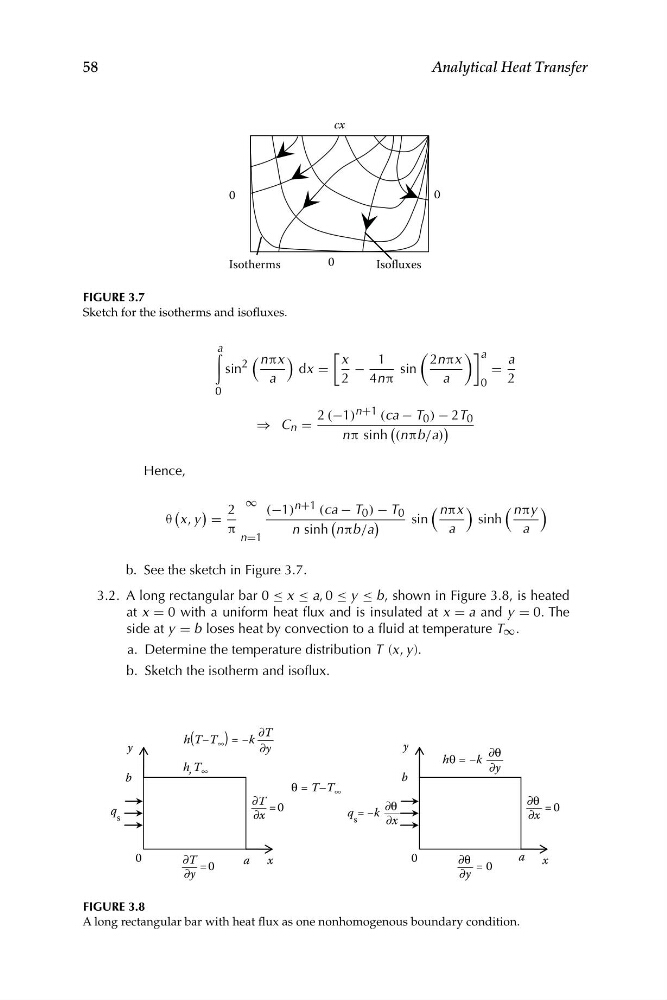
3.2. A long rectangular bar 0 ≤ x ≤ a, 0 ≤ y ≤ b, shown in Figure 3.8, is heated
at x = 0 with a uniform heat flux and is insulated at x = a and y = 0. The
side at y = b loses heat by convection to a fluid at temperature T ∞ .
a. Determine the temperature distribution T (x, y ).
b. Sketch the isotherm and isoflux.
∂T
h(T−T ∞ ) = −k
y
∂y
y
∂θ
hθ = −k
h T ∞
,
∂y
b
b
θ = T–T ∞
∂T
∂θ
=0
= 0
q
q = −k
∂θ
∂x
∂x
s
s
∂x
0
∂T
a x
0
∂θ
a x
=0
= 0
∂y
∂y
58
Analytical Heat Transfer
cx
0
0
Isotherms
Isofluxes
0
FIGURE 3.7
Sketch for the isotherms and isofluxes.
FIGURE 3.8
A long rectangular bar with heat flux as one nonhomogenous boundary condition.
(
)
�
�
�� a
nπx
x
1
2nπx
a
sin 2
dx =
−
sin
=
a
2
4nπ
a
2
0
0
2 (−1) n+1 (ca − T 0 ) − 2T 0
⇒ C n =
(
)
nπ sinh (nπb/a)
Hence,
(
)
∞
(
)
(
)
2
(−1) n+1 (ca − T 0 ) − T 0
nπx
nπy
θ x, y =
(
)
sin
sinh
π
n sinh nπb/a
a
a
n=1
b. See the sketch in Figure 3.7.
3.2. A long rectangular bar 0 ≤ x ≤ a, 0 ≤ y ≤ b, shown in Figure 3.8, is heated
at x = 0 with a uniform heat flux and is insulated at x = a and y = 0. The
side at y = b loses heat by convection to a fluid at temperature T ∞ .
a. Determine the temperature distribution T (x, y ).
b. Sketch the isotherm and isoflux.
∂T
h(T−T ∞ ) = −k
y
∂y
y
∂θ
hθ = −k
h T ∞
,
∂y
b
b
θ = T–T ∞
∂T
∂θ
=0
= 0
q
q = −k
∂θ
∂x
∂x
s
s
∂x
0
∂T
a x
0
∂θ
a x
=0
= 0
∂y
∂y
58
Analytical Heat Transfer
cx
0
0
Isotherms
Isofluxes
0
FIGURE 3.7
Sketch for the isotherms and isofluxes.
FIGURE 3.8
A long rectangular bar with heat flux as one nonhomogenous boundary condition.