

54
Analytical Heat Transfer
r
r
z
r
z
T(r,z)
T(r,ϕ)
T(r,z,ϕ)
ϕ
ϕ
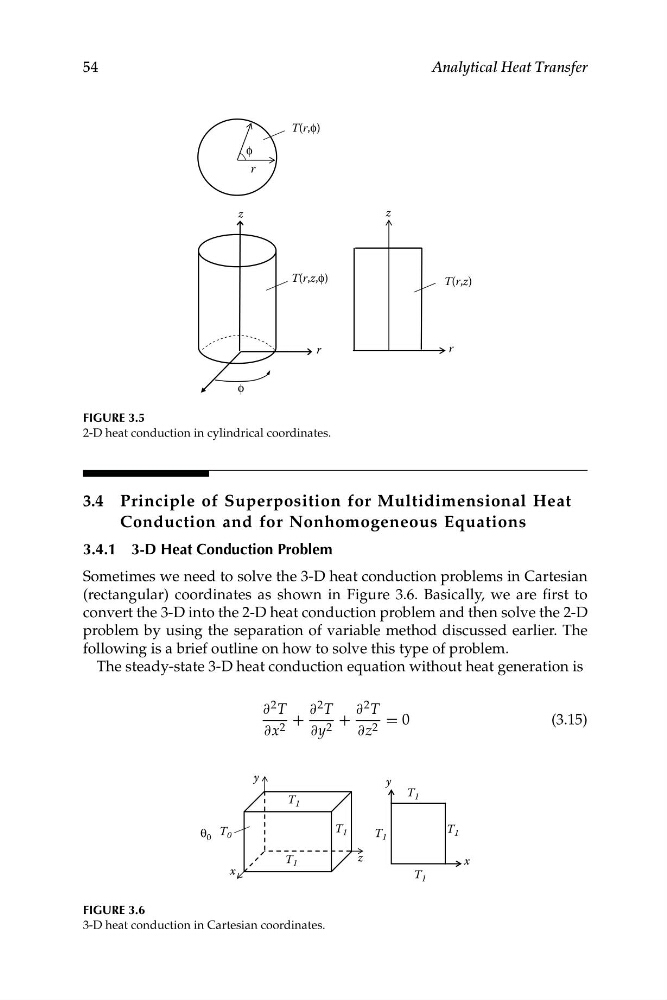
FIGURE 3.5
2-D heat conduction in cylindrical coordinates.
3.4 Principle of Superposition for Multidimensional Heat
Conduction and for Nonhomogeneous Equations
3.4.1 3-D Heat Conduction Problem
Sometimes we need to solve the 3-D heat conduction problems in Cartesian
(rectangular) coordinates as shown in Figure 3.6. Basically, we are first to
convert the 3-D into the 2-D heat conduction problem and then solve the 2-D
problem by using the separation of variable method discussed earlier. The
following is a brief outline on how to solve this type of problem.
The steady-state 3-D heat conduction equation without heat generation is
∂ 2 T
∂ 2 T
∂ 2 T
+
+
= 0
(3.15)
∂x 2
∂y 2
∂z 2
T 1
T 1
T 1
T 0
x
y
y
z
x
T 1
T 1
T 1
T 1
θ 0
FIGURE 3.6
3-D heat conduction in Cartesian coordinates.
Analytical Heat Transfer
r
r
z
r
z
T(r,z)
T(r,ϕ)
T(r,z,ϕ)
ϕ
ϕ
FIGURE 3.5
2-D heat conduction in cylindrical coordinates.
3.4 Principle of Superposition for Multidimensional Heat
Conduction and for Nonhomogeneous Equations
3.4.1 3-D Heat Conduction Problem
Sometimes we need to solve the 3-D heat conduction problems in Cartesian
(rectangular) coordinates as shown in Figure 3.6. Basically, we are first to
convert the 3-D into the 2-D heat conduction problem and then solve the 2-D
problem by using the separation of variable method discussed earlier. The
following is a brief outline on how to solve this type of problem.
The steady-state 3-D heat conduction equation without heat generation is
∂ 2 T
∂ 2 T
∂ 2 T
+
+
= 0
(3.15)
∂x 2
∂y 2
∂z 2
T 1
T 1
T 1
T 0
x
y
y
z
x
T 1
T 1
T 1
T 1
θ 0
FIGURE 3.6
3-D heat conduction in Cartesian coordinates.