

∂T
∂Y
dY
= X
= X
∂y
∂y
dy
∂ 2 T
∂ 2 Y
d 2 Y
= X
= X
∂y 2
∂y 2
dy 2
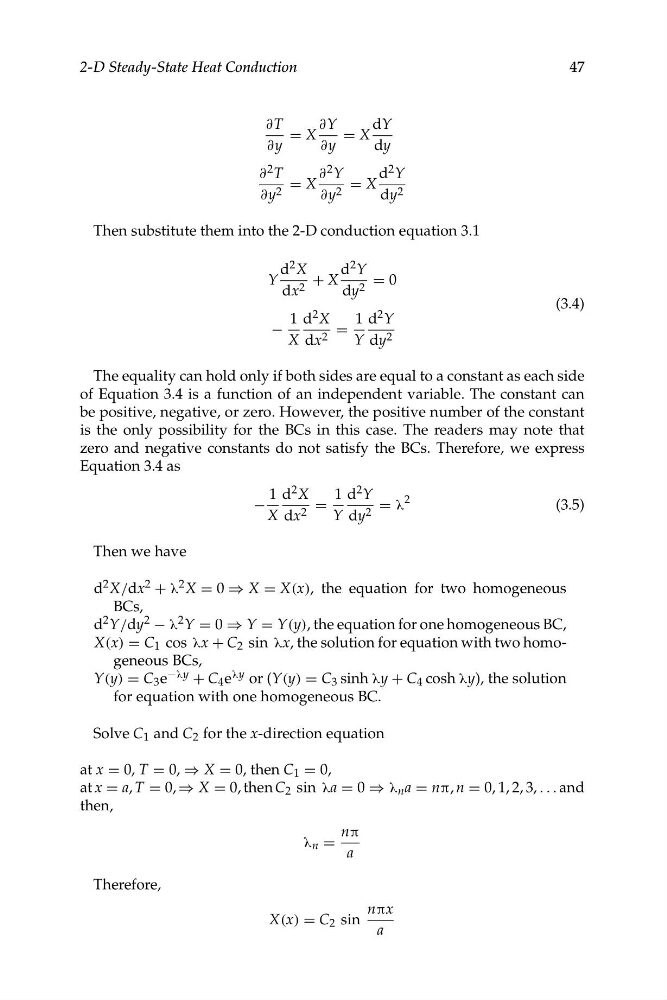
Then substitute them into the 2-D conduction equation 3.1
d 2 X
d 2 Y
Y
+ X
= 0
dx 2
dy 2
(3.4)
1 d 2 X
1 d 2 Y
−
=
X dx 2
Y dy 2
The equality can hold only if both sides are equal to a constant as each side
of Equation 3.4 is a function of an independent variable. The constant can
be positive, negative, or zero. However, the positive number of the constant
is the only possibility for the BCs in this case. The readers may note that
zero and negative constants do not satisfy the BCs. Therefore, we express
Equation 3.4 as
1 d 2 X
1 d 2 Y
2
−
=
= λ
(3.5)
X dx 2
Y dy 2
Then we have
d 2 X/dx 2 + λ 2 X = 0 ⇒ X = X(x), the equation for two homogeneous
BCs,
d 2 Y/dy 2 − λ 2 Y = 0 ⇒ Y = Y(y), the equation for one homogeneous BC,
X(x) = C 1 cos λx + C 2 sin λx, the solution for equation with two homogeneous BCs,
Y(y) = C 3 e −λy + C 4 e λy or (Y(y) = C 3 sinh λy + C 4 cosh λy), the solution
for equation with one homogeneous BC.
Solve C 1 and C 2 for the x-direction equation
at x = 0, T = 0, ⇒ X = 0, then C 1 = 0,
at x = a, T = 0, ⇒ X = 0, then C 2 sin λa = 0 ⇒ λ n a = nπ, n = 0, 1, 2, 3, . . . and
then,
nπ
λ n = a
Therefore,
nπx
X(x) = C 2 sin a
47
2-D Steady-State Heat Conduction
∂Y
dY
= X
= X
∂y
∂y
dy
∂ 2 T
∂ 2 Y
d 2 Y
= X
= X
∂y 2
∂y 2
dy 2
Then substitute them into the 2-D conduction equation 3.1
d 2 X
d 2 Y
Y
+ X
= 0
dx 2
dy 2
(3.4)
1 d 2 X
1 d 2 Y
−
=
X dx 2
Y dy 2
The equality can hold only if both sides are equal to a constant as each side
of Equation 3.4 is a function of an independent variable. The constant can
be positive, negative, or zero. However, the positive number of the constant
is the only possibility for the BCs in this case. The readers may note that
zero and negative constants do not satisfy the BCs. Therefore, we express
Equation 3.4 as
1 d 2 X
1 d 2 Y
2
−
=
= λ
(3.5)
X dx 2
Y dy 2
Then we have
d 2 X/dx 2 + λ 2 X = 0 ⇒ X = X(x), the equation for two homogeneous
BCs,
d 2 Y/dy 2 − λ 2 Y = 0 ⇒ Y = Y(y), the equation for one homogeneous BC,
X(x) = C 1 cos λx + C 2 sin λx, the solution for equation with two homogeneous BCs,
Y(y) = C 3 e −λy + C 4 e λy or (Y(y) = C 3 sinh λy + C 4 cosh λy), the solution
for equation with one homogeneous BC.
Solve C 1 and C 2 for the x-direction equation
at x = 0, T = 0, ⇒ X = 0, then C 1 = 0,
at x = a, T = 0, ⇒ X = 0, then C 2 sin λa = 0 ⇒ λ n a = nπ, n = 0, 1, 2, 3, . . . and
then,
nπ
λ n = a
Therefore,
nπx
X(x) = C 2 sin a
47
2-D Steady-State Heat Conduction