

y
T = T s
Isofluxes
b
T = 0
T = 0
Isotherm
x
T = 0
a
y
T s θ = θ s
b
T 0
T 0
θ = 0
θ = 0
x
T 0 θ = 0
a
θ = T –T 0
46
Analytical Heat Transfer
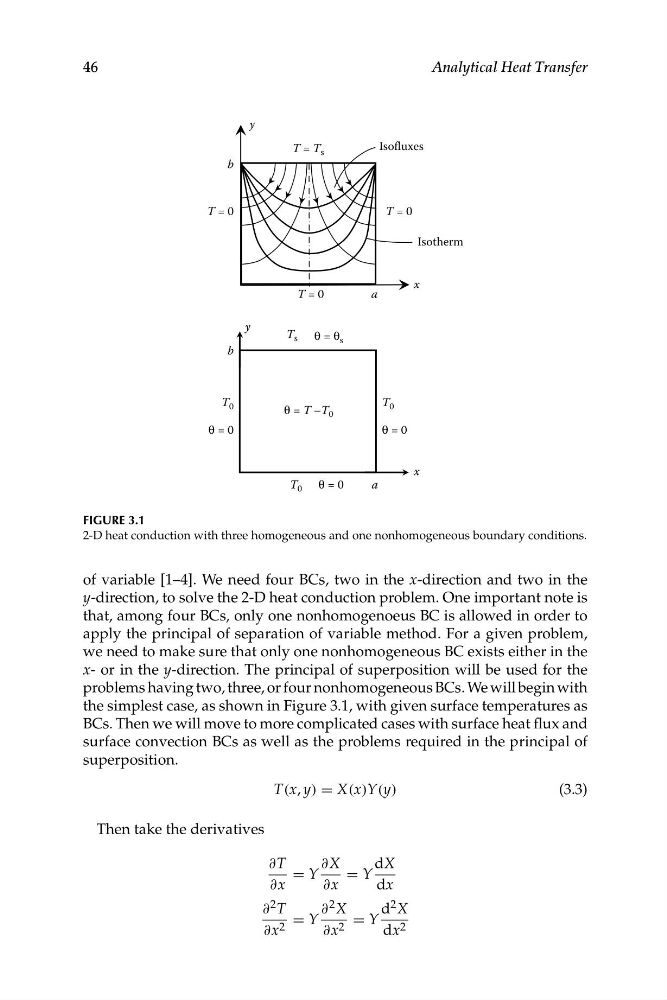
FIGURE 3.1
2-D heat conduction with three homogeneous and one nonhomogeneous boundary conditions.
of variable [1–4]. We need four BCs, two in the x-direction and two in the
y-direction, to solve the 2-D heat conduction problem. One important note is
that, among four BCs, only one nonhomogenoeus BC is allowed in order to
apply the principal of separation of variable method. For a given problem,
we need to make sure that only one nonhomogeneous BC exists either in the
x- or in the y-direction. The principal of superposition will be used for the
problems having two, three, or four nonhomogeneous BCs. We will begin with
the simplest case, as shown in Figure 3.1, with given surface temperatures as
BCs. Then we will move to more complicated cases with surface heat flux and
surface convection BCs as well as the problems required in the principal of
superposition.
T(x, y) = X(x)Y(y)
(3.3)
Then take the derivatives
∂T
∂X
dX
= Y
= Y
∂x
∂x
dx
∂ 2 T
∂ 2 X
d 2 X
= Y
= Y
∂x 2
∂x 2
dx 2
T = T s
Isofluxes
b
T = 0
T = 0
Isotherm
x
T = 0
a
y
T s θ = θ s
b
T 0
T 0
θ = 0
θ = 0
x
T 0 θ = 0
a
θ = T –T 0
46
Analytical Heat Transfer
FIGURE 3.1
2-D heat conduction with three homogeneous and one nonhomogeneous boundary conditions.
of variable [1–4]. We need four BCs, two in the x-direction and two in the
y-direction, to solve the 2-D heat conduction problem. One important note is
that, among four BCs, only one nonhomogenoeus BC is allowed in order to
apply the principal of separation of variable method. For a given problem,
we need to make sure that only one nonhomogeneous BC exists either in the
x- or in the y-direction. The principal of superposition will be used for the
problems having two, three, or four nonhomogeneous BCs. We will begin with
the simplest case, as shown in Figure 3.1, with given surface temperatures as
BCs. Then we will move to more complicated cases with surface heat flux and
surface convection BCs as well as the problems required in the principal of
superposition.
T(x, y) = X(x)Y(y)
(3.3)
Then take the derivatives
∂T
∂X
dX
= Y
= Y
∂x
∂x
dx
∂ 2 T
∂ 2 X
d 2 X
= Y
= Y
∂x 2
∂x 2
dx 2