

T 0
T L
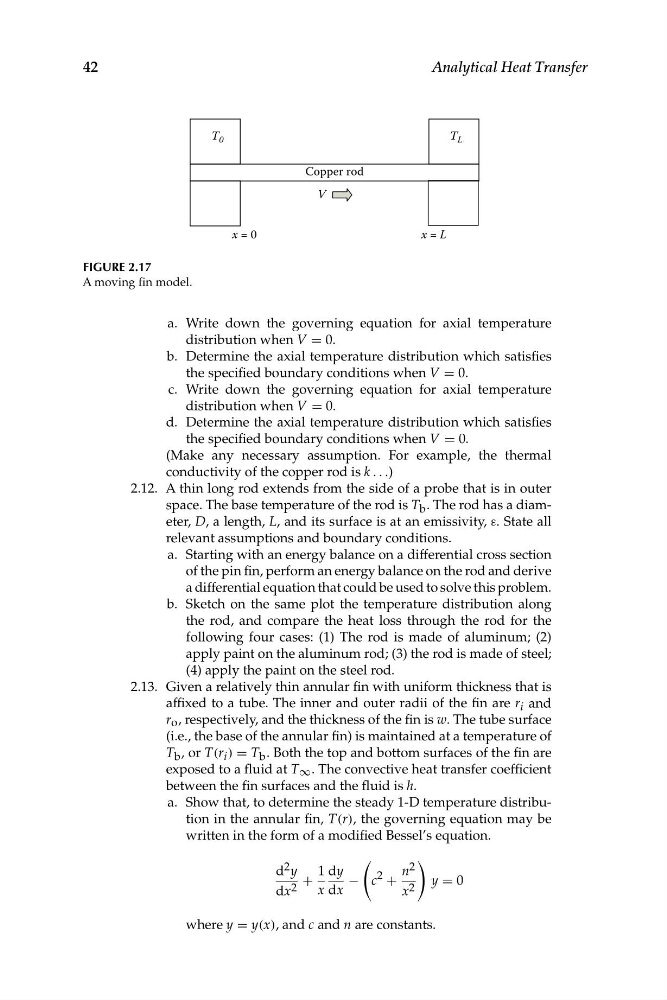
Copper rod
V
x = 0
x = L
42
Analytical Heat Transfer
FIGURE 2.17
A moving fin model.
a. Write down the governing equation for axial temperature
distribution when V = 0.
b. Determine the axial temperature distribution which satisfies
the specified boundary conditions when V = 0.
c. Write down the governing equation for axial temperature
distribution when V = 0.
d. Determine the axial temperature distribution which satisfies
the specified boundary conditions when V = 0.
(Make any necessary assumption. For example, the thermal
conductivity of the copper rod is k . . .)
2.12. A thin long rod extends from the side of a probe that is in outer
space. The base temperature of the rod is T b . The rod has a diameter, D, a length, L, and its surface is at an emissivity, ε. State all
relevant assumptions and boundary conditions.
a. Starting with an energy balance on a differential cross section
of the pin fin, perform an energy balance on the rod and derive
a differential equation that could be used to solve this problem.
b. Sketch on the same plot the temperature distribution along
the rod, and compare the heat loss through the rod for the
following four cases: (1) The rod is made of aluminum; (2)
apply paint on the aluminum rod; (3) the rod is made of steel;
(4) apply the paint on the steel rod.
2.13. Given a relatively thin annular fin with uniform thickness that is
affixed to a tube. The inner and outer radii of the fin are r i and
r o , respectively, and the thickness of the fin is w. The tube surface
(i.e., the base of the annular fin) is maintained at a temperature of
T b , or T(r i ) = T b . Both the top and bottom surfaces of the fin are
exposed to a fluid at T ∞ . The convective heat transfer coefficient
between the fin surfaces and the fluid is h.
a. Show that, to determine the steady 1-D temperature distribution in the annular fin, T(r), the governing equation may be
written in the form of a modified Bessel’s equation.
d 2 y
1 dy
n 2
dx
+
c 2
y 0
2
x dx
−
�
+
x 2
�
=
where y = y(x), and c and n are constants.
T L
Copper rod
V
x = 0
x = L
42
Analytical Heat Transfer
FIGURE 2.17
A moving fin model.
a. Write down the governing equation for axial temperature
distribution when V = 0.
b. Determine the axial temperature distribution which satisfies
the specified boundary conditions when V = 0.
c. Write down the governing equation for axial temperature
distribution when V = 0.
d. Determine the axial temperature distribution which satisfies
the specified boundary conditions when V = 0.
(Make any necessary assumption. For example, the thermal
conductivity of the copper rod is k . . .)
2.12. A thin long rod extends from the side of a probe that is in outer
space. The base temperature of the rod is T b . The rod has a diameter, D, a length, L, and its surface is at an emissivity, ε. State all
relevant assumptions and boundary conditions.
a. Starting with an energy balance on a differential cross section
of the pin fin, perform an energy balance on the rod and derive
a differential equation that could be used to solve this problem.
b. Sketch on the same plot the temperature distribution along
the rod, and compare the heat loss through the rod for the
following four cases: (1) The rod is made of aluminum; (2)
apply paint on the aluminum rod; (3) the rod is made of steel;
(4) apply the paint on the steel rod.
2.13. Given a relatively thin annular fin with uniform thickness that is
affixed to a tube. The inner and outer radii of the fin are r i and
r o , respectively, and the thickness of the fin is w. The tube surface
(i.e., the base of the annular fin) is maintained at a temperature of
T b , or T(r i ) = T b . Both the top and bottom surfaces of the fin are
exposed to a fluid at T ∞ . The convective heat transfer coefficient
between the fin surfaces and the fluid is h.
a. Show that, to determine the steady 1-D temperature distribution in the annular fin, T(r), the governing equation may be
written in the form of a modified Bessel’s equation.
d 2 y
1 dy
n 2
dx
+
c 2
y 0
2
x dx
−
�
+
x 2
�
=
where y = y(x), and c and n are constants.