

Furnace
500 K
A B C
Air
T ∞ = 300 K
V ∞ = 1.5 m/s
1 2 3 4
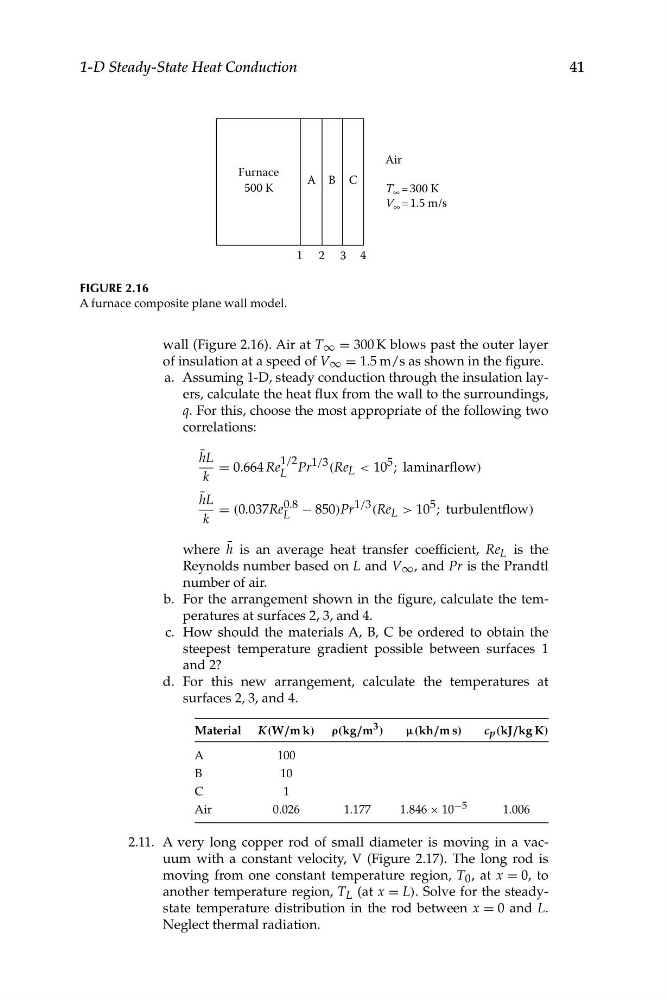
wall (Figure 2.16). Air at T ∞ = 300 K blows past the outer layer
of insulation at a speed of V ∞ = 1.5 m/s as shown in the figure.
a. Assuming 1-D, steady conduction through the insulation layers, calculate the heat flux from the wall to the surroundings,
q. For this, choose the most appropriate of the following two
correlations:
¯
hL = 0.664 Re
1/2 Pr 1/3 (Re L < 10 5 ; laminarflow)
L
k
¯
hL = (0.037Re 0.8 − 850)Pr 1/3 (Re L > 10 5 ; turbulentflow)
L
k
¯
where h is an average heat transfer coefficient, Re L is the
Reynolds number based on L and V ∞ , and Pr is the Prandtl
number of air.
b. For the arrangement shown in the figure, calculate the temperatures at surfaces 2, 3, and 4.
c. How should the materials A, B, C be ordered to obtain the
steepest temperature gradient possible between surfaces 1
and 2?
d. For this new arrangement, calculate the temperatures at
surfaces 2, 3, and 4.
Material K(W/m k) ρ(kg/m 3 )
μ(kh/m s)
c p (kJ/kg K)
A
100
B
1 0
C
1
Air
0.026
1.177
1.846 × 10 −5
1.006
2.11. A very long copper rod of small diameter is moving in a vacuum with a constant velocity, V (Figure 2.17). The long rod is
moving from one constant temperature region, T 0 , at x = 0, to
another temperature region, T L (at x = L). Solve for the steadystate temperature distribution in the rod between x = 0 and L.
Neglect thermal radiation.
41
1-D Steady-State Heat Conduction
FIGURE 2.16
A furnace composite plane wall model.
500 K
A B C
Air
T ∞ = 300 K
V ∞ = 1.5 m/s
1 2 3 4
wall (Figure 2.16). Air at T ∞ = 300 K blows past the outer layer
of insulation at a speed of V ∞ = 1.5 m/s as shown in the figure.
a. Assuming 1-D, steady conduction through the insulation layers, calculate the heat flux from the wall to the surroundings,
q. For this, choose the most appropriate of the following two
correlations:
¯
hL = 0.664 Re
1/2 Pr 1/3 (Re L < 10 5 ; laminarflow)
L
k
¯
hL = (0.037Re 0.8 − 850)Pr 1/3 (Re L > 10 5 ; turbulentflow)
L
k
¯
where h is an average heat transfer coefficient, Re L is the
Reynolds number based on L and V ∞ , and Pr is the Prandtl
number of air.
b. For the arrangement shown in the figure, calculate the temperatures at surfaces 2, 3, and 4.
c. How should the materials A, B, C be ordered to obtain the
steepest temperature gradient possible between surfaces 1
and 2?
d. For this new arrangement, calculate the temperatures at
surfaces 2, 3, and 4.
Material K(W/m k) ρ(kg/m 3 )
μ(kh/m s)
c p (kJ/kg K)
A
100
B
1 0
C
1
Air
0.026
1.177
1.846 × 10 −5
1.006
2.11. A very long copper rod of small diameter is moving in a vacuum with a constant velocity, V (Figure 2.17). The long rod is
moving from one constant temperature region, T 0 , at x = 0, to
another temperature region, T L (at x = L). Solve for the steadystate temperature distribution in the rod between x = 0 and L.
Neglect thermal radiation.
41
1-D Steady-State Heat Conduction
FIGURE 2.16
A furnace composite plane wall model.