

Blade tip
q rad
Combustion
gases
T b
L
T ∞, h
�
(
)�
�
�
34
Analytical Heat Transfer
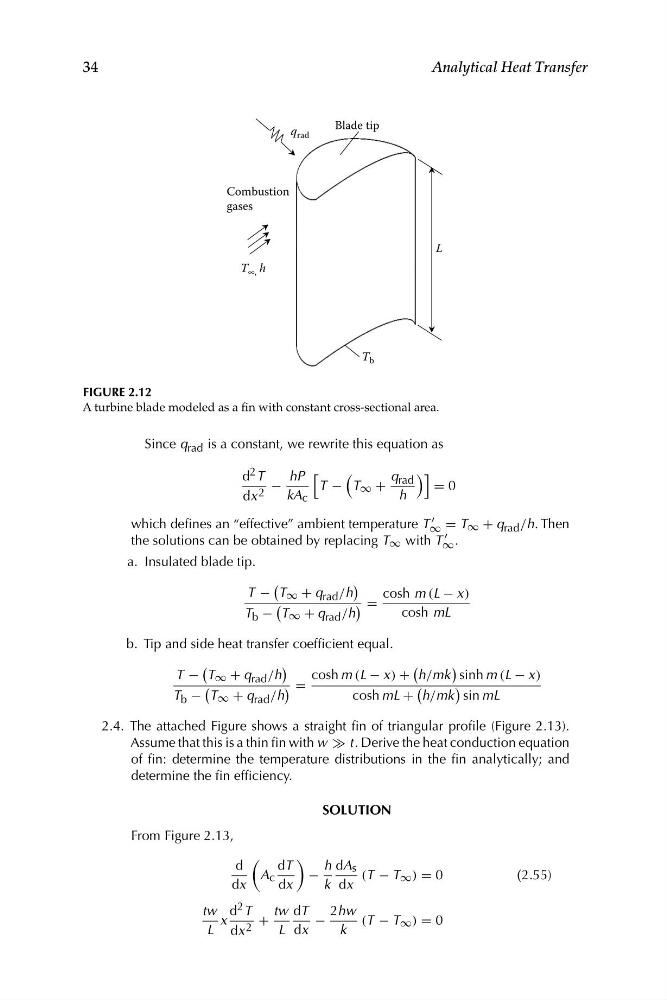
FIGURE 2.12
A turbine blade modeled as a fin with constant cross-sectional area.
Since q rad is a constant, we rewrite this equation as
d 2 T
hP
q rad
−
T − T ∞ +
= 0
dx 2
kA c
h
"
which defines an “effective” ambient temperature T = T ∞ + q rad /h. Then
∞ "
the solutions can be obtained by replacing T ∞ with T ∞ .
a. Insulated blade tip.
(
)
T − T ∞ + q rad /h
cosh m (L − x)
(
) =
T b −
cosh mL
T ∞ + q rad /h
b. Tip and side heat transfer coefficient equal.
(
)
(
)
T −
cosh m (L − x) + h/mk sinh m (L − x)
T ∞ + q rad /h
(
) =
(
)
cosh mL + h/mk sin mL
T b − T ∞ + q rad /h
2.4. The attached Figure shows a straight fin of triangular profile (Figure 2.13).
Assume that this is a thin fin with w » t . Derive the heat conduction equation
of fin: determine the temperature distributions in the fin analytically; and
determine the fin efficiency.
SOLUTION
From Figure 2.13,
d
dT
h dA s
A c
−
(T − T ∞ ) = 0
(2.55)
dx
dx
k dx
tw d 2 T
tw dT
2hw
x
+
−
(T − T ∞ ) = 0
L dx 2
L dx
k
q rad
Combustion
gases
T b
L
T ∞, h
�
(
)�
�
�
34
Analytical Heat Transfer
FIGURE 2.12
A turbine blade modeled as a fin with constant cross-sectional area.
Since q rad is a constant, we rewrite this equation as
d 2 T
hP
q rad
−
T − T ∞ +
= 0
dx 2
kA c
h
"
which defines an “effective” ambient temperature T = T ∞ + q rad /h. Then
∞ "
the solutions can be obtained by replacing T ∞ with T ∞ .
a. Insulated blade tip.
(
)
T − T ∞ + q rad /h
cosh m (L − x)
(
) =
T b −
cosh mL
T ∞ + q rad /h
b. Tip and side heat transfer coefficient equal.
(
)
(
)
T −
cosh m (L − x) + h/mk sinh m (L − x)
T ∞ + q rad /h
(
) =
(
)
cosh mL + h/mk sin mL
T b − T ∞ + q rad /h
2.4. The attached Figure shows a straight fin of triangular profile (Figure 2.13).
Assume that this is a thin fin with w » t . Derive the heat conduction equation
of fin: determine the temperature distributions in the fin analytically; and
determine the fin efficiency.
SOLUTION
From Figure 2.13,
d
dT
h dA s
A c
−
(T − T ∞ ) = 0
(2.55)
dx
dx
k dx
tw d 2 T
tw dT
2hw
x
+
−
(T − T ∞ ) = 0
L dx 2
L dx
k