

�
�
�
(
)�
�
�
�
�
dT
Boundary conditions: x = 0,
= 0 (symmetry); x = L,
dx
dT
− k
= h (T − T ∞ )
dx
Substituting the boundary conditions into the above equation to replace
C 1 and C 2 ,
( ) 4 ( ) 2
q ˙ o L 2 5 1 x
x
4
T − T ∞ =
+
−
+
2k
6 6 L
L
3Bi
b. q ˙ = a + b(T − T ∞ )
d 2 T
b
a
+
T − T ∞ −
= 0
dx 2
k
b
Solving the above equation,
(
a )
(
) 1/2
(
) 1/2
T − T ∞ −
= C 1 cos b/k
x + C 2 sin b/k
x
b
Applying boundary conditions,
(
)
(
) 1/2 (
)
a
h cos b/k
a/b x
T − T ∞ −
=
(
(
(
b
h cos b/k
) 1/2 L + b/k
) 1/2 sin b/k
) 1/2 L
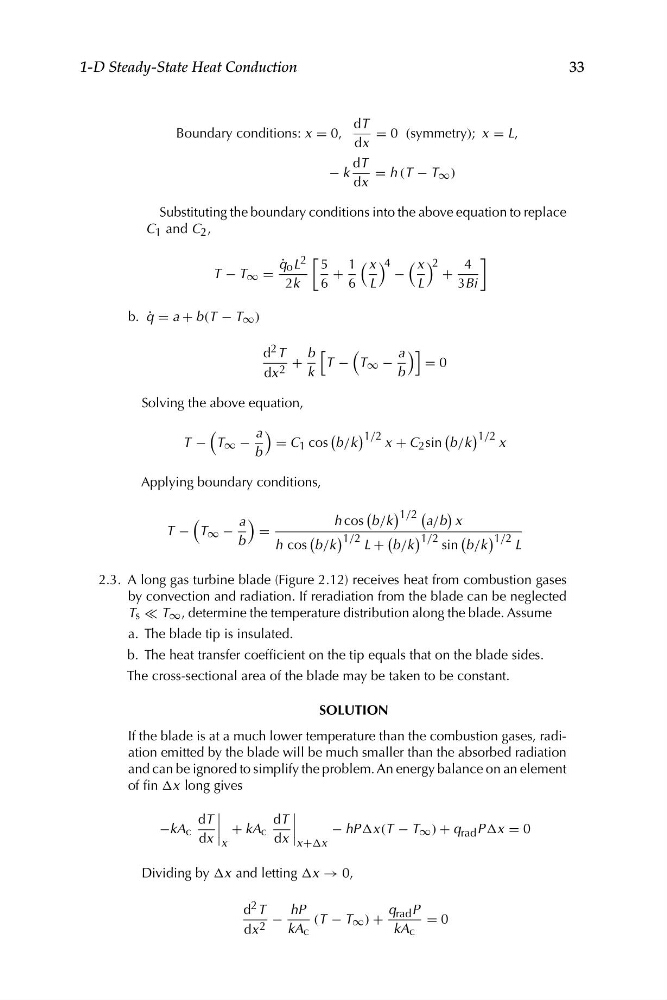
2.3. A long gas turbine blade (Figure 2.12) receives heat from combustion gases
by convection and radiation. If reradiation from the blade can be neglected
T s « T ∞ , determine the temperature distribution along the blade. Assume
a. The blade tip is insulated.
b. The heat transfer coefficient on the tip equals that on the blade sides.
The cross-sectional area of the blade may be taken to be constant.
SOLUTION
If the blade is at a much lower temperature than the combustion gases, radiation emitted by the blade will be much smaller than the absorbed radiation
and can be ignored to simplify the problem. An energy balance on an element
of fin Δx long gives
dT �
dT �
−kA c
+ kA c
= 0
�
�
− hP Δx(T − T ∞ ) + q rad P Δx
dx
dx
x
x+Δx
Dividing by Δx and letting Δx → 0,
d 2 T
hP
q rad P
−
(T − T ∞ ) +
= 0
dx 2
kA c
kA c
33
1-D Steady-State Heat Conduction
�
�
(
)�
�
�
�
�
dT
Boundary conditions: x = 0,
= 0 (symmetry); x = L,
dx
dT
− k
= h (T − T ∞ )
dx
Substituting the boundary conditions into the above equation to replace
C 1 and C 2 ,
( ) 4 ( ) 2
q ˙ o L 2 5 1 x
x
4
T − T ∞ =
+
−
+
2k
6 6 L
L
3Bi
b. q ˙ = a + b(T − T ∞ )
d 2 T
b
a
+
T − T ∞ −
= 0
dx 2
k
b
Solving the above equation,
(
a )
(
) 1/2
(
) 1/2
T − T ∞ −
= C 1 cos b/k
x + C 2 sin b/k
x
b
Applying boundary conditions,
(
)
(
) 1/2 (
)
a
h cos b/k
a/b x
T − T ∞ −
=
(
(
(
b
h cos b/k
) 1/2 L + b/k
) 1/2 sin b/k
) 1/2 L
2.3. A long gas turbine blade (Figure 2.12) receives heat from combustion gases
by convection and radiation. If reradiation from the blade can be neglected
T s « T ∞ , determine the temperature distribution along the blade. Assume
a. The blade tip is insulated.
b. The heat transfer coefficient on the tip equals that on the blade sides.
The cross-sectional area of the blade may be taken to be constant.
SOLUTION
If the blade is at a much lower temperature than the combustion gases, radiation emitted by the blade will be much smaller than the absorbed radiation
and can be ignored to simplify the problem. An energy balance on an element
of fin Δx long gives
dT �
dT �
−kA c
+ kA c
= 0
�
�
− hP Δx(T − T ∞ ) + q rad P Δx
dx
dx
x
x+Δx
Dividing by Δx and letting Δx → 0,
d 2 T
hP
q rad P
−
(T − T ∞ ) +
= 0
dx 2
kA c
kA c
33
1-D Steady-State Heat Conduction