

�
�
�
�
�
�
�
�
�
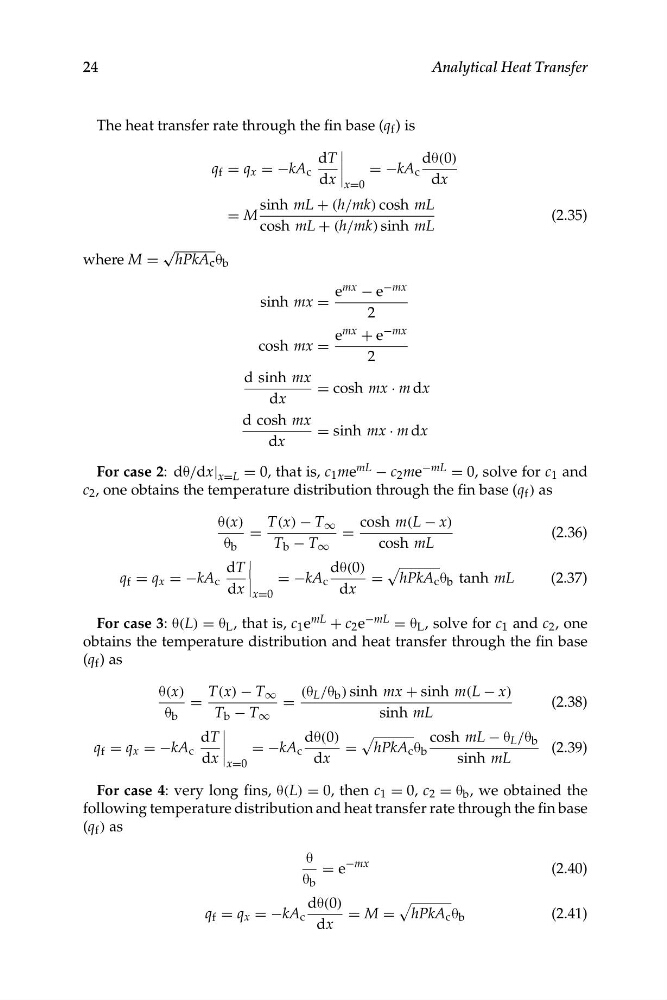
The heat transfer rate through the fin base (q f ) is
dT �
dθ(0)
q f = q x = −kA c
= −kA c
dx
dx
x=0
sinh mL + (h/mk) cosh mL
= M
(2.35)
cosh mL + (h/mk) sinh mL
√
where M = hPkA c θ b
e mx − e −mx
sinh mx =
2
e mx + e −mx
cosh mx =
2
d sinh mx = cosh mx · m dx
dx
d cosh mx = sinh mx · m dx
dx
For case 2: dθ/dx|
= 0, that is, c 1 me mL − c 2 me −mL = 0, solve for c 1 and
x=L
c 2 , one obtains the temperature distribution through the fin base (q f ) as
θ(x)
T(x) − T ∞
cosh m(L − x)
=
=
(2.36)
θ b
T b − T ∞
cosh mL
)
dT �
dθ(0)
q f = q x = −kA c
= −kA c
= hPkA c θ b tanh mL
(2.37)
dx
dx
x=0
mL + c 2 e −mL
For case 3: θ(L) = θ L , that is, c 1 e
= θ L , solve for c 1 and c 2 , one
obtains the temperature distribution and heat transfer through the fin base
(q f ) as
θ(x)
T(x) − T ∞
(θ L /θ b ) sinh mx + sinh m(L − x)
=
=
(2.38)
θ b
T b − T ∞
sinh mL
)
dT �
dθ(0)
cosh mL − θ L /θ b
q f = q x = −kA c
= −kA c
= hPkA c θ b
(2.39)
dx
dx
sinh mL
x=0
For case 4: very long fins, θ(L) = 0, then c 1 = 0, c 2 = θ b , we obtained the
following temperature distribution and heat transfer rate through the fin base
(q f ) as
θ = e
−mx
(2.40)
θ b
dθ(0)
)
q f = q x = −kA c
= M = hPkA c θ b
(2.41)
dx
24
Analytical Heat Transfer
�
�
�
�
�
�
�
�
The heat transfer rate through the fin base (q f ) is
dT �
dθ(0)
q f = q x = −kA c
= −kA c
dx
dx
x=0
sinh mL + (h/mk) cosh mL
= M
(2.35)
cosh mL + (h/mk) sinh mL
√
where M = hPkA c θ b
e mx − e −mx
sinh mx =
2
e mx + e −mx
cosh mx =
2
d sinh mx = cosh mx · m dx
dx
d cosh mx = sinh mx · m dx
dx
For case 2: dθ/dx|
= 0, that is, c 1 me mL − c 2 me −mL = 0, solve for c 1 and
x=L
c 2 , one obtains the temperature distribution through the fin base (q f ) as
θ(x)
T(x) − T ∞
cosh m(L − x)
=
=
(2.36)
θ b
T b − T ∞
cosh mL
)
dT �
dθ(0)
q f = q x = −kA c
= −kA c
= hPkA c θ b tanh mL
(2.37)
dx
dx
x=0
mL + c 2 e −mL
For case 3: θ(L) = θ L , that is, c 1 e
= θ L , solve for c 1 and c 2 , one
obtains the temperature distribution and heat transfer through the fin base
(q f ) as
θ(x)
T(x) − T ∞
(θ L /θ b ) sinh mx + sinh m(L − x)
=
=
(2.38)
θ b
T b − T ∞
sinh mL
)
dT �
dθ(0)
cosh mL − θ L /θ b
q f = q x = −kA c
= −kA c
= hPkA c θ b
(2.39)
dx
dx
sinh mL
x=0
For case 4: very long fins, θ(L) = 0, then c 1 = 0, c 2 = θ b , we obtained the
following temperature distribution and heat transfer rate through the fin base
(q f ) as
θ = e
−mx
(2.40)
θ b
dθ(0)
)
q f = q x = −kA c
= M = hPkA c θ b
(2.41)
dx
24
Analytical Heat Transfer