

�
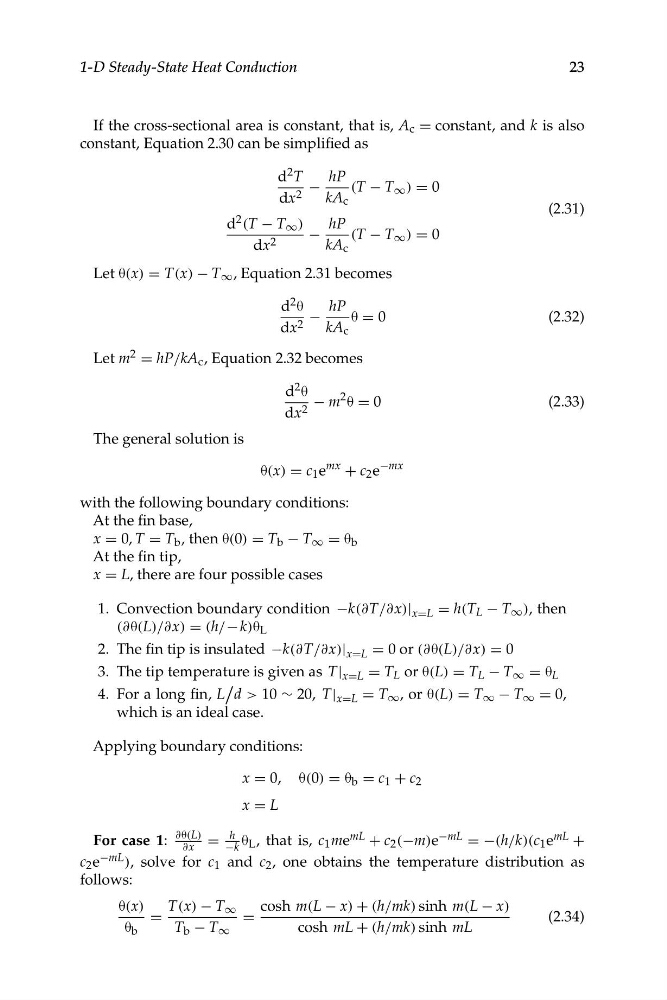
If the cross-sectional area is constant, that is, A c = constant, and k is also
constant, Equation 2.30 can be simplified as
d 2 T
dx 2
d 2 (T − T ∞ )
dx 2
−
−
hP
kA c
(T − T ∞ ) = 0
hP
kA c
(T − T ∞ ) = 0
(2.31)
Let θ(x) = T(x) − T ∞ , Equation 2.31 becomes
d 2 θ
dx 2 −
hP
kA c
θ = 0
(2.32)
Let m 2 = hP/kA c , Equation 2.32 becomes
d 2 θ
dx 2 − m
2
θ = 0
(2.33)
The general solution is
θ(x) = c 1 e
mx
+ c 2 e
−mx
with the following boundary conditions:
At the fin base,
x = 0, T = T b , then θ(0) = T b − T ∞ = θ b
At the fin tip,
x = L, there are four possible cases
1. Convection boundary condition −k(∂T/∂x)|
= h(T L − T ∞ ), then
x=L
(∂θ(L)/∂x) = (h/− k)θ L
2. The fin tip is insulated −k(∂T/∂x)|
= 0 or (∂θ(L)/∂x) = 0
x=L
3. The tip temperature is given as T|
= T L or θ(L) = T L − T ∞ = θ L
x=L
4. For a long fin, L d > 10 ∼ 20, T|
= T ∞ , or θ(L) = T ∞ − T ∞ = 0,
x=L
which is an ideal case.
Applying boundary conditions:
x = 0, θ(0) = θ b = c 1 + c 2
x = L
∂θ(L)
h
mL + c 2 (−
−mL = −(h/k)(c 1 e mL +
For case 1:
= −k θ L , that is, c 1 me
m)e
∂x
c 2 e −mL ), solve for c 1 and c 2 , one obtains the temperature distribution as
follows:
θ(x)
T(x) − T ∞
cosh m(L − x) + (h/mk) sinh m(L − x)
=
=
(2.34)
θ b
T b − T ∞
cosh mL + (h/mk) sinh mL
23
1-D Steady-State Heat Conduction
If the cross-sectional area is constant, that is, A c = constant, and k is also
constant, Equation 2.30 can be simplified as
d 2 T
dx 2
d 2 (T − T ∞ )
dx 2
−
−
hP
kA c
(T − T ∞ ) = 0
hP
kA c
(T − T ∞ ) = 0
(2.31)
Let θ(x) = T(x) − T ∞ , Equation 2.31 becomes
d 2 θ
dx 2 −
hP
kA c
θ = 0
(2.32)
Let m 2 = hP/kA c , Equation 2.32 becomes
d 2 θ
dx 2 − m
2
θ = 0
(2.33)
The general solution is
θ(x) = c 1 e
mx
+ c 2 e
−mx
with the following boundary conditions:
At the fin base,
x = 0, T = T b , then θ(0) = T b − T ∞ = θ b
At the fin tip,
x = L, there are four possible cases
1. Convection boundary condition −k(∂T/∂x)|
= h(T L − T ∞ ), then
x=L
(∂θ(L)/∂x) = (h/− k)θ L
2. The fin tip is insulated −k(∂T/∂x)|
= 0 or (∂θ(L)/∂x) = 0
x=L
3. The tip temperature is given as T|
= T L or θ(L) = T L − T ∞ = θ L
x=L
4. For a long fin, L d > 10 ∼ 20, T|
= T ∞ , or θ(L) = T ∞ − T ∞ = 0,
x=L
which is an ideal case.
Applying boundary conditions:
x = 0, θ(0) = θ b = c 1 + c 2
x = L
∂θ(L)
h
mL + c 2 (−
−mL = −(h/k)(c 1 e mL +
For case 1:
= −k θ L , that is, c 1 me
m)e
∂x
c 2 e −mL ), solve for c 1 and c 2 , one obtains the temperature distribution as
follows:
θ(x)
T(x) − T ∞
cosh m(L − x) + (h/mk) sinh m(L − x)
=
=
(2.34)
θ b
T b − T ∞
cosh mL + (h/mk) sinh mL
23
1-D Steady-State Heat Conduction