

1-D Steady-State Heat Conduction
17
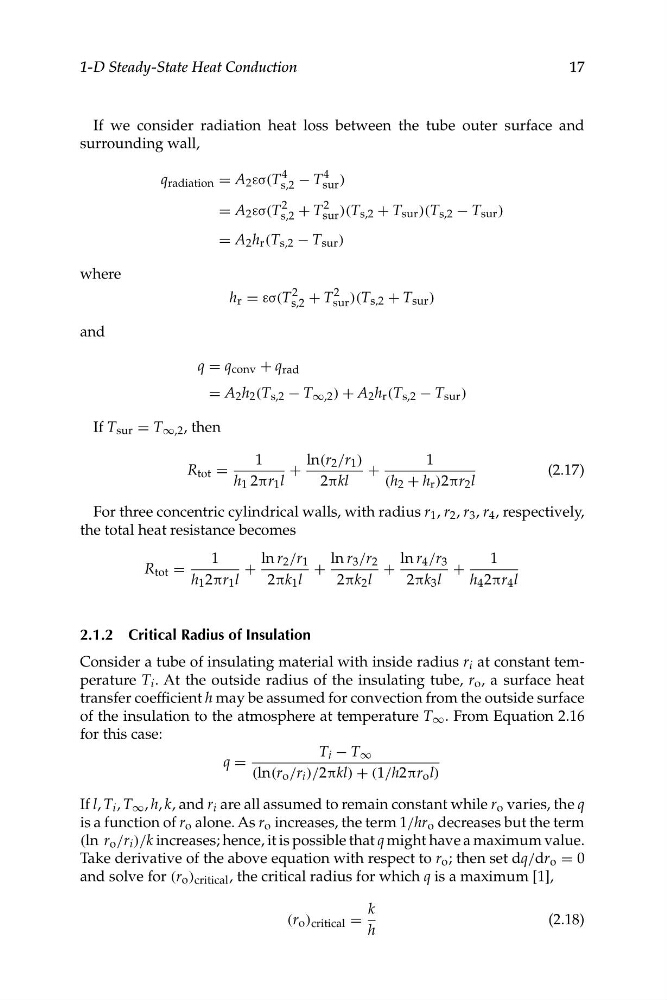
If we consider radiation heat loss between the tube outer surface and
surrounding wall,
s,2 − T
4 )
q radiation = A 2 εσ(T
4
sur
= A 2 εσ(T
2
s,2 + T
2 )(T s,2 + T sur )(T s,2 − T sur )
sur
= A 2 h r (T s,2 − T sur )
where
h r = εσ(T
2
)(T s,2 + T sur )
sur
s,2 + T
2
and
q = q conv + q rad
= A 2 h 2 (T s,2 − T ∞,2 ) + A 2 h r (T s,2 − T sur )
If T sur = T ∞,2 , then
1
ln(r 2 /r 1 )
1
R tot =
+
+
(2.17)
h 1 2πr 1 l
2πkl
(h 2 + h r )2πr 2 l
For three concentric cylindrical walls, with radius r 1 , r 2 , r 3 , r 4 , respectively,
the total heat resistance becomes
1
ln r 2 /r 1
ln r 3 /r 2
ln r 4 /r 3
1
R tot =
+
+
+
+
h 1 2πr 1 l
2πk 1 l
2πk 2 l
2πk 3 l
h 4 2πr 4 l
2.1.2 Critical Radius of Insulation
Consider a tube of insulating material with inside radius r i at constant temperature T i . At the outside radius of the insulating tube, r o , a surface heat
transfer coefficient h may be assumed for convection from the outside surface
of the insulation to the atmosphere at temperature T ∞ . From Equation 2.16
for this case:
T i − T ∞
q =
(ln(r o /r i )/2πkl) + (1/h2πr o l)
If l, T i , T ∞ , h, k, and r i are all assumed to remain constant while r o varies, the q
is a function of r o alone. As r o increases, the term 1/hr o decreases but the term
(ln r o /r i )/k increases; hence, it is possible that q might have a maximum value.
Take derivative of the above equation with respect to r o ; then set dq/dr o = 0
and solve for (r o ) critical , the critical radius for which q is a maximum [1],
k
(r o ) critical =
(2.18)
h
17
If we consider radiation heat loss between the tube outer surface and
surrounding wall,
s,2 − T
4 )
q radiation = A 2 εσ(T
4
sur
= A 2 εσ(T
2
s,2 + T
2 )(T s,2 + T sur )(T s,2 − T sur )
sur
= A 2 h r (T s,2 − T sur )
where
h r = εσ(T
2
)(T s,2 + T sur )
sur
s,2 + T
2
and
q = q conv + q rad
= A 2 h 2 (T s,2 − T ∞,2 ) + A 2 h r (T s,2 − T sur )
If T sur = T ∞,2 , then
1
ln(r 2 /r 1 )
1
R tot =
+
+
(2.17)
h 1 2πr 1 l
2πkl
(h 2 + h r )2πr 2 l
For three concentric cylindrical walls, with radius r 1 , r 2 , r 3 , r 4 , respectively,
the total heat resistance becomes
1
ln r 2 /r 1
ln r 3 /r 2
ln r 4 /r 3
1
R tot =
+
+
+
+
h 1 2πr 1 l
2πk 1 l
2πk 2 l
2πk 3 l
h 4 2πr 4 l
2.1.2 Critical Radius of Insulation
Consider a tube of insulating material with inside radius r i at constant temperature T i . At the outside radius of the insulating tube, r o , a surface heat
transfer coefficient h may be assumed for convection from the outside surface
of the insulation to the atmosphere at temperature T ∞ . From Equation 2.16
for this case:
T i − T ∞
q =
(ln(r o /r i )/2πkl) + (1/h2πr o l)
If l, T i , T ∞ , h, k, and r i are all assumed to remain constant while r o varies, the q
is a function of r o alone. As r o increases, the term 1/hr o decreases but the term
(ln r o /r i )/k increases; hence, it is possible that q might have a maximum value.
Take derivative of the above equation with respect to r o ; then set dq/dr o = 0
and solve for (r o ) critical , the critical radius for which q is a maximum [1],
k
(r o ) critical =
(2.18)
h