

j
T g
G i
i
E bg
J i
N
e g
T i A i q i
a g
282
Analytical Heat Transfer
14.2 Radiation Exchange between an Isothermal Gray Gas
and Gray Diffuse Isothermal Surfaces in an Enclosure
Since we know how to obtain gas radiation properties such as emissivity and
absorptivity and how to determine the view factor between two surfaces, the
following shows how to determine radiation heat transfer between surfaces
in an enclosure with radiation gases. Assume that there are N gray diffuse and
isothermal surfaces [2,4,5]. This implies that each surface at T i has uniform
radiosity J i (emission plus reflection). Also assume that radiation gases are
gray gases at uniform pressure and temperature (emissivity = absorptivity)
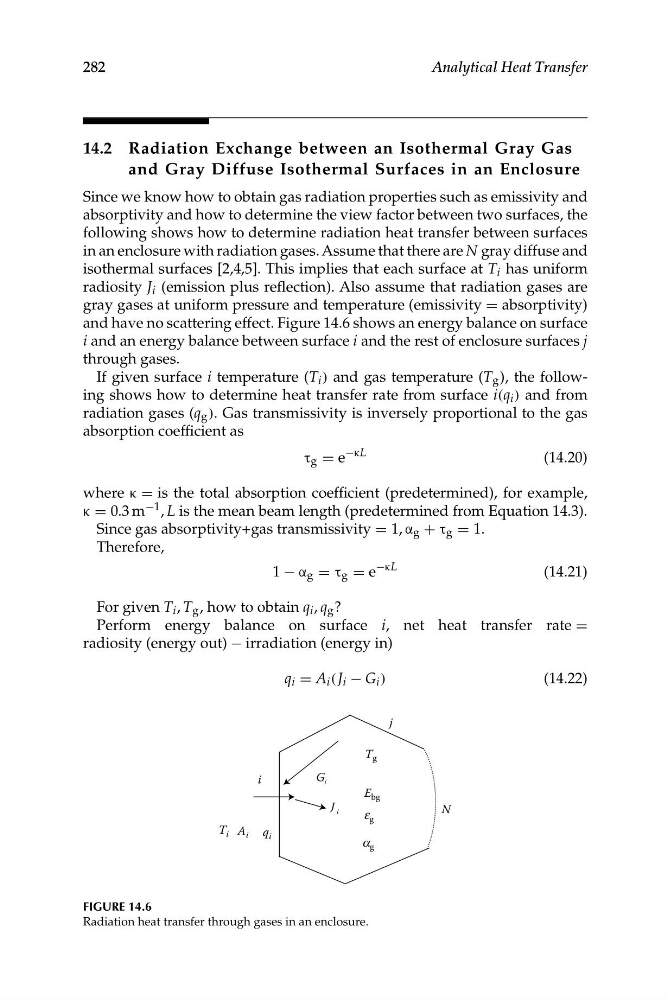
and have no scattering effect. Figure 14.6 shows an energy balance on surface
i and an energy balance between surface i and the rest of enclosure surfaces j
through gases.
If given surface i temperature (T i ) and gas temperature (T g ), the following shows how to determine heat transfer rate from surface i(q i ) and from
radiation gases (q g ). Gas transmissivity is inversely proportional to the gas
absorption coefficient as
−κL
τ g = e
(14.20)
where κ = is the total absorption coefficient (predetermined), for example,
κ = 0.3 m −1 , L is the mean beam length (predetermined from Equation 14.3).
Since gas absorptivity+gas transmissivity = 1, α g + τ g = 1.
Therefore,
−κL
1 − α g = τ g = e
(14.21)
For given T i , T g , how to obtain q i , q g ?
Perform energy balance on surface i, net heat transfer rate =
radiosity (energy out) − irradiation (energy in)
q i = A i ( J i − G i )
(14.22)
FIGURE 14.6
Radiation heat transfer through gases in an enclosure.
T g
G i
i
E bg
J i
N
e g
T i A i q i
a g
282
Analytical Heat Transfer
14.2 Radiation Exchange between an Isothermal Gray Gas
and Gray Diffuse Isothermal Surfaces in an Enclosure
Since we know how to obtain gas radiation properties such as emissivity and
absorptivity and how to determine the view factor between two surfaces, the
following shows how to determine radiation heat transfer between surfaces
in an enclosure with radiation gases. Assume that there are N gray diffuse and
isothermal surfaces [2,4,5]. This implies that each surface at T i has uniform
radiosity J i (emission plus reflection). Also assume that radiation gases are
gray gases at uniform pressure and temperature (emissivity = absorptivity)
and have no scattering effect. Figure 14.6 shows an energy balance on surface
i and an energy balance between surface i and the rest of enclosure surfaces j
through gases.
If given surface i temperature (T i ) and gas temperature (T g ), the following shows how to determine heat transfer rate from surface i(q i ) and from
radiation gases (q g ). Gas transmissivity is inversely proportional to the gas
absorption coefficient as
−κL
τ g = e
(14.20)
where κ = is the total absorption coefficient (predetermined), for example,
κ = 0.3 m −1 , L is the mean beam length (predetermined from Equation 14.3).
Since gas absorptivity+gas transmissivity = 1, α g + τ g = 1.
Therefore,
−κL
1 − α g = τ g = e
(14.21)
For given T i , T g , how to obtain q i , q g ?
Perform energy balance on surface i, net heat transfer rate =
radiosity (energy out) − irradiation (energy in)
q i = A i ( J i − G i )
(14.22)
FIGURE 14.6
Radiation heat transfer through gases in an enclosure.