

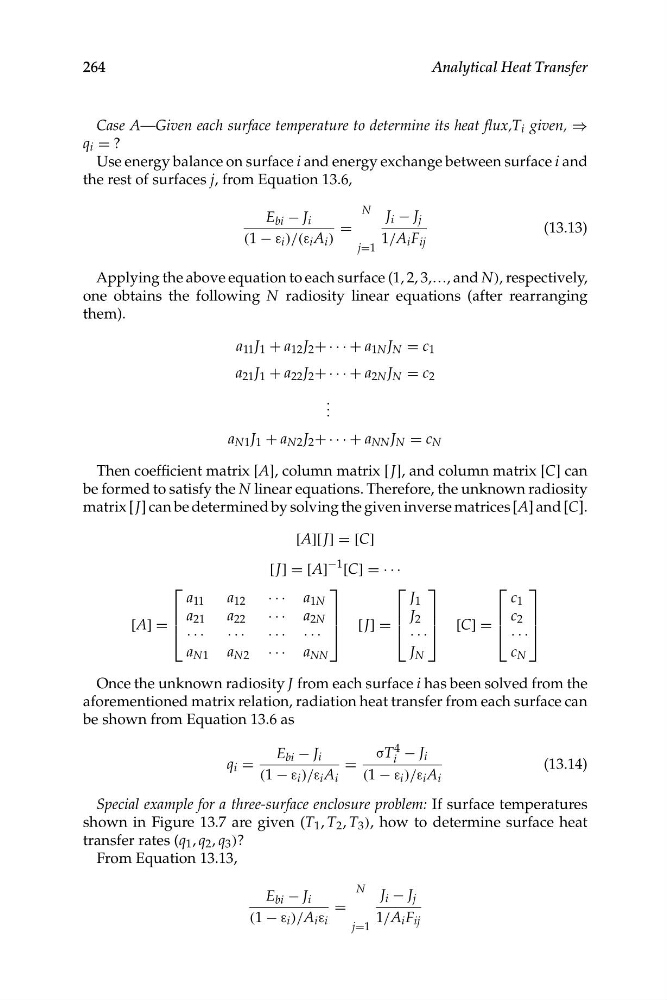
Case A—Given each surface temperature to determine its heat flux,T i given, ⇒
q i = ?
Use energy balance on surface i and energy exchange between surface i and
the rest of surfaces j, from Equation 13.6,
N
E bi − J i
J i − J j
=
(13.13)
(1 − ε i )/(ε i A i )
1/A i F ij
j=1
Applying the above equation to each surface (1, 2, 3,…, and N), respectively,
one obtains the following N radiosity linear equations (after rearranging
them).
a 11 J 1 + a 12 J 2 + · · · + a 1N J N = c 1
a 21 J 1 + a 22 J 2 + · · · + a 2N J N = c 2
. . .
a N1 J 1 + a N2 J 2 + · · · + a NN J N = c N
Then coefficient matrix [A], column matrix [ J], and column matrix [C] can
be formed to satisfy the N linear equations. Therefore, the unknown radiosity
matrix [ J] can be determined by solving the given inverse matrices [A] and [C].
[A][J] = [C]
[ J] = [A]
−1
[C] = · · ·
a 11
⎡
a 12
· · · a 1N
⎤
⎡
J 1
⎤
⎡
c 1
⎤
[A] =
⎢
⎢
⎣
a 21
· · ·
a 22
· · ·
· · ·
· · ·
a 2N
· · ·
⎥
⎥
⎦ [J] =
⎢
⎢
⎣
J 2
· · ·
⎥
⎥
⎦ [C] =
⎢
⎢
⎣
c 2
· · ·
⎥
⎥
⎦
a N1 a N2 · · · a NN
J N
c N
Once the unknown radiosity J from each surface i has been solved from the
aforementioned matrix relation, radiation heat transfer from each surface can
be shown from Equation 13.6 as
σT 4 − J i
E bi − J i
i
q i =
=
(13.14)
(1 − ε i )/ε i A i
(1 − ε i )/ε i A i
Special example for a three-surface enclosure problem: If surface temperatures
shown in Figure 13.7 are given (T 1 , T 2 , T 3 ), how to determine surface heat
transfer rates (q 1 , q 2 , q 3 )?
From Equation 13.13,
N
E bi − J i
J i − J j
=
(1 − ε i )/A i ε i
1/A i F ij
j=1
264
Analytical Heat Transfer
q i = ?
Use energy balance on surface i and energy exchange between surface i and
the rest of surfaces j, from Equation 13.6,
N
E bi − J i
J i − J j
=
(13.13)
(1 − ε i )/(ε i A i )
1/A i F ij
j=1
Applying the above equation to each surface (1, 2, 3,…, and N), respectively,
one obtains the following N radiosity linear equations (after rearranging
them).
a 11 J 1 + a 12 J 2 + · · · + a 1N J N = c 1
a 21 J 1 + a 22 J 2 + · · · + a 2N J N = c 2
. . .
a N1 J 1 + a N2 J 2 + · · · + a NN J N = c N
Then coefficient matrix [A], column matrix [ J], and column matrix [C] can
be formed to satisfy the N linear equations. Therefore, the unknown radiosity
matrix [ J] can be determined by solving the given inverse matrices [A] and [C].
[A][J] = [C]
[ J] = [A]
−1
[C] = · · ·
a 11
⎡
a 12
· · · a 1N
⎤
⎡
J 1
⎤
⎡
c 1
⎤
[A] =
⎢
⎢
⎣
a 21
· · ·
a 22
· · ·
· · ·
· · ·
a 2N
· · ·
⎥
⎥
⎦ [J] =
⎢
⎢
⎣
J 2
· · ·
⎥
⎥
⎦ [C] =
⎢
⎢
⎣
c 2
· · ·
⎥
⎥
⎦
a N1 a N2 · · · a NN
J N
c N
Once the unknown radiosity J from each surface i has been solved from the
aforementioned matrix relation, radiation heat transfer from each surface can
be shown from Equation 13.6 as
σT 4 − J i
E bi − J i
i
q i =
=
(13.14)
(1 − ε i )/ε i A i
(1 − ε i )/ε i A i
Special example for a three-surface enclosure problem: If surface temperatures
shown in Figure 13.7 are given (T 1 , T 2 , T 3 ), how to determine surface heat
transfer rates (q 1 , q 2 , q 3 )?
From Equation 13.13,
N
E bi − J i
J i − J j
=
(1 − ε i )/A i ε i
1/A i F ij
j=1
264
Analytical Heat Transfer