

�
�
�
from
J 1 − J R
J R − J 2
A 1 F 1R J 1 + A R F R2 J 2
=
⇒ J R =
1/A 1 F 1R
1/A R F R2
A 1 F 1R + A R F R2
Therefore,
� 1/4
J R
J R = E b,R = σT R
4
⇒ T R =
(13.12)
σ
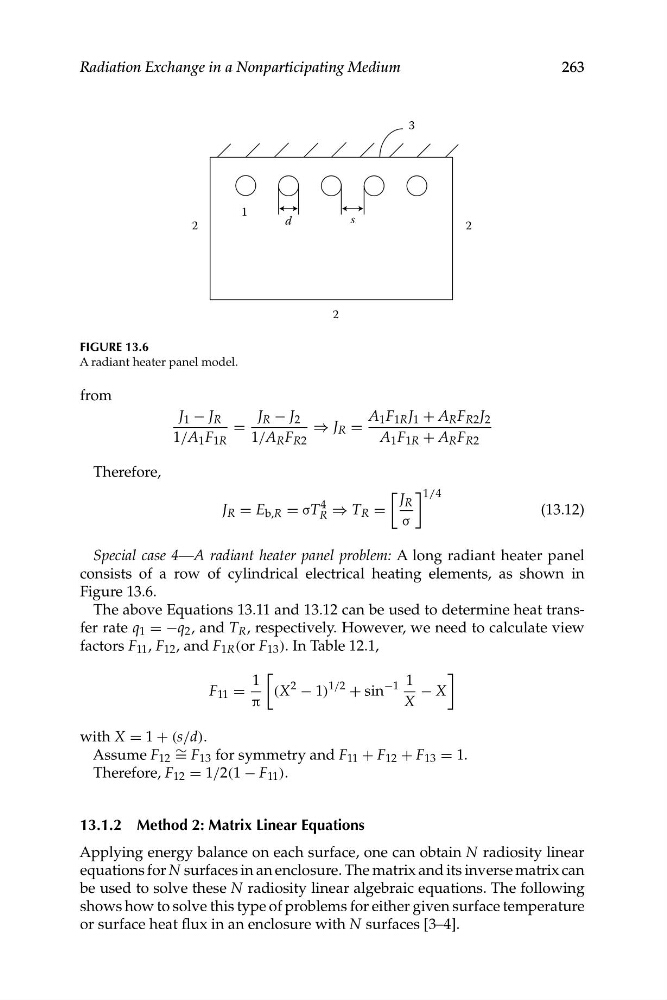
Special case 4—A radiant heater panel problem: A long radiant heater panel
consists of a row of cylindrical electrical heating elements, as shown in
Figure 13.6.
The above Equations 13.11 and 13.12 can be used to determine heat transfer rate q 1 = −q 2 , and T R , respectively. However, we need to calculate view
factors F 11 , F 12 , and F 1R (or F 13 ). In Table 12.1,
1
F 11 =
(X
2
− 1)
1/2
+ sin
−1 1 − X
π
X
with X = 1 + (s/d).
∼
Assume F 12 = F 13 for symmetry and F 11 + F 12 + F 13 = 1.
Therefore, F 12 = 1/2(1 − F 11 ).
263
Radiation Exchange in a Nonparticipating Medium
3
2
d
s
1
2
2
FIGURE 13.6
A radiant heater panel model.
13.1.2 Method 2: Matrix Linear Equations
Applying energy balance on each surface, one can obtain N radiosity linear
equations for N surfaces in an enclosure. The matrix and its inverse matrix can
be used to solve these N radiosity linear algebraic equations. The following
shows how to solve this type of problems for either given surface temperature
or surface heat flux in an enclosure with N surfaces [3–4].
�
�
from
J 1 − J R
J R − J 2
A 1 F 1R J 1 + A R F R2 J 2
=
⇒ J R =
1/A 1 F 1R
1/A R F R2
A 1 F 1R + A R F R2
Therefore,
� 1/4
J R
J R = E b,R = σT R
4
⇒ T R =
(13.12)
σ
Special case 4—A radiant heater panel problem: A long radiant heater panel
consists of a row of cylindrical electrical heating elements, as shown in
Figure 13.6.
The above Equations 13.11 and 13.12 can be used to determine heat transfer rate q 1 = −q 2 , and T R , respectively. However, we need to calculate view
factors F 11 , F 12 , and F 1R (or F 13 ). In Table 12.1,
1
F 11 =
(X
2
− 1)
1/2
+ sin
−1 1 − X
π
X
with X = 1 + (s/d).
∼
Assume F 12 = F 13 for symmetry and F 11 + F 12 + F 13 = 1.
Therefore, F 12 = 1/2(1 − F 11 ).
263
Radiation Exchange in a Nonparticipating Medium
3
2
d
s
1
2
2
FIGURE 13.6
A radiant heater panel model.
13.1.2 Method 2: Matrix Linear Equations
Applying energy balance on each surface, one can obtain N radiosity linear
equations for N surfaces in an enclosure. The matrix and its inverse matrix can
be used to solve these N radiosity linear algebraic equations. The following
shows how to solve this type of problems for either given surface temperature
or surface heat flux in an enclosure with N surfaces [3–4].