

225
Fundamental Radiation
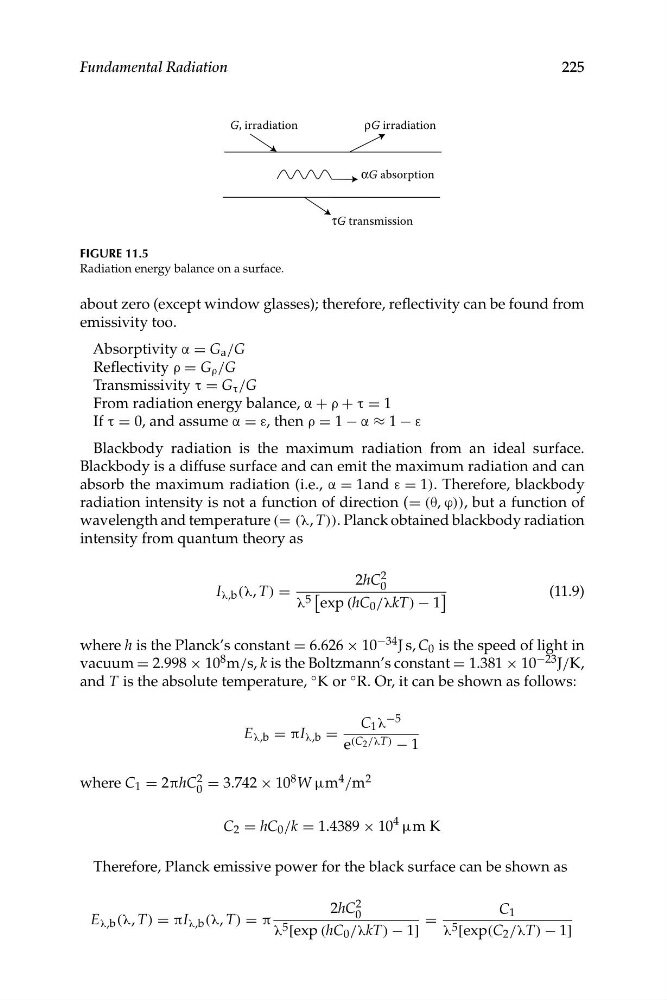
G, irradiation
ρG irradiation
αG absorption
τG transmission
FIGURE 11.5
Radiation energy balance on a surface.
about zero (except window glasses); therefore, reflectivity can be found from
emissivity too.
Absorptivity α = G a /G
Reflectivity ρ = G ρ /G
Transmissivity τ = G τ /G
From radiation energy balance, α + ρ + τ = 1
If τ = 0, and assume α = ε, then ρ = 1 − α ≈ 1 − ε
Blackbody radiation is the maximum radiation from an ideal surface.
Blackbody is a diffuse surface and can emit the maximum radiation and can
absorb the maximum radiation (i.e., α = 1and ε = 1). Therefore, blackbody
radiation intensity is not a function of direction (= (θ, ϕ)), but a function of
wavelength and temperature (= (λ, T)). Planck obtained blackbody radiation
intensity from quantum theory as
2hC 0
2
I λ,b (λ, T) = λ 5
[
]
(11.9)
exp (hC 0 /λkT) − 1
where h is the Planck’s constant = 6.626 × 10 −34 J s, C 0 is the speed of light in
vacuum = 2.998 × 10 8 m/s, k is the Boltzmann’s constant = 1.381 × 10 −23 J/K,
and T is the absolute temperature, ◦ K or ◦ R. Or, it can be shown as follows:
C 1 λ −5
E λ,b = πI λ,b = e (C 2 /λT) − 1
2
where C 1 = 2πhC 2 = 3.742 × 10 8 W μm 4 /m
0
C 2 = hC 0 /k = 1.4389 × 10
4
μm K
Therefore, Planck emissive power for the black surface can be shown as
2hC 2
C 1
E λ,b (λ, T) = πI λ,b (λ, T) = π
0
=
λ 5 [exp (hC 0 /λkT) − 1]
λ 5 [exp(C 2 /λT) − 1]
Fundamental Radiation
G, irradiation
ρG irradiation
αG absorption
τG transmission
FIGURE 11.5
Radiation energy balance on a surface.
about zero (except window glasses); therefore, reflectivity can be found from
emissivity too.
Absorptivity α = G a /G
Reflectivity ρ = G ρ /G
Transmissivity τ = G τ /G
From radiation energy balance, α + ρ + τ = 1
If τ = 0, and assume α = ε, then ρ = 1 − α ≈ 1 − ε
Blackbody radiation is the maximum radiation from an ideal surface.
Blackbody is a diffuse surface and can emit the maximum radiation and can
absorb the maximum radiation (i.e., α = 1and ε = 1). Therefore, blackbody
radiation intensity is not a function of direction (= (θ, ϕ)), but a function of
wavelength and temperature (= (λ, T)). Planck obtained blackbody radiation
intensity from quantum theory as
2hC 0
2
I λ,b (λ, T) = λ 5
[
]
(11.9)
exp (hC 0 /λkT) − 1
where h is the Planck’s constant = 6.626 × 10 −34 J s, C 0 is the speed of light in
vacuum = 2.998 × 10 8 m/s, k is the Boltzmann’s constant = 1.381 × 10 −23 J/K,
and T is the absolute temperature, ◦ K or ◦ R. Or, it can be shown as follows:
C 1 λ −5
E λ,b = πI λ,b = e (C 2 /λT) − 1
2
where C 1 = 2πhC 2 = 3.742 × 10 8 W μm 4 /m
0
C 2 = hC 0 /k = 1.4389 × 10
4
μm K
Therefore, Planck emissive power for the black surface can be shown as
2hC 2
C 1
E λ,b (λ, T) = πI λ,b (λ, T) = π
0
=
λ 5 [exp (hC 0 /λkT) − 1]
λ 5 [exp(C 2 /λT) − 1]