

Total emissive power for real surface
E = πI = εσT
4
(11.6)
Monochromatic emissivity, a surface radiation property, is defined as
monochromatic emissive power from a real surface to an ideal surface.
E(θ, ϕ, λ, T)
ε λ,θ (θ, ϕ, λ, T) =
(11.7)
E b (λ, T)
Therefore, the total hemispherical emissivity can be obtained as a ratio
of total emissive power from a real surface to an ideal surface. The total
emissivity varies from 0 to 1.
E(T)
ε(T) =
= 0 ∼ 1
(11.8)
E b (T)
θ
ε λ
Non conductor
Gray surface ε ≅ ε λ = const
Diffuse surface ε ≅ ε θ = const
0
45°
90°
Conductor
0.1
0.9
ε
λ
θ
ε
ε
224
Analytical Heat Transfer
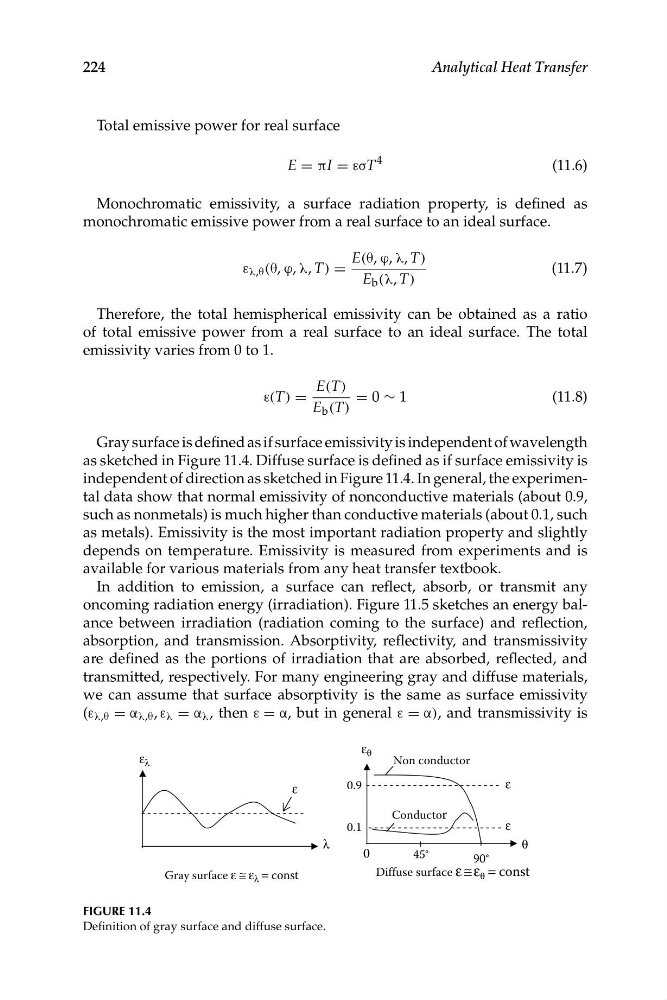
Gray surface is defined as if surface emissivity is independent of wavelength
as sketched in Figure 11.4. Diffuse surface is defined as if surface emissivity is
independent of direction as sketched in Figure 11.4. In general, the experimental data show that normal emissivity of nonconductive materials (about 0.9,
such as nonmetals) is much higher than conductive materials (about 0.1, such
as metals). Emissivity is the most important radiation property and slightly
depends on temperature. Emissivity is measured from experiments and is
available for various materials from any heat transfer textbook.
In addition to emission, a surface can reflect, absorb, or transmit any
oncoming radiation energy (irradiation). Figure 11.5 sketches an energy balance between irradiation (radiation coming to the surface) and reflection,
absorption, and transmission. Absorptivity, reflectivity, and transmissivity
are defined as the portions of irradiation that are absorbed, reflected, and
transmitted, respectively. For many engineering gray and diffuse materials,
we can assume that surface absorptivity is the same as surface emissivity
(ε λ,θ = α λ,θ , ε λ = α λ , then ε = α, but in general ε = α), and transmissivity is
ε
FIGURE 11.4
Definition of gray surface and diffuse surface.
E = πI = εσT
4
(11.6)
Monochromatic emissivity, a surface radiation property, is defined as
monochromatic emissive power from a real surface to an ideal surface.
E(θ, ϕ, λ, T)
ε λ,θ (θ, ϕ, λ, T) =
(11.7)
E b (λ, T)
Therefore, the total hemispherical emissivity can be obtained as a ratio
of total emissive power from a real surface to an ideal surface. The total
emissivity varies from 0 to 1.
E(T)
ε(T) =
= 0 ∼ 1
(11.8)
E b (T)
θ
ε λ
Non conductor
Gray surface ε ≅ ε λ = const
Diffuse surface ε ≅ ε θ = const
0
45°
90°
Conductor
0.1
0.9
ε
λ
θ
ε
ε
224
Analytical Heat Transfer
Gray surface is defined as if surface emissivity is independent of wavelength
as sketched in Figure 11.4. Diffuse surface is defined as if surface emissivity is
independent of direction as sketched in Figure 11.4. In general, the experimental data show that normal emissivity of nonconductive materials (about 0.9,
such as nonmetals) is much higher than conductive materials (about 0.1, such
as metals). Emissivity is the most important radiation property and slightly
depends on temperature. Emissivity is measured from experiments and is
available for various materials from any heat transfer textbook.
In addition to emission, a surface can reflect, absorb, or transmit any
oncoming radiation energy (irradiation). Figure 11.5 sketches an energy balance between irradiation (radiation coming to the surface) and reflection,
absorption, and transmission. Absorptivity, reflectivity, and transmissivity
are defined as the portions of irradiation that are absorbed, reflected, and
transmitted, respectively. For many engineering gray and diffuse materials,
we can assume that surface absorptivity is the same as surface emissivity
(ε λ,θ = α λ,θ , ε λ = α λ , then ε = α, but in general ε = α), and transmissivity is
ε
FIGURE 11.4
Definition of gray surface and diffuse surface.