

�
�
��
�
�
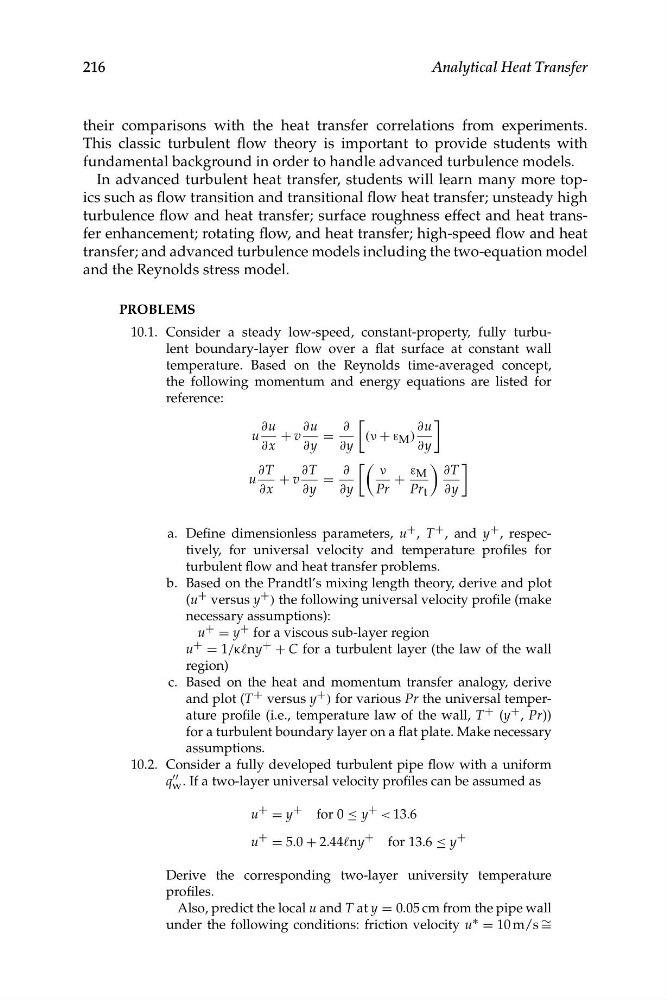
∂u
∂u
∂
∂u
u
+ v
=
(ν + ε M )
∂x
∂y
∂y
∂y
∂T
∂T
∂
ν
ε M ∂T
u
+ v
=
+
∂x
∂y
∂y
Pr
Pr t ∂y
+
+
a. Define dimensionless parameters, u , T + , and y , respectively, for universal velocity and temperature profiles for
turbulent flow and heat transfer problems.
b. Based on the Prandtl’s mixing length theory, derive and plot
+
(u versus y + ) the following universal velocity profile (make
necessary assumptions):
+
u = y + for a viscous sub-layer region
+
u = 1/κ�ny + + C for a turbulent layer (the law of the wall
region)
c. Based on the heat and momentum transfer analogy, derive
and plot (T + versus y + ) for various Pr the universal temper+
ature profile (i.e., temperature law of the wall, T + (y , Pr))
for a turbulent boundary layer on a flat plate. Make necessary
assumptions.
10.2. Consider a fully developed turbulent pipe flow with a uniform
""
q . If a two-layer universal velocity profiles can be assumed as
w
+
+
+
u = y
for 0 ≤ y < 13.6
+
+
+
u = 5.0 + 2.44�ny
for 13.6 ≤ y
Derive the corresponding two-layer university temperature
profiles.
Also, predict the local u and T at y = 0.05 cm from the pipe wall
∗
under the following conditions: friction velocity u = 10 m/s ∼ =
216
Analytical Heat Transfer
their comparisons with the heat transfer correlations from experiments.
This classic turbulent flow theory is important to provide students with
fundamental background in order to handle advanced turbulence models.
In advanced turbulent heat transfer, students will learn many more topics such as flow transition and transitional flow heat transfer; unsteady high
turbulence flow and heat transfer; surface roughness effect and heat transfer enhancement; rotating flow, and heat transfer; high-speed flow and heat
transfer; and advanced turbulence models including the two-equation model
and the Reynolds stress model.
PROBLEMS
10.1. Consider a steady low-speed, constant-property, fully turbulent boundary-layer flow over a flat surface at constant wall
temperature. Based on the Reynolds time-averaged concept,
the following momentum and energy equations are listed for
reference:
�
��
�
�
∂u
∂u
∂
∂u
u
+ v
=
(ν + ε M )
∂x
∂y
∂y
∂y
∂T
∂T
∂
ν
ε M ∂T
u
+ v
=
+
∂x
∂y
∂y
Pr
Pr t ∂y
+
+
a. Define dimensionless parameters, u , T + , and y , respectively, for universal velocity and temperature profiles for
turbulent flow and heat transfer problems.
b. Based on the Prandtl’s mixing length theory, derive and plot
+
(u versus y + ) the following universal velocity profile (make
necessary assumptions):
+
u = y + for a viscous sub-layer region
+
u = 1/κ�ny + + C for a turbulent layer (the law of the wall
region)
c. Based on the heat and momentum transfer analogy, derive
and plot (T + versus y + ) for various Pr the universal temper+
ature profile (i.e., temperature law of the wall, T + (y , Pr))
for a turbulent boundary layer on a flat plate. Make necessary
assumptions.
10.2. Consider a fully developed turbulent pipe flow with a uniform
""
q . If a two-layer universal velocity profiles can be assumed as
w
+
+
+
u = y
for 0 ≤ y < 13.6
+
+
+
u = 5.0 + 2.44�ny
for 13.6 ≤ y
Derive the corresponding two-layer university temperature
profiles.
Also, predict the local u and T at y = 0.05 cm from the pipe wall
∗
under the following conditions: friction velocity u = 10 m/s ∼ =
216
Analytical Heat Transfer
their comparisons with the heat transfer correlations from experiments.
This classic turbulent flow theory is important to provide students with
fundamental background in order to handle advanced turbulence models.
In advanced turbulent heat transfer, students will learn many more topics such as flow transition and transitional flow heat transfer; unsteady high
turbulence flow and heat transfer; surface roughness effect and heat transfer enhancement; rotating flow, and heat transfer; high-speed flow and heat
transfer; and advanced turbulence models including the two-equation model
and the Reynolds stress model.
PROBLEMS
10.1. Consider a steady low-speed, constant-property, fully turbulent boundary-layer flow over a flat surface at constant wall
temperature. Based on the Reynolds time-averaged concept,
the following momentum and energy equations are listed for
reference: