

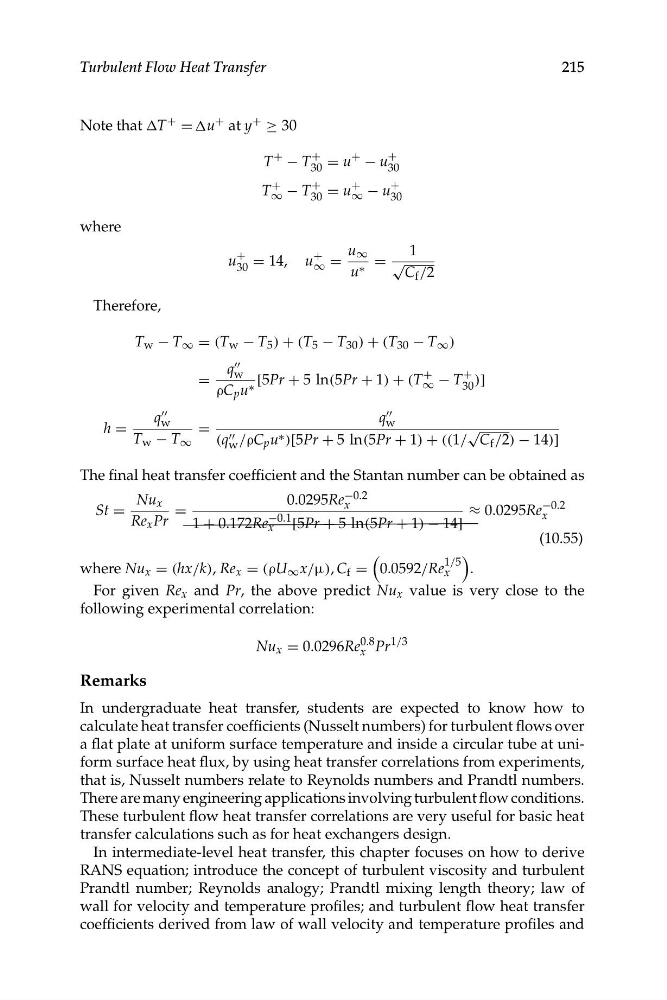
Note that ΔT + = Δu
+ at y + ≥ 30
+
T
+
− T
+
= u
+
− u
30
30
T
+
+
+
∞ − T
+
= u ∞ − u
30
30
where
+
+
u ∞
1
u = 14, u =
= √
30
∞
u ∗
C f /2
Therefore,
T w − T ∞ = (T w − T 5 ) + (T 5 − T 30 ) + (T 30 − T ∞ )
""
q
∞ − T
+
w
=
[5Pr + 5 ln(5Pr + 1) + (T
+
30 )]
ρC p u ∗
""
""
q
q
h =
w
=
w
√
T w − T ∞
(q "" /ρC p u ∗ )[5Pr + 5 ln(5Pr + 1) + ((1/ C f /2) − 14)]
w
The final heat transfer coefficient and the Stantan number can be obtained as
(
)
where Nu x = (hx/k), Re x = (ρU ∞ x/μ), C f = 0.0592/Re
1/5 .
x
For given Re x and Pr, the above predict Nu x value is very close to the
following experimental correlation:
Nu x = 0.0296Re
0.8 Pr
1/3
x
215
Turbulent Flow Heat Transfer
Remarks
In undergraduate heat transfer, students are expected to know how to
calculate heat transfer coefficients (Nusselt numbers) for turbulent flows over
a flat plate at uniform surface temperature and inside a circular tube at uniform surface heat flux, by using heat transfer correlations from experiments,
that is, Nusselt numbers relate to Reynolds numbers and Prandtl numbers.
There are many engineering applications involving turbulent flow conditions.
These turbulent flow heat transfer correlations are very useful for basic heat
transfer calculations such as for heat exchangers design.
In intermediate-level heat transfer, this chapter focuses on how to derive
RANS equation; introduce the concept of turbulent viscosity and turbulent
Prandtl number; Reynolds analogy; Prandtl mixing length theory; law of
wall for velocity and temperature profiles; and turbulent flow heat transfer
coefficients derived from law of wall velocity and temperature profiles and
+ at y + ≥ 30
+
T
+
− T
+
= u
+
− u
30
30
T
+
+
+
∞ − T
+
= u ∞ − u
30
30
where
+
+
u ∞
1
u = 14, u =
= √
30
∞
u ∗
C f /2
Therefore,
T w − T ∞ = (T w − T 5 ) + (T 5 − T 30 ) + (T 30 − T ∞ )
""
q
∞ − T
+
w
=
[5Pr + 5 ln(5Pr + 1) + (T
+
30 )]
ρC p u ∗
""
""
q
q
h =
w
=
w
√
T w − T ∞
(q "" /ρC p u ∗ )[5Pr + 5 ln(5Pr + 1) + ((1/ C f /2) − 14)]
w
The final heat transfer coefficient and the Stantan number can be obtained as
(
)
where Nu x = (hx/k), Re x = (ρU ∞ x/μ), C f = 0.0592/Re
1/5 .
x
For given Re x and Pr, the above predict Nu x value is very close to the
following experimental correlation:
Nu x = 0.0296Re
0.8 Pr
1/3
x
215
Turbulent Flow Heat Transfer
Remarks
In undergraduate heat transfer, students are expected to know how to
calculate heat transfer coefficients (Nusselt numbers) for turbulent flows over
a flat plate at uniform surface temperature and inside a circular tube at uniform surface heat flux, by using heat transfer correlations from experiments,
that is, Nusselt numbers relate to Reynolds numbers and Prandtl numbers.
There are many engineering applications involving turbulent flow conditions.
These turbulent flow heat transfer correlations are very useful for basic heat
transfer calculations such as for heat exchangers design.
In intermediate-level heat transfer, this chapter focuses on how to derive
RANS equation; introduce the concept of turbulent viscosity and turbulent
Prandtl number; Reynolds analogy; Prandtl mixing length theory; law of
wall for velocity and temperature profiles; and turbulent flow heat transfer
coefficients derived from law of wall velocity and temperature profiles and