

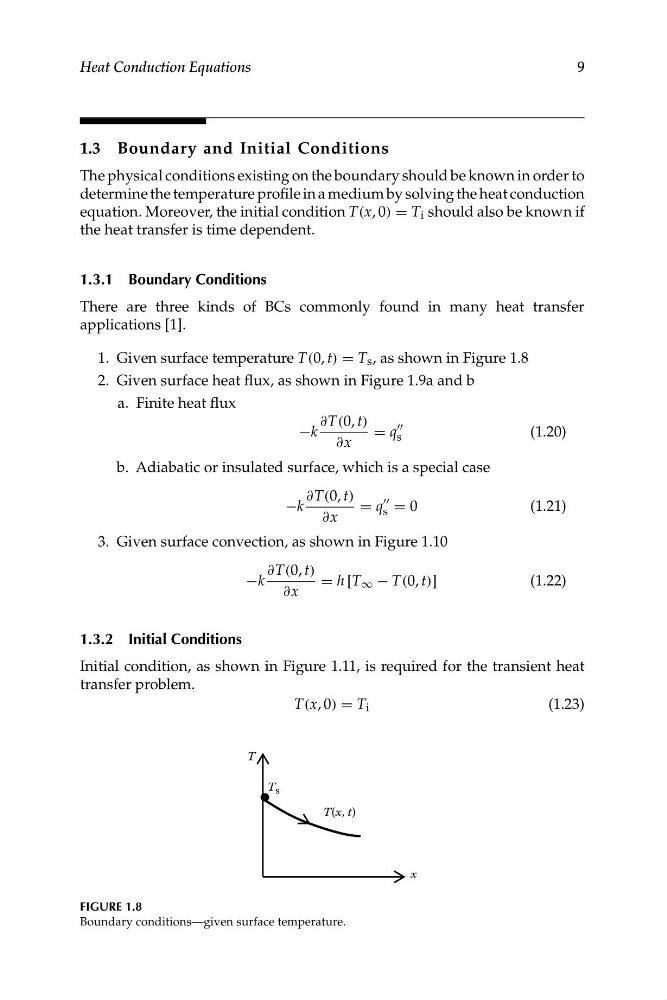
1. Given surface temperature T(0, t) = T s , as shown in Figure 1.8
2. Given surface heat flux, as shown in Figure 1.9a and b
a. Finite heat flux
∂T(0, t)
""
−k
= q
(1.20)
s
∂x
b. Adiabatic or insulated surface, which is a special case
∂T(0, t)
""
−k
= q = 0
(1.21)
s
∂x
3. Given surface convection, as shown in Figure 1.10
∂T(0, t)
−k
= h [T ∞ − T(0, t)]
(1.22)
∂x
1.3.2 Initial Conditions
Initial condition, as shown in Figure 1.11, is required for the transient heat
transfer problem.
T(x, 0) T i
(1.23)
=
9
Heat Conduction Equations
1.3 Boundary and Initial Conditions
The physical conditions existing on the boundary should be known in order to
determine the temperature profile in a medium by solving the heat conduction
equation. Moreover, the initial condition T(x, 0) = T i should also be known if
the heat transfer is time dependent.
1.3.1 Boundary Conditions
There are three kinds of BCs commonly found in many heat transfer
applications [1].
T s
T(x, t)
T
x
FIGURE 1.8
Boundary conditions—given surface temperature.
2. Given surface heat flux, as shown in Figure 1.9a and b
a. Finite heat flux
∂T(0, t)
""
−k
= q
(1.20)
s
∂x
b. Adiabatic or insulated surface, which is a special case
∂T(0, t)
""
−k
= q = 0
(1.21)
s
∂x
3. Given surface convection, as shown in Figure 1.10
∂T(0, t)
−k
= h [T ∞ − T(0, t)]
(1.22)
∂x
1.3.2 Initial Conditions
Initial condition, as shown in Figure 1.11, is required for the transient heat
transfer problem.
T(x, 0) T i
(1.23)
=
9
Heat Conduction Equations
1.3 Boundary and Initial Conditions
The physical conditions existing on the boundary should be known in order to
determine the temperature profile in a medium by solving the heat conduction
equation. Moreover, the initial condition T(x, 0) = T i should also be known if
the heat transfer is time dependent.
1.3.1 Boundary Conditions
There are three kinds of BCs commonly found in many heat transfer
applications [1].
T s
T(x, t)
T
x
FIGURE 1.8
Boundary conditions—given surface temperature.