

�
�
�
�
�
�
�
�
�
�
�
�
�
�
Dividing out the dimensions of the small control volume dx dy dz, Equation 1.14 is simplified as
∂
∂T
∂(ρC p T)
k
+ q ˙ =
(1.15)
∂x
∂x
∂t
If we consider energy conservation, in a 3-D system (x-direction, y-direction,
z-direction), the heat equation can be written as
∂
∂T
∂
∂T
∂
∂T
∂(ρC p T)
k
+
k
+
k
+ q ˙ =
(1.16)
∂x
∂x
∂y
∂y
∂z
∂z
∂t
The thermal conductivity k, which is a function of temperature, is hard to
determine. If we assume that k, ρ, and C p are constants, then Equation 1.16 is
simplified as
∂ 2 T
∂ 2 T
∂ 2 T
q ˙
1 ∂T
+
+
+ =
(1.17)
∂x 2
∂y 2
∂z 2
k
α ∂t
where α = k/ρC p is the thermal diffusivity.
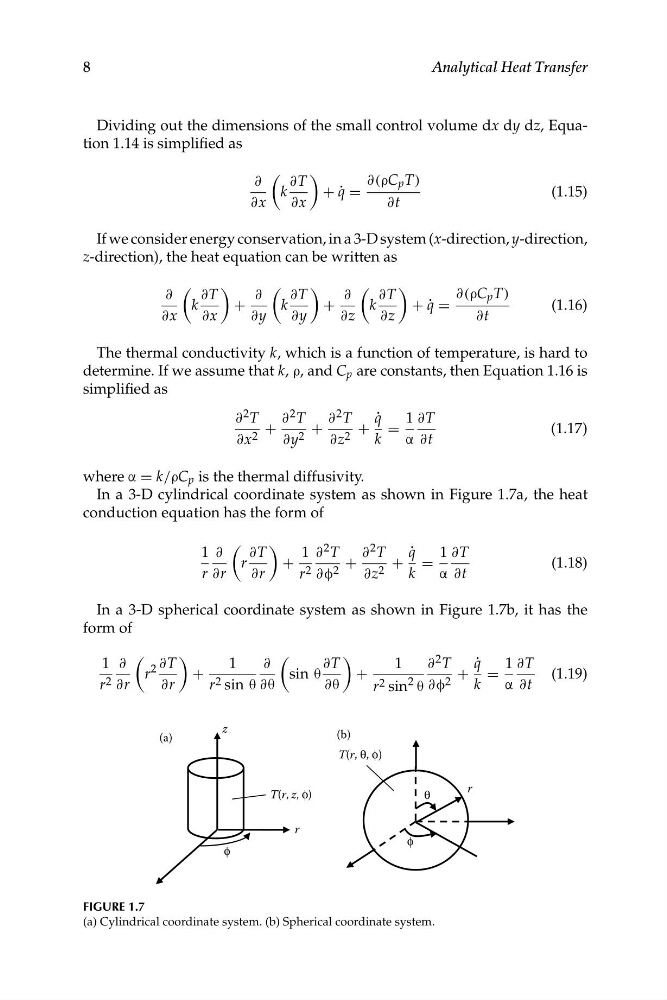
In a 3-D cylindrical coordinate system as shown in Figure 1.7a, the heat
conduction equation has the form of
1 ∂
∂T
1 ∂ 2 T
∂ 2 T
q ˙
1 ∂T
r
+
+
+ =
(1.18)
r ∂r
∂r
r 2 ∂φ 2
∂z 2
k
α ∂t
In a 3-D spherical coordinate system as shown in Figure 1.7b, it has the
form of
1 ∂
2 ∂T
1
∂
∂T
1
∂ 2 T
q ˙
1 ∂T
r
+
sin θ
+
+ =
(1.19)
r 2 ∂r
∂r
r 2 sin θ ∂θ
∂θ
r 2 sin
2
θ ∂φ 2
k
α ∂t
z
r
(a)
(b)
r
T(r, z, ϕ)
T(r, θ, ϕ)
ϕ
ϕ
θ
8
Analytical Heat Transfer
FIGURE 1.7
(a) Cylindrical coordinate system. (b) Spherical coordinate system.
�
�
�
�
�
�
�
�
�
�
�
�
�
Dividing out the dimensions of the small control volume dx dy dz, Equation 1.14 is simplified as
∂
∂T
∂(ρC p T)
k
+ q ˙ =
(1.15)
∂x
∂x
∂t
If we consider energy conservation, in a 3-D system (x-direction, y-direction,
z-direction), the heat equation can be written as
∂
∂T
∂
∂T
∂
∂T
∂(ρC p T)
k
+
k
+
k
+ q ˙ =
(1.16)
∂x
∂x
∂y
∂y
∂z
∂z
∂t
The thermal conductivity k, which is a function of temperature, is hard to
determine. If we assume that k, ρ, and C p are constants, then Equation 1.16 is
simplified as
∂ 2 T
∂ 2 T
∂ 2 T
q ˙
1 ∂T
+
+
+ =
(1.17)
∂x 2
∂y 2
∂z 2
k
α ∂t
where α = k/ρC p is the thermal diffusivity.
In a 3-D cylindrical coordinate system as shown in Figure 1.7a, the heat
conduction equation has the form of
1 ∂
∂T
1 ∂ 2 T
∂ 2 T
q ˙
1 ∂T
r
+
+
+ =
(1.18)
r ∂r
∂r
r 2 ∂φ 2
∂z 2
k
α ∂t
In a 3-D spherical coordinate system as shown in Figure 1.7b, it has the
form of
1 ∂
2 ∂T
1
∂
∂T
1
∂ 2 T
q ˙
1 ∂T
r
+
sin θ
+
+ =
(1.19)
r 2 ∂r
∂r
r 2 sin θ ∂θ
∂θ
r 2 sin
2
θ ∂φ 2
k
α ∂t
z
r
(a)
(b)
r
T(r, z, ϕ)
T(r, θ, ϕ)
ϕ
ϕ
θ
8
Analytical Heat Transfer
FIGURE 1.7
(a) Cylindrical coordinate system. (b) Spherical coordinate system.