

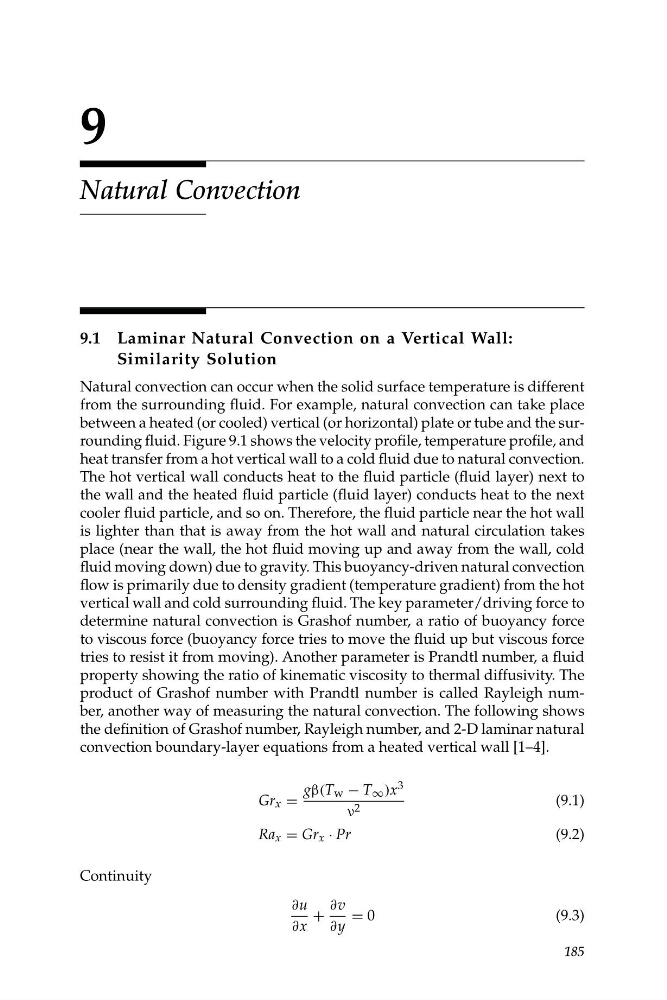
gβ(T w − T ∞ )x 3
Gr x =
(9.1)
ν 2
Ra x = Gr x · Pr
(9.2)
Continuity
∂u
∂x
+
∂v
∂y
= 0
(9.3)
9
Natural Convection
9.1 Laminar Natural Convection on a Vertical Wall:
Similarity Solution
Natural convection can occur when the solid surface temperature is different
from the surrounding fluid. For example, natural convection can take place
between a heated (or cooled) vertical (or horizontal) plate or tube and the surrounding fluid. Figure 9.1 shows the velocity profile, temperature profile, and
heat transfer from a hot vertical wall to a cold fluid due to natural convection.
The hot vertical wall conducts heat to the fluid particle (fluid layer) next to
the wall and the heated fluid particle (fluid layer) conducts heat to the next
cooler fluid particle, and so on. Therefore, the fluid particle near the hot wall
is lighter than that is away from the hot wall and natural circulation takes
place (near the wall, the hot fluid moving up and away from the wall, cold
fluid moving down) due to gravity. This buoyancy-driven natural convection
flow is primarily due to density gradient (temperature gradient) from the hot
vertical wall and cold surrounding fluid. The key parameter/driving force to
determine natural convection is Grashof number, a ratio of buoyancy force
to viscous force (buoyancy force tries to move the fluid up but viscous force
tries to resist it from moving). Another parameter is Prandtl number, a fluid
property showing the ratio of kinematic viscosity to thermal diffusivity. The
product of Grashof number with Prandtl number is called Rayleigh number, another way of measuring the natural convection. The following shows
the definition of Grashof number, Rayleigh number, and 2-D laminar natural
convection boundary-layer equations from a heated vertical wall [1–4].
185
Gr x =
(9.1)
ν 2
Ra x = Gr x · Pr
(9.2)
Continuity
∂u
∂x
+
∂v
∂y
= 0
(9.3)
9
Natural Convection
9.1 Laminar Natural Convection on a Vertical Wall:
Similarity Solution
Natural convection can occur when the solid surface temperature is different
from the surrounding fluid. For example, natural convection can take place
between a heated (or cooled) vertical (or horizontal) plate or tube and the surrounding fluid. Figure 9.1 shows the velocity profile, temperature profile, and
heat transfer from a hot vertical wall to a cold fluid due to natural convection.
The hot vertical wall conducts heat to the fluid particle (fluid layer) next to
the wall and the heated fluid particle (fluid layer) conducts heat to the next
cooler fluid particle, and so on. Therefore, the fluid particle near the hot wall
is lighter than that is away from the hot wall and natural circulation takes
place (near the wall, the hot fluid moving up and away from the wall, cold
fluid moving down) due to gravity. This buoyancy-driven natural convection
flow is primarily due to density gradient (temperature gradient) from the hot
vertical wall and cold surrounding fluid. The key parameter/driving force to
determine natural convection is Grashof number, a ratio of buoyancy force
to viscous force (buoyancy force tries to move the fluid up but viscous force
tries to resist it from moving). Another parameter is Prandtl number, a fluid
property showing the ratio of kinematic viscosity to thermal diffusivity. The
product of Grashof number with Prandtl number is called Rayleigh number, another way of measuring the natural convection. The following shows
the definition of Grashof number, Rayleigh number, and 2-D laminar natural
convection boundary-layer equations from a heated vertical wall [1–4].
185