

165
External Forced Convection
c. Determine the local heat transfer coefficient (h x ) and the Nusselt number Nu x . Express the answer in terms of the thermal
boundary-layer thickness δ t .
7.21. Consider a 2-D laminar air flow over a friction less plate. The flow
approaches the leading edge of the plate with uniform velocity
U ∞ and temperature T ∞ . The plate is subjected to a constant wall
temperature, T s (> T ∞ ).
a. Qualitatively sketch hydrodynamic (δ) and thermal boundary
layer (δ t ) growth as a function of distance x from the leading
edge.
b. Qualitatively sketch velocity and temperature profiles at a
distance x from the leading edge.
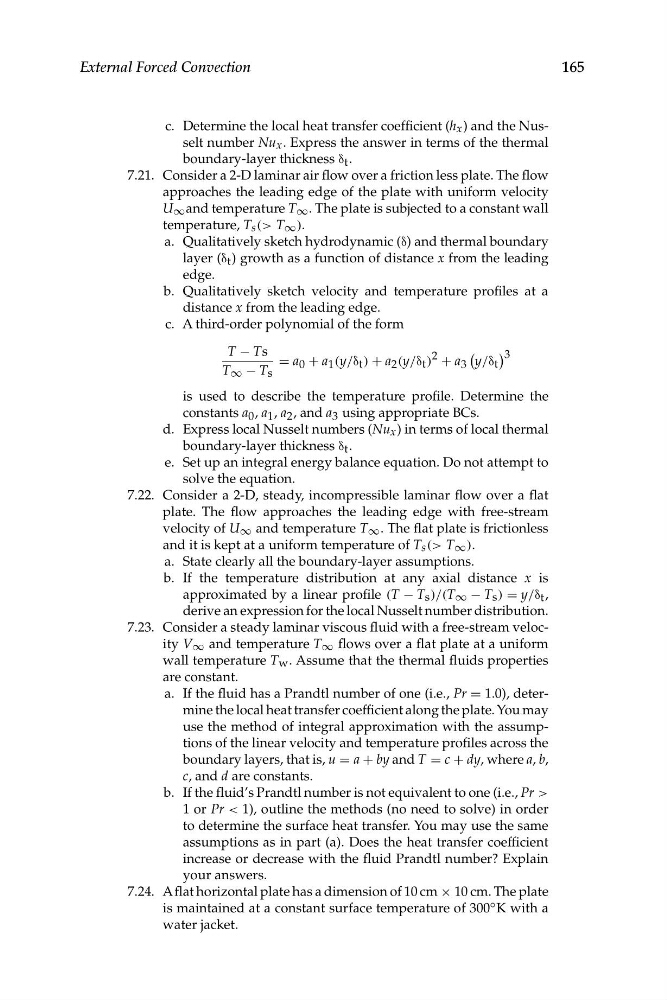
c. A third-order polynomial of the form
T − Ts =
2
3
a 0 a 1 (y/δ t ) a 2 (y/δ
δ
−
t )
a 3 y/ t
T ∞ T s
+
+
+
(
)
is used to describe the temperature profile. Determine the
constants a 0 , a 1 , a 2 , and a 3 using appropriate BCs.
d. Express local Nusselt numbers (Nu x ) in terms of local thermal
boundary-layer thickness δ t .
e. Set up an integral energy balance equation. Do not attempt to
solve the equation.
7.22. Consider a 2-D, steady, incompressible laminar flow over a flat
plate. The flow approaches the leading edge with free-stream
velocity of U ∞ and temperature T ∞ . The flat plate is frictionless
and it is kept at a uniform temperature of T s (> T ∞ ).
a. State clearly all the boundary-layer assumptions.
b. If the temperature distribution at any axial distance x is
approximated by a linear profile (T − T s )/(T ∞ − T s ) = y/δ t ,
derive an expression for the local Nusselt number distribution.
7.23. Consider a steady laminar viscous fluid with a free-stream velocity V ∞ and temperature T ∞ flows over a flat plate at a uniform
wall temperature T w . Assume that the thermal fluids properties
are constant.
a. If the fluid has a Prandtl number of one (i.e., Pr = 1.0), determine the local heat transfer coefficient along the plate. You may
use the method of integral approximation with the assumptions of the linear velocity and temperature profiles across the
boundary layers, that is, u = a + by and T = c + dy, where a, b,
c, and d are constants.
b. If the fluid’s Prandtl number is not equivalent to one (i.e., Pr >
1 or Pr < 1), outline the methods (no need to solve) in order
to determine the surface heat transfer. You may use the same
assumptions as in part (a). Does the heat transfer coefficient
increase or decrease with the fluid Prandtl number? Explain
your answers.
7.24. A flat horizontal plate has a dimension of 10 cm × 10 cm. The plate
is maintained at a constant surface temperature of 300 ◦ K with a
water jacket.
External Forced Convection
c. Determine the local heat transfer coefficient (h x ) and the Nusselt number Nu x . Express the answer in terms of the thermal
boundary-layer thickness δ t .
7.21. Consider a 2-D laminar air flow over a friction less plate. The flow
approaches the leading edge of the plate with uniform velocity
U ∞ and temperature T ∞ . The plate is subjected to a constant wall
temperature, T s (> T ∞ ).
a. Qualitatively sketch hydrodynamic (δ) and thermal boundary
layer (δ t ) growth as a function of distance x from the leading
edge.
b. Qualitatively sketch velocity and temperature profiles at a
distance x from the leading edge.
c. A third-order polynomial of the form
T − Ts =
2
3
a 0 a 1 (y/δ t ) a 2 (y/δ
δ
−
t )
a 3 y/ t
T ∞ T s
+
+
+
(
)
is used to describe the temperature profile. Determine the
constants a 0 , a 1 , a 2 , and a 3 using appropriate BCs.
d. Express local Nusselt numbers (Nu x ) in terms of local thermal
boundary-layer thickness δ t .
e. Set up an integral energy balance equation. Do not attempt to
solve the equation.
7.22. Consider a 2-D, steady, incompressible laminar flow over a flat
plate. The flow approaches the leading edge with free-stream
velocity of U ∞ and temperature T ∞ . The flat plate is frictionless
and it is kept at a uniform temperature of T s (> T ∞ ).
a. State clearly all the boundary-layer assumptions.
b. If the temperature distribution at any axial distance x is
approximated by a linear profile (T − T s )/(T ∞ − T s ) = y/δ t ,
derive an expression for the local Nusselt number distribution.
7.23. Consider a steady laminar viscous fluid with a free-stream velocity V ∞ and temperature T ∞ flows over a flat plate at a uniform
wall temperature T w . Assume that the thermal fluids properties
are constant.
a. If the fluid has a Prandtl number of one (i.e., Pr = 1.0), determine the local heat transfer coefficient along the plate. You may
use the method of integral approximation with the assumptions of the linear velocity and temperature profiles across the
boundary layers, that is, u = a + by and T = c + dy, where a, b,
c, and d are constants.
b. If the fluid’s Prandtl number is not equivalent to one (i.e., Pr >
1 or Pr < 1), outline the methods (no need to solve) in order
to determine the surface heat transfer. You may use the same
assumptions as in part (a). Does the heat transfer coefficient
increase or decrease with the fluid Prandtl number? Explain
your answers.
7.24. A flat horizontal plate has a dimension of 10 cm × 10 cm. The plate
is maintained at a constant surface temperature of 300 ◦ K with a
water jacket.