

""
�
�
�
�
�
�
�
�
�
�
�
�
�
�
√
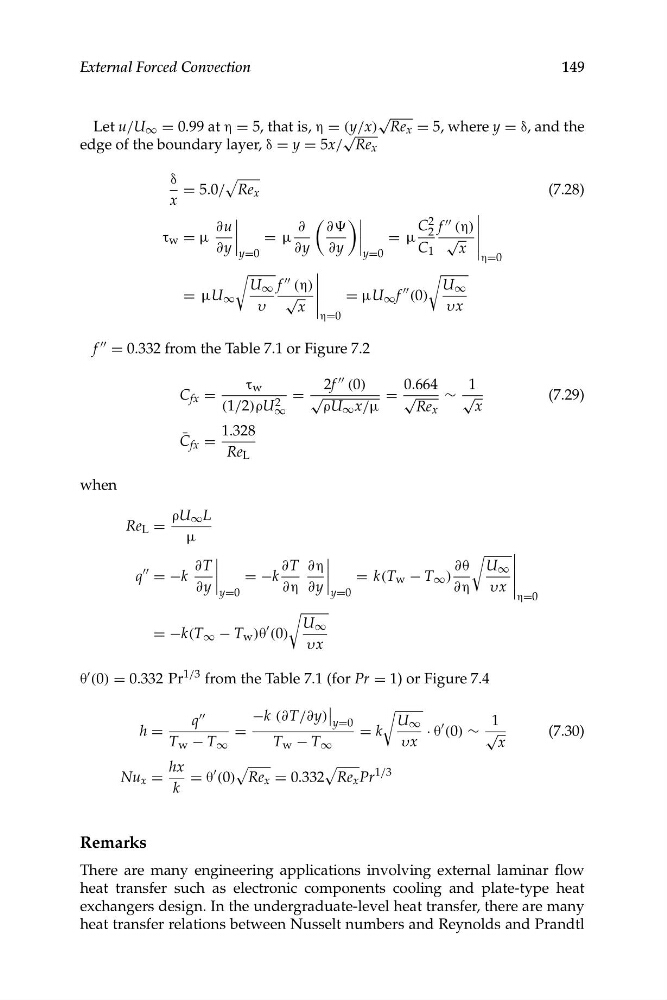
Let u/U ∞ = 0.99 at η = 5, that is, η = (y/x) Re x = 5, where y = δ, and the
√
edge of the boundary layer, δ = y = 5x/ Re x
δ
x
)
= 5.0/ Re x
(7.28)
�
τ w = μ
∂u
∂y
�
�
�
�
y=0
= μ
∂
∂y
�
∂Ψ
∂y
� �
�
�
�
y=0
= μ
C 2
2
C 1
f "" (η)
√
x
�
�
�
� η=0
�
= μU ∞
�
U ∞
υ
f "" (η)
√
x
�
�
�
�
= μU ∞ f
"" (0)
�
U ∞
υx
η=0
f "" = 0.332 from the Table 7.1 or Figure 7.2
"" (0)
τ w
2f
0.664
1
C fx =
= √
= √
∼ √
(7.29)
(1/2)ρU 2
ρU ∞ x/μ
Re x
x
∞
1.328
¯
C fx = Re L
when
ρU ∞ L
Re L = μ
∂T �
∂T ∂η �
∂θ U ∞
q = −k
= −k
= k(T w − T ∞ )
�
∂y
∂η ∂y
∂η υx �
y=0
y=0
η=0
U ∞
"
= −k(T ∞ − T w )θ (0)
υx
θ " (0) = 0.332 Pr
1/3 from the Table 7.1 (for Pr = 1) or Figure 7.4
""
−k (∂T/∂y)
q
y=0
U ∞
1
"
h =
=
= k
· θ (0) ∼ √
(7.30)
T w − T ∞
T w − T ∞
υx
x
)
)
"
Nu x =
hx = θ (0) Re x = 0.332 Re x Pr
1/3
k
149
External Forced Convection
Remarks
There are many engineering applications involving external laminar flow
heat transfer such as electronic components cooling and plate-type heat
exchangers design. In the undergraduate-level heat transfer, there are many
heat transfer relations between Nusselt numbers and Reynolds and Prandtl
�
�
�
�
�
�
�
�
�
�
�
�
�
�
√
Let u/U ∞ = 0.99 at η = 5, that is, η = (y/x) Re x = 5, where y = δ, and the
√
edge of the boundary layer, δ = y = 5x/ Re x
δ
x
)
= 5.0/ Re x
(7.28)
�
τ w = μ
∂u
∂y
�
�
�
�
y=0
= μ
∂
∂y
�
∂Ψ
∂y
� �
�
�
�
y=0
= μ
C 2
2
C 1
f "" (η)
√
x
�
�
�
� η=0
�
= μU ∞
�
U ∞
υ
f "" (η)
√
x
�
�
�
�
= μU ∞ f
"" (0)
�
U ∞
υx
η=0
f "" = 0.332 from the Table 7.1 or Figure 7.2
"" (0)
τ w
2f
0.664
1
C fx =
= √
= √
∼ √
(7.29)
(1/2)ρU 2
ρU ∞ x/μ
Re x
x
∞
1.328
¯
C fx = Re L
when
ρU ∞ L
Re L = μ
∂T �
∂T ∂η �
∂θ U ∞
q = −k
= −k
= k(T w − T ∞ )
�
∂y
∂η ∂y
∂η υx �
y=0
y=0
η=0
U ∞
"
= −k(T ∞ − T w )θ (0)
υx
θ " (0) = 0.332 Pr
1/3 from the Table 7.1 (for Pr = 1) or Figure 7.4
""
−k (∂T/∂y)
q
y=0
U ∞
1
"
h =
=
= k
· θ (0) ∼ √
(7.30)
T w − T ∞
T w − T ∞
υx
x
)
)
"
Nu x =
hx = θ (0) Re x = 0.332 Re x Pr
1/3
k
149
External Forced Convection
Remarks
There are many engineering applications involving external laminar flow
heat transfer such as electronic components cooling and plate-type heat
exchangers design. In the undergraduate-level heat transfer, there are many
heat transfer relations between Nusselt numbers and Reynolds and Prandtl