

where
1
"
θ (0) = � ∞
[ � η
]
(7.27)
0 exp − 0 Pr/2( f dη) dη
If Pr = 1, f " = θ, the thermal boundary layer is the same as the hydrodynamic boundary layer (Equation 7.20 = Equation 7.25).
For a given Pr, θ and θ " can be determined if f "" has been solved previously.
For example,
f """
f = −
""
(1/2)f
� η
""
0 f dη = −2 ln f
� η
f
""
− 0 1/2( f dη)
= e
� η (
f "" ) Pr dη
0
θ = � ∞ ( ) Pr
""
f
dη
0
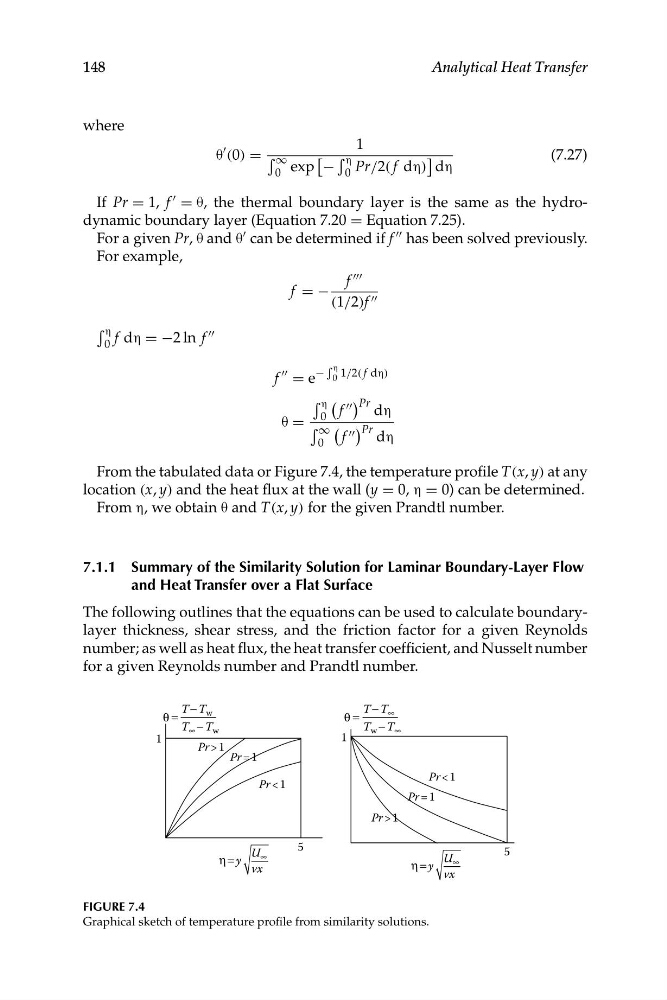
From the tabulated data or Figure 7.4, the temperature profile T(x, y) at any
location (x, y) and the heat flux at the wall (y = 0, η = 0) can be determined.
From η, we obtain θ and T(x, y) for the given Prandtl number.
T − T w
T − T ∞
θ
T ∞ − T w
T w − T ∞
U ∞
vx
η = y
U ∞
η = y
5
vx
5
Pr > 1
Pr = 1
Pr < 1
1
Pr > 1
Pr = 1
Pr < 1
=
θ =
1
148
Analytical Heat Transfer
7.1.1 Summary of the Similarity Solution for Laminar Boundary-Layer Flow
and Heat Transfer over a Flat Surface
The following outlines that the equations can be used to calculate boundarylayer thickness, shear stress, and the friction factor for a given Reynolds
number; as well as heat flux, the heat transfer coefficient, and Nusselt number
for a given Reynolds number and Prandtl number.
FIGURE 7.4
Graphical sketch of temperature profile from similarity solutions.
1
"
θ (0) = � ∞
[ � η
]
(7.27)
0 exp − 0 Pr/2( f dη) dη
If Pr = 1, f " = θ, the thermal boundary layer is the same as the hydrodynamic boundary layer (Equation 7.20 = Equation 7.25).
For a given Pr, θ and θ " can be determined if f "" has been solved previously.
For example,
f """
f = −
""
(1/2)f
� η
""
0 f dη = −2 ln f
� η
f
""
− 0 1/2( f dη)
= e
� η (
f "" ) Pr dη
0
θ = � ∞ ( ) Pr
""
f
dη
0
From the tabulated data or Figure 7.4, the temperature profile T(x, y) at any
location (x, y) and the heat flux at the wall (y = 0, η = 0) can be determined.
From η, we obtain θ and T(x, y) for the given Prandtl number.
T − T w
T − T ∞
θ
T ∞ − T w
T w − T ∞
U ∞
vx
η = y
U ∞
η = y
5
vx
5
Pr > 1
Pr = 1
Pr < 1
1
Pr > 1
Pr = 1
Pr < 1
=
θ =
1
148
Analytical Heat Transfer
7.1.1 Summary of the Similarity Solution for Laminar Boundary-Layer Flow
and Heat Transfer over a Flat Surface
The following outlines that the equations can be used to calculate boundarylayer thickness, shear stress, and the friction factor for a given Reynolds
number; as well as heat flux, the heat transfer coefficient, and Nusselt number
for a given Reynolds number and Prandtl number.
FIGURE 7.4
Graphical sketch of temperature profile from similarity solutions.