

q y +
∂ (q y ) dy
∂y
ρvi dx dz + ∂ (ρvi dx dz) dy
∂y
E
E
cond, y+dy
conv, y + dy
q x
∂
q x + (q x ) dx
∂x
E cond,x + dx
E cond, x
Δy
E conv, x
E conv,x + dx
Δx
ρui dy dz
ρui dy dz+ ∂ (ρui dy dz) dx
∂x
E cond,y
E conv,y
i = enthalpy
q y
ρvi dx dz
p
P
e
C T
= + =
ρ
Internal energy
135
Heat Convection Equations
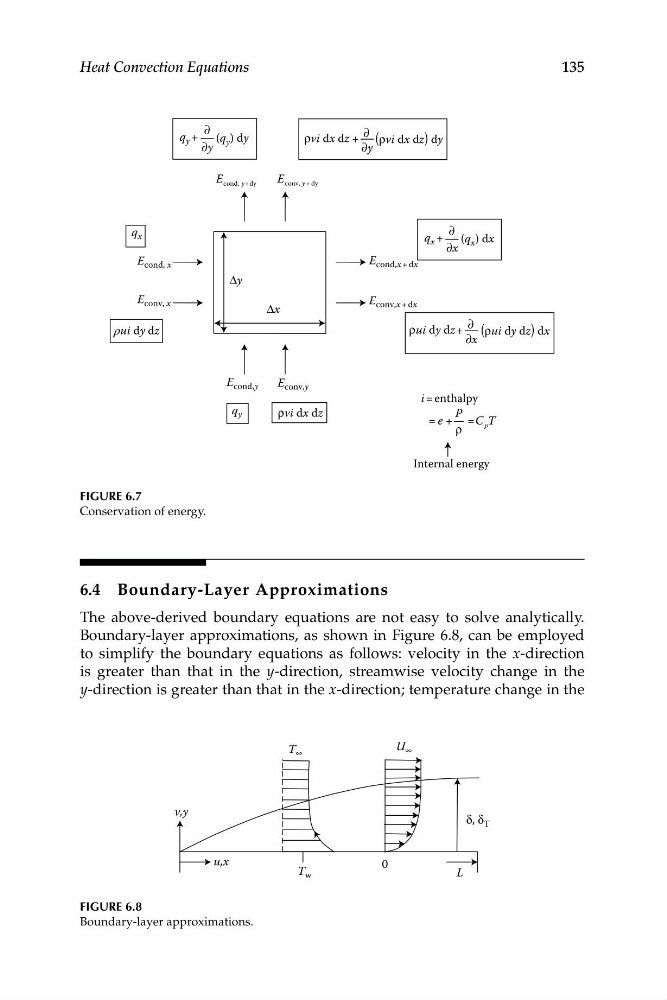
FIGURE 6.7
Conservation of energy.
6.4 Boundary-Layer Approximations
The above-derived boundary equations are not easy to solve analytically.
Boundary-layer approximations, as shown in Figure 6.8, can be employed
to simplify the boundary equations as follows: velocity in the x-direction
is greater than that in the y-direction, streamwise velocity change in the
y-direction is greater than that in the x-direction; temperature change in the
U ∞
T ∞
v,y
u,x
T w
L
0
δ, δ T
FIGURE 6.8
Boundary-layer approximations.
∂ (q y ) dy
∂y
ρvi dx dz + ∂ (ρvi dx dz) dy
∂y
E
E
cond, y+dy
conv, y + dy
q x
∂
q x + (q x ) dx
∂x
E cond,x + dx
E cond, x
Δy
E conv, x
E conv,x + dx
Δx
ρui dy dz
ρui dy dz+ ∂ (ρui dy dz) dx
∂x
E cond,y
E conv,y
i = enthalpy
q y
ρvi dx dz
p
P
e
C T
= + =
ρ
Internal energy
135
Heat Convection Equations
FIGURE 6.7
Conservation of energy.
6.4 Boundary-Layer Approximations
The above-derived boundary equations are not easy to solve analytically.
Boundary-layer approximations, as shown in Figure 6.8, can be employed
to simplify the boundary equations as follows: velocity in the x-direction
is greater than that in the y-direction, streamwise velocity change in the
y-direction is greater than that in the x-direction; temperature change in the
U ∞
T ∞
v,y
u,x
T w
L
0
δ, δ T
FIGURE 6.8
Boundary-layer approximations.