

�
�
If the flow is steady-state,
∂
∂
− (ρu dy) dx −
(ρv dx) dy = 0
∂x
∂y
∂(ρu) ∂(ρv)
+
= 0
(6.6)
∂x
∂y
For incompressible flow, ρ = const, the continuity equation can be simplified as
∂u ∂v
+
= 0
(6.7)
∂x ∂y
Conservation of momentum:
From Newton’s second law, net force exerting on a body equals the
momentum change.
F x = ma x
F y = ma y
where a x is the acceleration in the x–direction, and a y is the acceleration in the
y-direction.
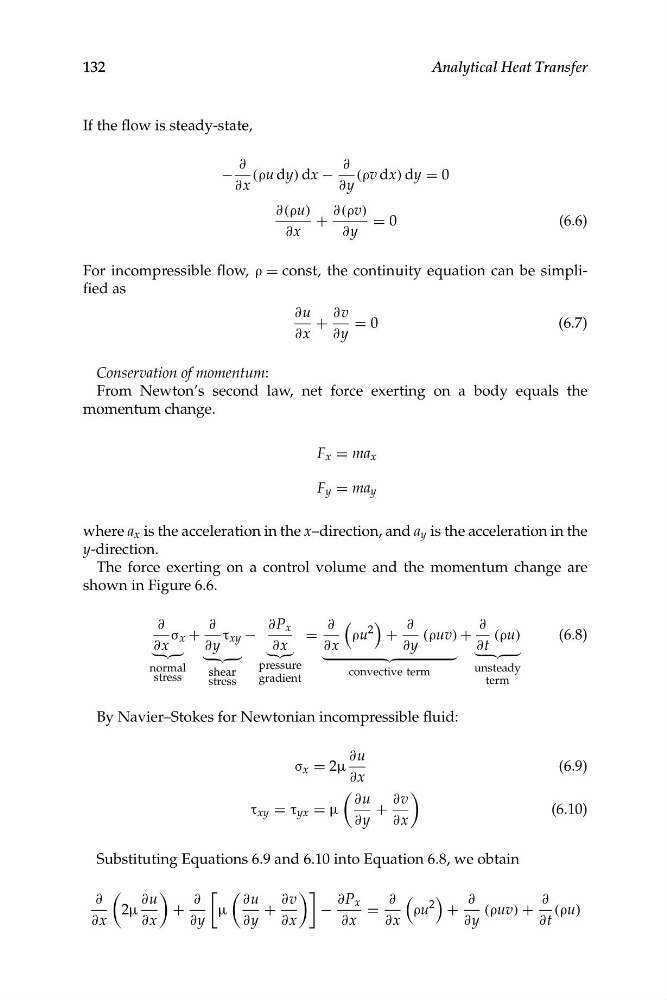
The force exerting on a control volume and the momentum change are
shown in Figure 6.6.
( )
∂
∂
∂P x
∂
2
∂
∂
σ x + τ xy −
=
ρu +
(ρuv) + (ρu)
(6.8)
∂x
∂y
∂x
∂x
∂y
∂t
' -v '
'-v'
'
'
-v
' -v '
'
-v
'
pressure
normal
unsteady
shear
convective term
stress
gradient
stress
term
By Navier–Stokes for Newtonian incompressible fluid:
∂u
σ x = 2μ
(6.9)
∂x
∂u ∂v
τ xy = τ yx = μ
+
(6.10)
∂y
∂x
Substituting Equations 6.9 and 6.10 into Equation 6.8, we obtain
�
�
� �
��
( )
∂
∂u
∂
∂u ∂v
∂P x
∂
∂
∂
2μ
+
μ
+
−
=
ρu
2
+
(ρuv) + (ρu)
∂x
∂x
∂y
∂y
∂x
∂x
∂x
∂y
∂t
132
Analytical Heat Transfer
�
If the flow is steady-state,
∂
∂
− (ρu dy) dx −
(ρv dx) dy = 0
∂x
∂y
∂(ρu) ∂(ρv)
+
= 0
(6.6)
∂x
∂y
For incompressible flow, ρ = const, the continuity equation can be simplified as
∂u ∂v
+
= 0
(6.7)
∂x ∂y
Conservation of momentum:
From Newton’s second law, net force exerting on a body equals the
momentum change.
F x = ma x
F y = ma y
where a x is the acceleration in the x–direction, and a y is the acceleration in the
y-direction.
The force exerting on a control volume and the momentum change are
shown in Figure 6.6.
( )
∂
∂
∂P x
∂
2
∂
∂
σ x + τ xy −
=
ρu +
(ρuv) + (ρu)
(6.8)
∂x
∂y
∂x
∂x
∂y
∂t
' -v '
'-v'
'
'
-v
' -v '
'
-v
'
pressure
normal
unsteady
shear
convective term
stress
gradient
stress
term
By Navier–Stokes for Newtonian incompressible fluid:
∂u
σ x = 2μ
(6.9)
∂x
∂u ∂v
τ xy = τ yx = μ
+
(6.10)
∂y
∂x
Substituting Equations 6.9 and 6.10 into Equation 6.8, we obtain
�
�
� �
��
( )
∂
∂u
∂
∂u ∂v
∂P x
∂
∂
∂
2μ
+
μ
+
−
=
ρu
2
+
(ρuv) + (ρu)
∂x
∂x
∂y
∂y
∂x
∂x
∂x
∂y
∂t
132
Analytical Heat Transfer