

131
Heat Convection Equations
6.3 2-D Heat Convection Equations
Many real-life applications for flow moving over a solid body can be modeled as a 2-D boundary-layer flow and heat transfer problems. We need to
know the 2-D velocity profiles u(x, y, t) and v(x, y, t) in order to calculate
the wall shear stress (related to pressure loss) and the friction factor along
the surface for a given fluid at given flow conditions, as well as the 2-D temperature profiles T(x, y, t) in order to calculate the wall heat flux (related
to heat transfer rate) and the heat transfer coefficient along the surface for a
given fluid at given flow and thermal BCs. Since flow moving due to pressure
difference between upstream and downstream flow and viscous boundary
layer effect over the solid surface, it is necessary to perform conservation of
mass (continuity equation) and momentum (momentum equation) through
the boundary layer in order to solve for velocity distributions over the surface. Similarly, since heat transfer due to temperature difference between
the free-stream and the solid surface and flow moving carrying energy, it
is necessary to perform conservation of energy (energy equation) through
the thermal boundary layer in order to solve for temperature distributions
over the heated (or cooled) surface. Consider a small 2-D differential fluid
element (dxdy) at any point of the boundary layer, the following shows a
step-by-step derivation of 2-D conservation equations for mass, momentum,
and energy through hydrodynamic and thermal boundary layers over a solid
surface [1–3].
Conservation of mass:
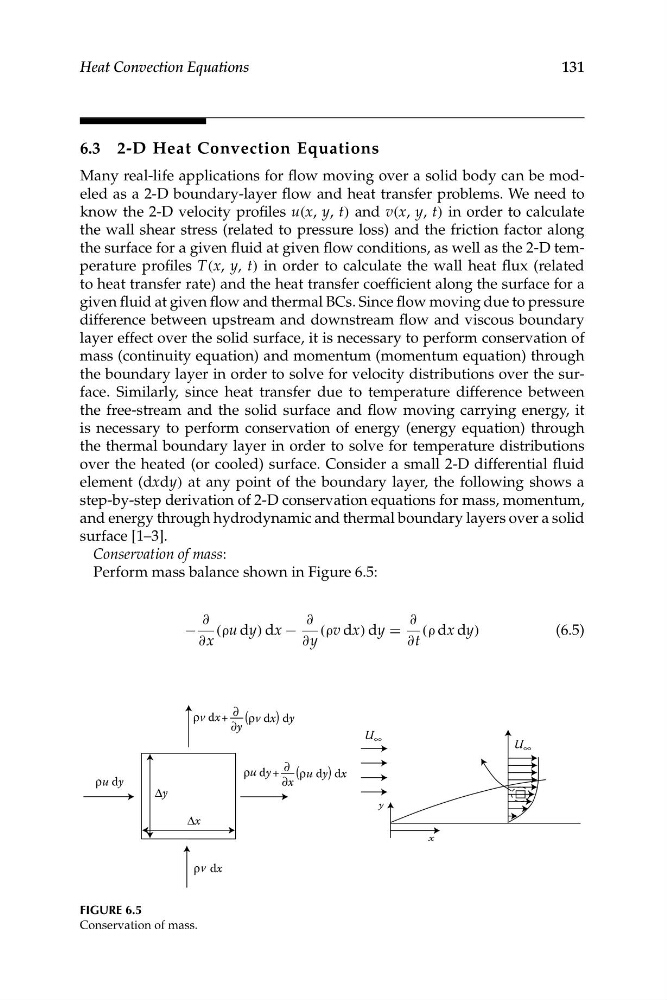
Perform mass balance shown in Figure 6.5:
∂
∂
∂
− (ρu dy) dx −
(ρv dx) dy = (ρ dx dy)
(6.5)
∂x
∂y
∂t
(ρv dx) dy
y
∂
+ ∂
Δy
Δx
U ∞
U ∞
x
y
ρv dx
(ρu dy) dx
x
∂
+ ∂
ρ dy
ρu dy
ρ dx
u
v
FIGURE 6.5
Conservation of mass.
Heat Convection Equations
6.3 2-D Heat Convection Equations
Many real-life applications for flow moving over a solid body can be modeled as a 2-D boundary-layer flow and heat transfer problems. We need to
know the 2-D velocity profiles u(x, y, t) and v(x, y, t) in order to calculate
the wall shear stress (related to pressure loss) and the friction factor along
the surface for a given fluid at given flow conditions, as well as the 2-D temperature profiles T(x, y, t) in order to calculate the wall heat flux (related
to heat transfer rate) and the heat transfer coefficient along the surface for a
given fluid at given flow and thermal BCs. Since flow moving due to pressure
difference between upstream and downstream flow and viscous boundary
layer effect over the solid surface, it is necessary to perform conservation of
mass (continuity equation) and momentum (momentum equation) through
the boundary layer in order to solve for velocity distributions over the surface. Similarly, since heat transfer due to temperature difference between
the free-stream and the solid surface and flow moving carrying energy, it
is necessary to perform conservation of energy (energy equation) through
the thermal boundary layer in order to solve for temperature distributions
over the heated (or cooled) surface. Consider a small 2-D differential fluid
element (dxdy) at any point of the boundary layer, the following shows a
step-by-step derivation of 2-D conservation equations for mass, momentum,
and energy through hydrodynamic and thermal boundary layers over a solid
surface [1–3].
Conservation of mass:
Perform mass balance shown in Figure 6.5:
∂
∂
∂
− (ρu dy) dx −
(ρv dx) dy = (ρ dx dy)
(6.5)
∂x
∂y
∂t
(ρv dx) dy
y
∂
+ ∂
Δy
Δx
U ∞
U ∞
x
y
ρv dx
(ρu dy) dx
x
∂
+ ∂
ρ dy
ρu dy
ρ dx
u
v
FIGURE 6.5
Conservation of mass.