

122
Analytical Heat Transfer
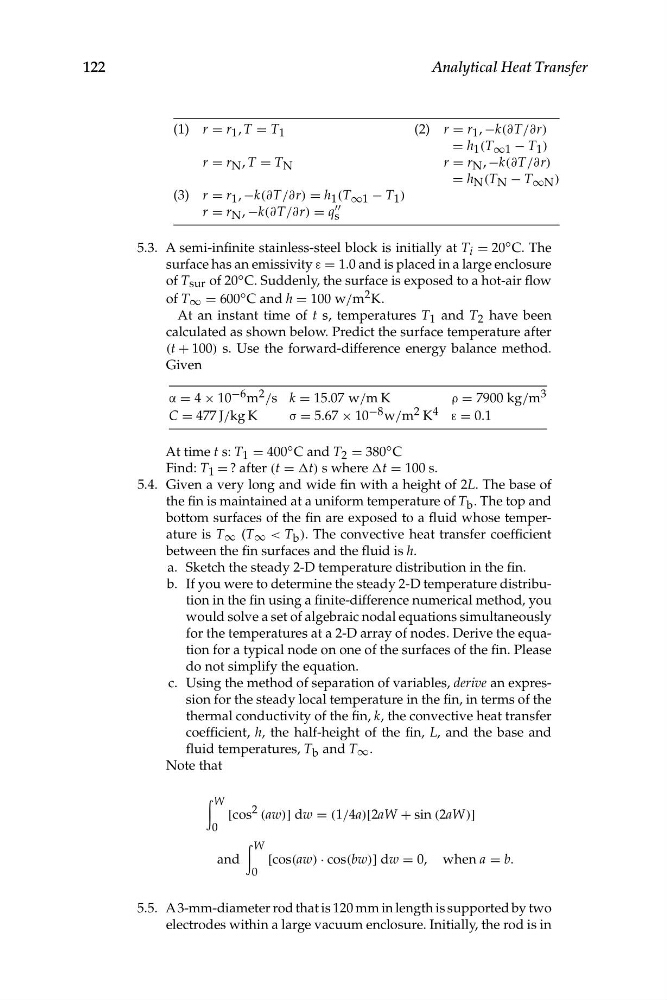
(1) r = r 1 , T = T 1
(2) r = r 1 , −k(∂T/∂r)
= h 1 (T ∞1 − T 1 )
r = r N , T = T N
r = r N , −k(∂T/∂r)
= h N (T N − T ∞N )
(3) r = r 1 , −k(∂T/∂r) = h 1 (T ∞1 − T 1 )
""
r = r N , −k(∂T/∂r) = q s
5.3. A semi-infinite stainless-steel block is initially at T i = 20 ◦ C. The
surface has an emissivity ε = 1.0 and is placed in a large enclosure
of T sur of 20 ◦ C. Suddenly, the surface is exposed to a hot-air flow
of T ∞ = 600 ◦ C and h = 100 w/m 2 K.
At an instant time of t s, temperatures T 1 and T 2 have been
calculated as shown below. Predict the surface temperature after
(t + 100) s. Use the forward-difference energy balance method.
Given
3
α = 4 × 10 −6 m 2 /s k = 15.07 w/m K
ρ = 7900 kg/m
C = 477 J/kg K
σ = 5.67 × 10 −8 w/m 2 K 4 ε = 0.1
At time t s: T 1 = 400 ◦ C and T 2 = 380 ◦ C
Find: T 1 = ? after (t = Δt) s where Δt = 100 s.
5.4. Given a very long and wide fin with a height of 2L. The base of
the fin is maintained at a uniform temperature of T b . The top and
bottom surfaces of the fin are exposed to a fluid whose temperature is T ∞ (T ∞ < T b ). The convective heat transfer coefficient
between the fin surfaces and the fluid is h.
a. Sketch the steady 2-D temperature distribution in the fin.
b. If you were to determine the steady 2-D temperature distribution in the fin using a finite-difference numerical method, you
would solve a set of algebraic nodal equations simultaneously
for the temperatures at a 2-D array of nodes. Derive the equation for a typical node on one of the surfaces of the fin. Please
do not simplify the equation.
c. Using the method of separation of variables, derive an expression for the steady local temperature in the fin, in terms of the
thermal conductivity of the fin, k, the convective heat transfer
coefficient, h, the half-height of the fin, L, and the base and
fluid temperatures, T b and T ∞ .
Note that
� W
[cos 2 (aw)] dw (1/4a) 2aW sin (2aW)
0
=
[
+
]
� W
and
[cos(aw) · cos(bw)] dw = 0, when a = b.
0
5.5. A 3-mm-diameter rod that is 120 mm in length is supported by two
electrodes within a large vacuum enclosure. Initially, the rod is in
Analytical Heat Transfer
(1) r = r 1 , T = T 1
(2) r = r 1 , −k(∂T/∂r)
= h 1 (T ∞1 − T 1 )
r = r N , T = T N
r = r N , −k(∂T/∂r)
= h N (T N − T ∞N )
(3) r = r 1 , −k(∂T/∂r) = h 1 (T ∞1 − T 1 )
""
r = r N , −k(∂T/∂r) = q s
5.3. A semi-infinite stainless-steel block is initially at T i = 20 ◦ C. The
surface has an emissivity ε = 1.0 and is placed in a large enclosure
of T sur of 20 ◦ C. Suddenly, the surface is exposed to a hot-air flow
of T ∞ = 600 ◦ C and h = 100 w/m 2 K.
At an instant time of t s, temperatures T 1 and T 2 have been
calculated as shown below. Predict the surface temperature after
(t + 100) s. Use the forward-difference energy balance method.
Given
3
α = 4 × 10 −6 m 2 /s k = 15.07 w/m K
ρ = 7900 kg/m
C = 477 J/kg K
σ = 5.67 × 10 −8 w/m 2 K 4 ε = 0.1
At time t s: T 1 = 400 ◦ C and T 2 = 380 ◦ C
Find: T 1 = ? after (t = Δt) s where Δt = 100 s.
5.4. Given a very long and wide fin with a height of 2L. The base of
the fin is maintained at a uniform temperature of T b . The top and
bottom surfaces of the fin are exposed to a fluid whose temperature is T ∞ (T ∞ < T b ). The convective heat transfer coefficient
between the fin surfaces and the fluid is h.
a. Sketch the steady 2-D temperature distribution in the fin.
b. If you were to determine the steady 2-D temperature distribution in the fin using a finite-difference numerical method, you
would solve a set of algebraic nodal equations simultaneously
for the temperatures at a 2-D array of nodes. Derive the equation for a typical node on one of the surfaces of the fin. Please
do not simplify the equation.
c. Using the method of separation of variables, derive an expression for the steady local temperature in the fin, in terms of the
thermal conductivity of the fin, k, the convective heat transfer
coefficient, h, the half-height of the fin, L, and the base and
fluid temperatures, T b and T ∞ .
Note that
� W
[cos 2 (aw)] dw (1/4a) 2aW sin (2aW)
0
=
[
+
]
� W
and
[cos(aw) · cos(bw)] dw = 0, when a = b.
0
5.5. A 3-mm-diameter rod that is 120 mm in length is supported by two
electrodes within a large vacuum enclosure. Initially, the rod is in