

�
�
�
�
�
�
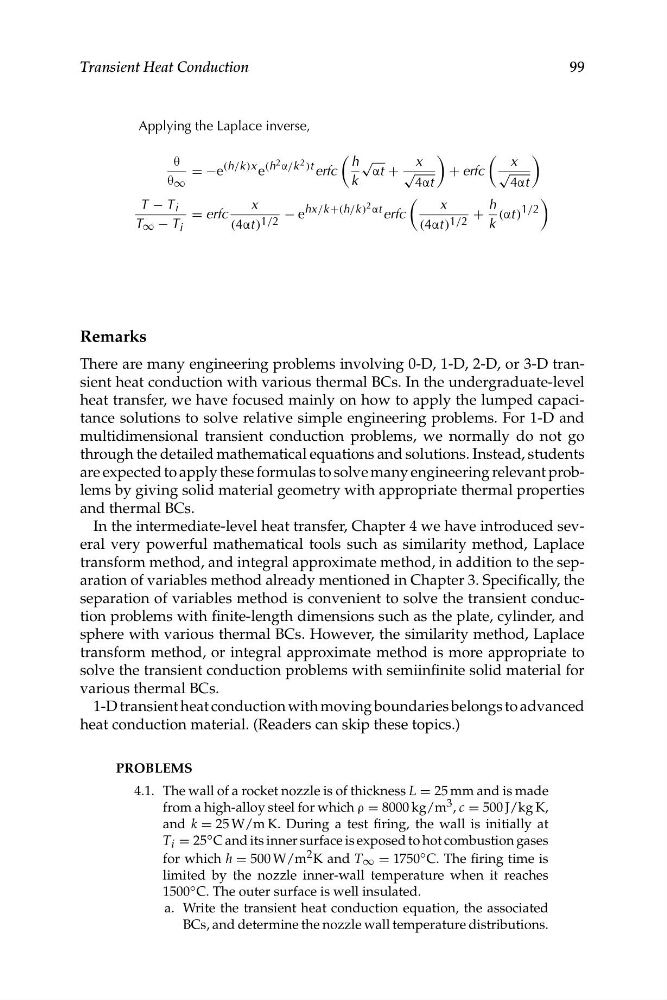
Applying the Laplace inverse,
θ
h √
x
x
(h/k )x
= −e
e (h 2 α/k 2 )t erfc
αt + √
+ erfc √
θ ∞
k
4αt
4αt
T − T
x
x
h
i
1/2
= erfc
− e hx/k +(h/k ) 2 αt erfc
+ (αt )
T ∞ − T i
(4αt ) 1/2
(4αt ) 1/2
k
99
Transient Heat Conduction
Remarks
There are many engineering problems involving 0-D, 1-D, 2-D, or 3-D transient heat conduction with various thermal BCs. In the undergraduate-level
heat transfer, we have focused mainly on how to apply the lumped capacitance solutions to solve relative simple engineering problems. For 1-D and
multidimensional transient conduction problems, we normally do not go
through the detailed mathematical equations and solutions. Instead, students
are expected to apply these formulas to solve many engineering relevant problems by giving solid material geometry with appropriate thermal properties
and thermal BCs.
In the intermediate-level heat transfer, Chapter 4 we have introduced several very powerful mathematical tools such as similarity method, Laplace
transform method, and integral approximate method, in addition to the separation of variables method already mentioned in Chapter 3. Specifically, the
separation of variables method is convenient to solve the transient conduction problems with finite-length dimensions such as the plate, cylinder, and
sphere with various thermal BCs. However, the similarity method, Laplace
transform method, or integral approximate method is more appropriate to
solve the transient conduction problems with semiinfinite solid material for
various thermal BCs.
1-D transient heat conduction with moving boundaries belongs to advanced
heat conduction material. (Readers can skip these topics.)
PROBLEMS
4.1. The wall of a rocket nozzle is of thickness L = 25 mm and is made
from a high-alloy steel for which ρ = 8000 kg/m 3 , c = 500 J/kg K,
and k = 25 W/m K. During a test firing, the wall is initially at
T i = 25 ◦ C and its inner surface is exposed to hot combustion gases
for which h = 500 W/m 2 K and T ∞ = 1750 ◦ C. The firing time is
limited by the nozzle inner-wall temperature when it reaches
1500 ◦ C. The outer surface is well insulated.
a. Write the transient heat conduction equation, the associated
BCs, and determine the nozzle wall temperature distributions.
�
�
�
�
�
Applying the Laplace inverse,
θ
h √
x
x
(h/k )x
= −e
e (h 2 α/k 2 )t erfc
αt + √
+ erfc √
θ ∞
k
4αt
4αt
T − T
x
x
h
i
1/2
= erfc
− e hx/k +(h/k ) 2 αt erfc
+ (αt )
T ∞ − T i
(4αt ) 1/2
(4αt ) 1/2
k
99
Transient Heat Conduction
Remarks
There are many engineering problems involving 0-D, 1-D, 2-D, or 3-D transient heat conduction with various thermal BCs. In the undergraduate-level
heat transfer, we have focused mainly on how to apply the lumped capacitance solutions to solve relative simple engineering problems. For 1-D and
multidimensional transient conduction problems, we normally do not go
through the detailed mathematical equations and solutions. Instead, students
are expected to apply these formulas to solve many engineering relevant problems by giving solid material geometry with appropriate thermal properties
and thermal BCs.
In the intermediate-level heat transfer, Chapter 4 we have introduced several very powerful mathematical tools such as similarity method, Laplace
transform method, and integral approximate method, in addition to the separation of variables method already mentioned in Chapter 3. Specifically, the
separation of variables method is convenient to solve the transient conduction problems with finite-length dimensions such as the plate, cylinder, and
sphere with various thermal BCs. However, the similarity method, Laplace
transform method, or integral approximate method is more appropriate to
solve the transient conduction problems with semiinfinite solid material for
various thermal BCs.
1-D transient heat conduction with moving boundaries belongs to advanced
heat conduction material. (Readers can skip these topics.)
PROBLEMS
4.1. The wall of a rocket nozzle is of thickness L = 25 mm and is made
from a high-alloy steel for which ρ = 8000 kg/m 3 , c = 500 J/kg K,
and k = 25 W/m K. During a test firing, the wall is initially at
T i = 25 ◦ C and its inner surface is exposed to hot combustion gases
for which h = 500 W/m 2 K and T ∞ = 1750 ◦ C. The firing time is
limited by the nozzle inner-wall temperature when it reaches
1500 ◦ C. The outer surface is well insulated.
a. Write the transient heat conduction equation, the associated
BCs, and determine the nozzle wall temperature distributions.