

""
�
�
�
at x = ∞, T = T ∞ = C 3
α
at x = 0, T = T m = −C 1
+ C 3
V a
V a
V a
−C 1 = (T m − C 3 )
= (T m − T ∞ )
α
α
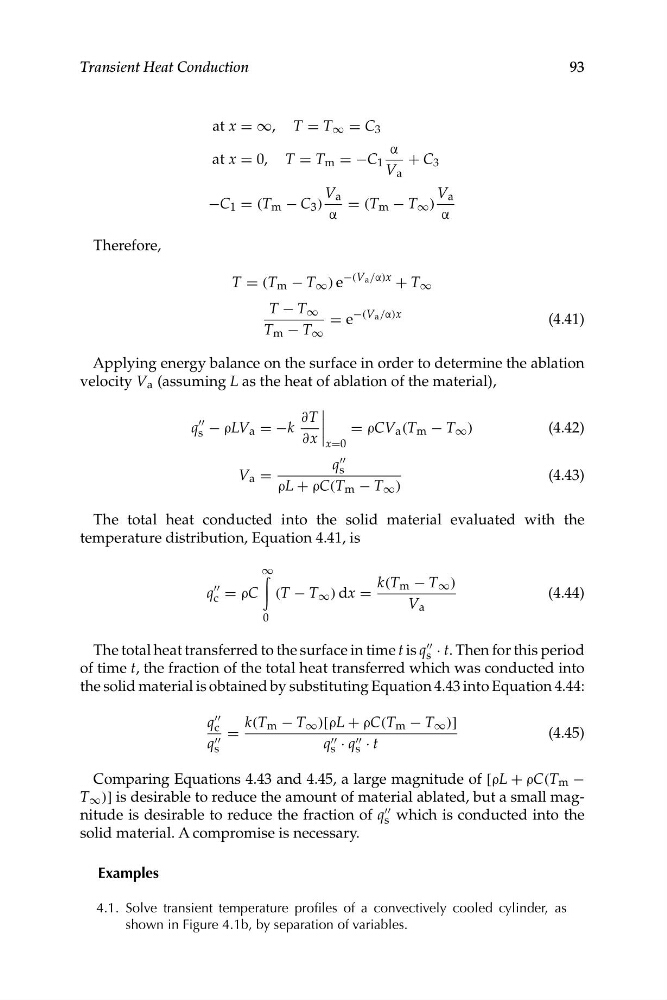
Therefore,
−(V a /α)x
+ T ∞
T = (T m − T ∞ ) e
T − T ∞
−(V a /α)x
= e
(4.41)
T m − T ∞
Applying energy balance on the surface in order to determine the ablation
velocity V a (assuming L as the heat of ablation of the material),
∂T �
q − ρLV a = −k
= ρCV a (T m − T ∞ )
(4.42)
s
�
∂x x=0
""
q s
V a =
(4.43)
ρL + ρC(T m − T ∞ )
The total heat conducted into the solid material evaluated with the
temperature distribution, Equation 4.41, is
∞
k(T m − T ∞ )
""
q = ρC (T − T ∞ ) dx =
(4.44)
c
V a
0
""
The total heat transferred to the surface in time t is q · t. Then for this period
s
of time t, the fraction of the total heat transferred which was conducted into
the solid material is obtained by substituting Equation 4.43 into Equation 4.44:
""
q
k(T m − T ∞ )[ρL + ρC(T m − T ∞ )]
c
=
(4.45)
q ""
q "" · q "" · t
s
s
s
Comparing Equations 4.43 and 4.45, a large magnitude of [ρL + ρC(T m −
T ∞ )] is desirable to reduce the amount of material ablated, but a small mag""
nitude is desirable to reduce the fraction of q which is conducted into the
s
solid material. A compromise is necessary.
Examples
4.1. Solve transient temperature profiles of a convectively cooled cylinder, as
shown in Figure 4.1b, by separation of variables.
93
Transient Heat Conduction
�
�
�
at x = ∞, T = T ∞ = C 3
α
at x = 0, T = T m = −C 1
+ C 3
V a
V a
V a
−C 1 = (T m − C 3 )
= (T m − T ∞ )
α
α
Therefore,
−(V a /α)x
+ T ∞
T = (T m − T ∞ ) e
T − T ∞
−(V a /α)x
= e
(4.41)
T m − T ∞
Applying energy balance on the surface in order to determine the ablation
velocity V a (assuming L as the heat of ablation of the material),
∂T �
q − ρLV a = −k
= ρCV a (T m − T ∞ )
(4.42)
s
�
∂x x=0
""
q s
V a =
(4.43)
ρL + ρC(T m − T ∞ )
The total heat conducted into the solid material evaluated with the
temperature distribution, Equation 4.41, is
∞
k(T m − T ∞ )
""
q = ρC (T − T ∞ ) dx =
(4.44)
c
V a
0
""
The total heat transferred to the surface in time t is q · t. Then for this period
s
of time t, the fraction of the total heat transferred which was conducted into
the solid material is obtained by substituting Equation 4.43 into Equation 4.44:
""
q
k(T m − T ∞ )[ρL + ρC(T m − T ∞ )]
c
=
(4.45)
q ""
q "" · q "" · t
s
s
s
Comparing Equations 4.43 and 4.45, a large magnitude of [ρL + ρC(T m −
T ∞ )] is desirable to reduce the amount of material ablated, but a small mag""
nitude is desirable to reduce the fraction of q which is conducted into the
s
solid material. A compromise is necessary.
Examples
4.1. Solve transient temperature profiles of a convectively cooled cylinder, as
shown in Figure 4.1b, by separation of variables.
93
Transient Heat Conduction