

28
Electromagnetic Fields in Biological Systems
To standardize SAR measurements for compliance testing of cell phones against
applicable exposure guidelines and to minimize variability in measured results, a specific anthropomorphic mannequin (SAM) is proposed for laboratory settings (IEEE
Standard 1528; IEEE 2003). The simplified physical model of the human head consists of
a lossless plastic shell and ear spacer. Inside the shell, there is a homogeneous fluid having the dielectric properties of average head tissue at the test frequency. Because current
technology does not allow reliable measurement of SAR in small, complex geometric
structures such as a simulated pinna, SAM uses a thin lossless ear spacer on the model
to mimic the energy reaching the brain and to reduce the measurement uncertainty.
It is designed to provide conservative SAR values averaged over 1 and 10 g of tissue
mass for a majority of individuals during normal use of wireless handsets. The SAM has
also been adopted by the U.S. FCC (1997), European Committee for Electrotechnical
Standardization (CENELEC 2003; EN 50361), and Association of Radio Industries and
Businesses in Japan (ARIB 2002; ARIB STD-T56). The extent to which SAM is truly
conservative has been a subject of study for several investigators; they used computational dosimetry that compared the SAR in SAM with that in realistic anatomical models of the human head (Gandhi and Kang 2002; Christ et al. 2005; Kainz et al. 2005;
Beard et al. 2006).
There are many advantages to numerical modeling in SAR determination. These
include a more realistic representation of the human anatomy and the telephone as well
as the device’s position relative to the user. The ability to vary these parameters to examine the dosimetric interaction of RF radiation from cellular telephone operation with
the entire human body or its parts such as the head and the hand is also important (Lin
and Gandhi 1996; Lin and Bernardi 2007).
Regarding the aforementioned aspect, the most widely applied numerical method is
the finite-difference time-domain (FDTD) algorithm. This method, first proposed by
Yee (1966), is based on the substitution of each partial derivative in Maxwell’s equations
in time domain with its finite difference representation. This substitution leads to a set
of six equations for which each field component is evaluated at a point of time as a function of the adjacent components evaluated in preceding points of time. The space and
time variables are divided into discrete increments in which the electromagnetic field
is assumed constant. This leads to the definition of a unit cell (referred to as Yee’s cell)
in which the electromagnetic field is assumed constant. To improve the method’s precision without increasing the complexity of the formulas, the electric field and magnetic
field components are placed in different positions within the Yee’s cell and evaluated at
half-time steps.
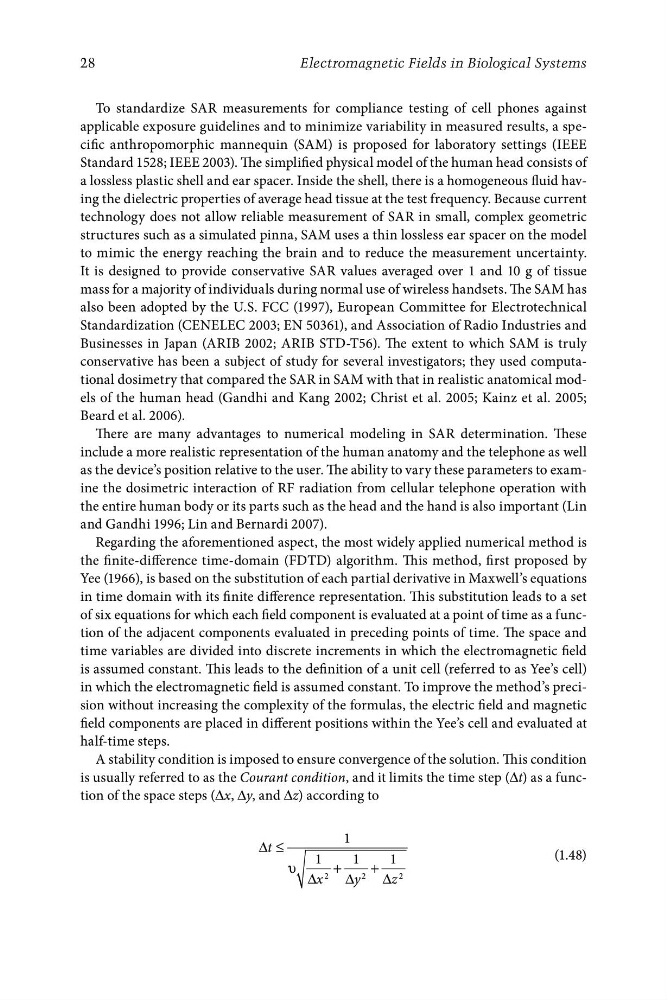
A stability condition is imposed to ensure convergence of the solution. This condition
is usually referred to as the Courant condition, and it limits the time step (Δt) as a function of the space steps (Δx, Δy, and Δz) according to
1
Δt ≤
1
1
1
(1.48)
υ
+
+
Δx
2
Δy
2
Δz
2
Electromagnetic Fields in Biological Systems
To standardize SAR measurements for compliance testing of cell phones against
applicable exposure guidelines and to minimize variability in measured results, a specific anthropomorphic mannequin (SAM) is proposed for laboratory settings (IEEE
Standard 1528; IEEE 2003). The simplified physical model of the human head consists of
a lossless plastic shell and ear spacer. Inside the shell, there is a homogeneous fluid having the dielectric properties of average head tissue at the test frequency. Because current
technology does not allow reliable measurement of SAR in small, complex geometric
structures such as a simulated pinna, SAM uses a thin lossless ear spacer on the model
to mimic the energy reaching the brain and to reduce the measurement uncertainty.
It is designed to provide conservative SAR values averaged over 1 and 10 g of tissue
mass for a majority of individuals during normal use of wireless handsets. The SAM has
also been adopted by the U.S. FCC (1997), European Committee for Electrotechnical
Standardization (CENELEC 2003; EN 50361), and Association of Radio Industries and
Businesses in Japan (ARIB 2002; ARIB STD-T56). The extent to which SAM is truly
conservative has been a subject of study for several investigators; they used computational dosimetry that compared the SAR in SAM with that in realistic anatomical models of the human head (Gandhi and Kang 2002; Christ et al. 2005; Kainz et al. 2005;
Beard et al. 2006).
There are many advantages to numerical modeling in SAR determination. These
include a more realistic representation of the human anatomy and the telephone as well
as the device’s position relative to the user. The ability to vary these parameters to examine the dosimetric interaction of RF radiation from cellular telephone operation with
the entire human body or its parts such as the head and the hand is also important (Lin
and Gandhi 1996; Lin and Bernardi 2007).
Regarding the aforementioned aspect, the most widely applied numerical method is
the finite-difference time-domain (FDTD) algorithm. This method, first proposed by
Yee (1966), is based on the substitution of each partial derivative in Maxwell’s equations
in time domain with its finite difference representation. This substitution leads to a set
of six equations for which each field component is evaluated at a point of time as a function of the adjacent components evaluated in preceding points of time. The space and
time variables are divided into discrete increments in which the electromagnetic field
is assumed constant. This leads to the definition of a unit cell (referred to as Yee’s cell)
in which the electromagnetic field is assumed constant. To improve the method’s precision without increasing the complexity of the formulas, the electric field and magnetic
field components are placed in different positions within the Yee’s cell and evaluated at
half-time steps.
A stability condition is imposed to ensure convergence of the solution. This condition
is usually referred to as the Courant condition, and it limits the time step (Δt) as a function of the space steps (Δx, Δy, and Δz) according to
1
Δt ≤
1
1
1
(1.48)
υ
+
+
Δx
2
Δy
2
Δz
2