

27
Coupling of Electromagnetic Fields into Biological Systems
radiation into air to enable wireless communication, RF energy from these devices is
coupled into the user’s head, neck, or hand situated in the near zone of the radiating system. A variety of experimental and computational methods have been used to quantify
induced fields and SARs, and to assess the health and safety risks posed by these wireless
communication devices (Lin and Bernardi 2007; Bernardi et al. 2009; see also Chapter 5
of this book). It is noteworthy that SAR has been adopted as the metric in guidelines for
human exposure to cellular mobile telephone RF fields and compliance testing of cell
phones worldwide (FCC 1996; ICNIRP 1998; IEEE 2005; NCRP 1986). A 1997 Federal
Communications Commission (FCC) bulletin provides acceptable methods for determining compliance limits through the use of computational and experimental models.
Experimental measurement of SAR distributions in anatomically shaped models of
the human head employs isotropic electric probes in plastic skulls filled with brainequivalent liquid dielectric phantom materials (Balzano, Garay, and Steel 1978; Balzano,
Garay, and Manning 1995; Cleveland and Athey 1989; Gandhi et al. 1999; Kuster and
Balzano 1992; Schmid, Egger, and Kuster 1996). These efforts are compounded by the
variability of electric and magnetic fields in the near zone of the antenna and also by
the wide array of possible device positions and tilt angles of the antenna during normal use. Thus, an intended use position and an angle of 30° are often adopted in measurements for a given device. Nevertheless, a survey of the reported measurements in
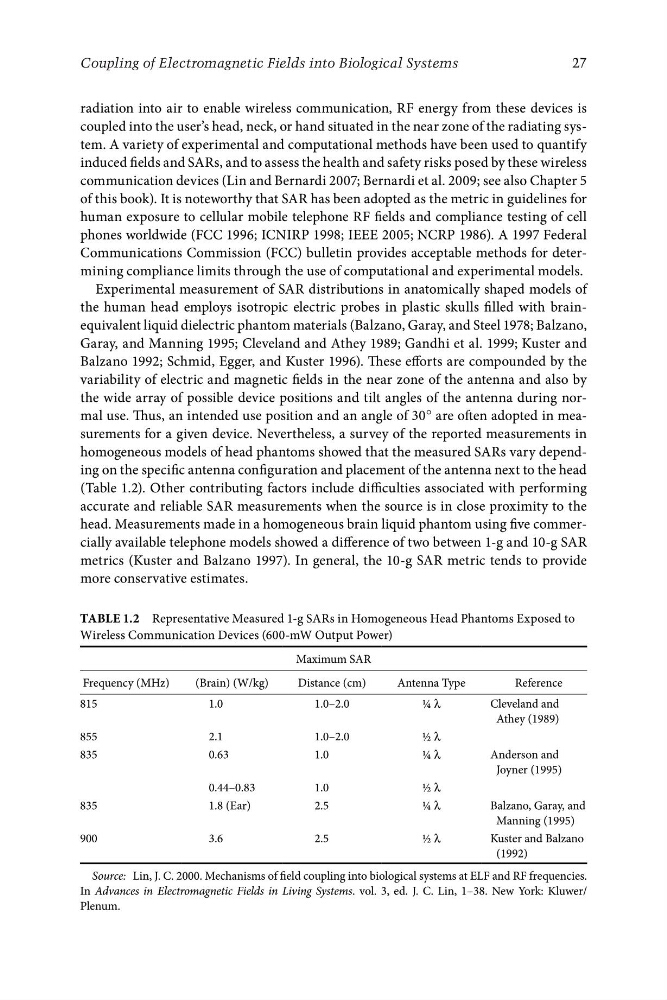
homogeneous models of head phantoms showed that the measured SARs vary depending on the specific antenna configuration and placement of the antenna next to the head
(Table 1.2). Other contributing factors include difficulties associated with performing
accurate and reliable SAR measurements when the source is in close proximity to the
head. Measurements made in a homogeneous brain liquid phantom using five commercially available telephone models showed a difference of two between 1-g and 10-g SAR
metrics (Kuster and Balzano 1997). In general, the 10-g SAR metric tends to provide
more conservative estimates.
TaBlE 1.2 Representative Measured 1-g SARs in Homogeneous Head Phantoms Exposed to
Wireless Communication Devices (600-mW Output Power)
Maximum SAR
Frequency (MHz)
(Brain) (W/kg)
Distance (cm)
Antenna Type
Reference
815
1.0
1.0–2.0
¼ λ
Cleveland and
Athey (1989)
855
2.1
1.0–2.0
½ λ
835
0.63
1.0
¼ λ
Anderson and
Joyner (1995)
0.44–0.83
1.0
½ λ
835
1.8 (Ear)
2.5
¼ λ
Balzano, Garay, and
Manning (1995)
900
3.6
2.5
½ λ
Kuster and Balzano
(1992)
Source: Lin, J. C. 2000. Mechanisms of field coupling into biological systems at ELF and RF frequencies.
In Advances in Electromagnetic Fields in Living Systems. vol. 3, ed. J. C. Lin, 1–38. New York: Kluwer/
Plenum.
Coupling of Electromagnetic Fields into Biological Systems
radiation into air to enable wireless communication, RF energy from these devices is
coupled into the user’s head, neck, or hand situated in the near zone of the radiating system. A variety of experimental and computational methods have been used to quantify
induced fields and SARs, and to assess the health and safety risks posed by these wireless
communication devices (Lin and Bernardi 2007; Bernardi et al. 2009; see also Chapter 5
of this book). It is noteworthy that SAR has been adopted as the metric in guidelines for
human exposure to cellular mobile telephone RF fields and compliance testing of cell
phones worldwide (FCC 1996; ICNIRP 1998; IEEE 2005; NCRP 1986). A 1997 Federal
Communications Commission (FCC) bulletin provides acceptable methods for determining compliance limits through the use of computational and experimental models.
Experimental measurement of SAR distributions in anatomically shaped models of
the human head employs isotropic electric probes in plastic skulls filled with brainequivalent liquid dielectric phantom materials (Balzano, Garay, and Steel 1978; Balzano,
Garay, and Manning 1995; Cleveland and Athey 1989; Gandhi et al. 1999; Kuster and
Balzano 1992; Schmid, Egger, and Kuster 1996). These efforts are compounded by the
variability of electric and magnetic fields in the near zone of the antenna and also by
the wide array of possible device positions and tilt angles of the antenna during normal use. Thus, an intended use position and an angle of 30° are often adopted in measurements for a given device. Nevertheless, a survey of the reported measurements in
homogeneous models of head phantoms showed that the measured SARs vary depending on the specific antenna configuration and placement of the antenna next to the head
(Table 1.2). Other contributing factors include difficulties associated with performing
accurate and reliable SAR measurements when the source is in close proximity to the
head. Measurements made in a homogeneous brain liquid phantom using five commercially available telephone models showed a difference of two between 1-g and 10-g SAR
metrics (Kuster and Balzano 1997). In general, the 10-g SAR metric tends to provide
more conservative estimates.
TaBlE 1.2 Representative Measured 1-g SARs in Homogeneous Head Phantoms Exposed to
Wireless Communication Devices (600-mW Output Power)
Maximum SAR
Frequency (MHz)
(Brain) (W/kg)
Distance (cm)
Antenna Type
Reference
815
1.0
1.0–2.0
¼ λ
Cleveland and
Athey (1989)
855
2.1
1.0–2.0
½ λ
835
0.63
1.0
¼ λ
Anderson and
Joyner (1995)
0.44–0.83
1.0
½ λ
835
1.8 (Ear)
2.5
¼ λ
Balzano, Garay, and
Manning (1995)
900
3.6
2.5
½ λ
Kuster and Balzano
(1992)
Source: Lin, J. C. 2000. Mechanisms of field coupling into biological systems at ELF and RF frequencies.
In Advances in Electromagnetic Fields in Living Systems. vol. 3, ed. J. C. Lin, 1–38. New York: Kluwer/
Plenum.