

385
Terahertz Radiation
Table 7.1 Monochromatic-Tunable Terahertz (THz)-Wave Sources Based on Nonlinear
Frequency Conversion
THz Source
THz-wave
Parametric Generation
THz-wave
Parametric Oscillator
Injection-seeded
THz-wave Parametric
(TPG)
(TPO)
Generation (Is-TPG)
Tuning by
Frequency range
Line width
THz grating
0.9–3.8 THz
>1 THz
Cavity rotation
0.9–2.7 THz
∼30 GHz
Seeding
0.6–3.0 THz
∼100 MHz
Output power
10 nJ/pulse
6 W (peak)
20 nJ/pulse
2 W (peak)
100 nJ/pulse
30 W (peak)
Source: Data courtesy of Dr. Kodo Kawase.
Typically, the pump pulse (ω p ) and the idler pulses (ω i ) are at near-IR optical frequencies, whereas the signal photon is at THz frequencies (ω THz ). The sum of ω THz and ω I are
equal in quantum energy to the ω p (i.e., ω p = ω THz + ω I ). These processes are most commonly exploited using lithium niobate crystals (LiNbO 3 ). LiNbO 3 is an ideal material for
THz wave generation because it is transparent over a wide wavelength range, and it has
a large nonlinear absorption coefficient at wavelengths where pump lasers have the most
power. OPO sources often use a Q-switched mode-locked Nd:YAG laser as the pump
source (λ = 1.064 μm, 7 ps pulse duration, 50 MHz repetition rate, and 10 W average
power). These sources are continuously tunable from 1 to 3 THz, and their output power
is directly proportional to the idler intensity.
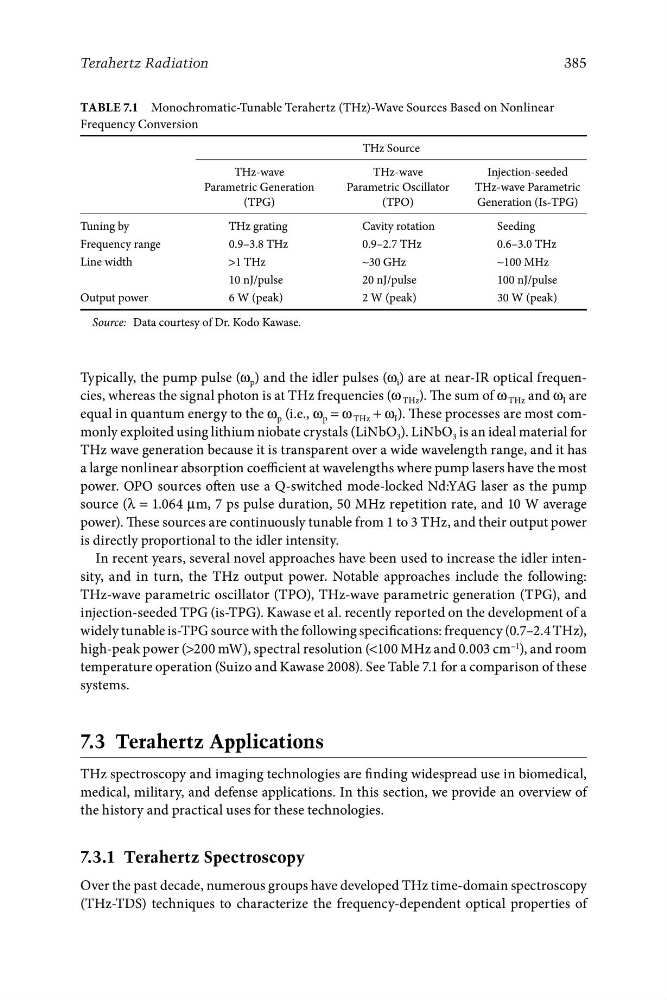
In recent years, several novel approaches have been used to increase the idler intensity, and in turn, the THz output power. Notable approaches include the following:
THz-wave parametric oscillator (TPO), THz-wave parametric generation (TPG), and
injection-seeded TPG (is-TPG). Kawase et al. recently reported on the development of a
widely tunable is-TPG source with the following specifications: frequency (0.7–2.4 THz),
high-peak power (>200 mW), spectral resolution (<100 MHz and 0.003 cm –1 ), and room
temperature operation (Suizo and Kawase 2008). See Table 7.1 for a comparison of these
systems.
7.3 Terahertz Applications
THz spectroscopy and imaging technologies are finding widespread use in biomedical,
medical, military, and defense applications. In this section, we provide an overview of
the history and practical uses for these technologies.
7.3.1 Terahertz Spectroscopy
Over the past decade, numerous groups have developed THz time-domain spectroscopy
(THz-TDS) techniques to characterize the frequency-dependent optical properties of
Terahertz Radiation
Table 7.1 Monochromatic-Tunable Terahertz (THz)-Wave Sources Based on Nonlinear
Frequency Conversion
THz Source
THz-wave
Parametric Generation
THz-wave
Parametric Oscillator
Injection-seeded
THz-wave Parametric
(TPG)
(TPO)
Generation (Is-TPG)
Tuning by
Frequency range
Line width
THz grating
0.9–3.8 THz
>1 THz
Cavity rotation
0.9–2.7 THz
∼30 GHz
Seeding
0.6–3.0 THz
∼100 MHz
Output power
10 nJ/pulse
6 W (peak)
20 nJ/pulse
2 W (peak)
100 nJ/pulse
30 W (peak)
Source: Data courtesy of Dr. Kodo Kawase.
Typically, the pump pulse (ω p ) and the idler pulses (ω i ) are at near-IR optical frequencies, whereas the signal photon is at THz frequencies (ω THz ). The sum of ω THz and ω I are
equal in quantum energy to the ω p (i.e., ω p = ω THz + ω I ). These processes are most commonly exploited using lithium niobate crystals (LiNbO 3 ). LiNbO 3 is an ideal material for
THz wave generation because it is transparent over a wide wavelength range, and it has
a large nonlinear absorption coefficient at wavelengths where pump lasers have the most
power. OPO sources often use a Q-switched mode-locked Nd:YAG laser as the pump
source (λ = 1.064 μm, 7 ps pulse duration, 50 MHz repetition rate, and 10 W average
power). These sources are continuously tunable from 1 to 3 THz, and their output power
is directly proportional to the idler intensity.
In recent years, several novel approaches have been used to increase the idler intensity, and in turn, the THz output power. Notable approaches include the following:
THz-wave parametric oscillator (TPO), THz-wave parametric generation (TPG), and
injection-seeded TPG (is-TPG). Kawase et al. recently reported on the development of a
widely tunable is-TPG source with the following specifications: frequency (0.7–2.4 THz),
high-peak power (>200 mW), spectral resolution (<100 MHz and 0.003 cm –1 ), and room
temperature operation (Suizo and Kawase 2008). See Table 7.1 for a comparison of these
systems.
7.3 Terahertz Applications
THz spectroscopy and imaging technologies are finding widespread use in biomedical,
medical, military, and defense applications. In this section, we provide an overview of
the history and practical uses for these technologies.
7.3.1 Terahertz Spectroscopy
Over the past decade, numerous groups have developed THz time-domain spectroscopy
(THz-TDS) techniques to characterize the frequency-dependent optical properties of