

18
Electromagnetic Fields in Biological Systems
10 E 0
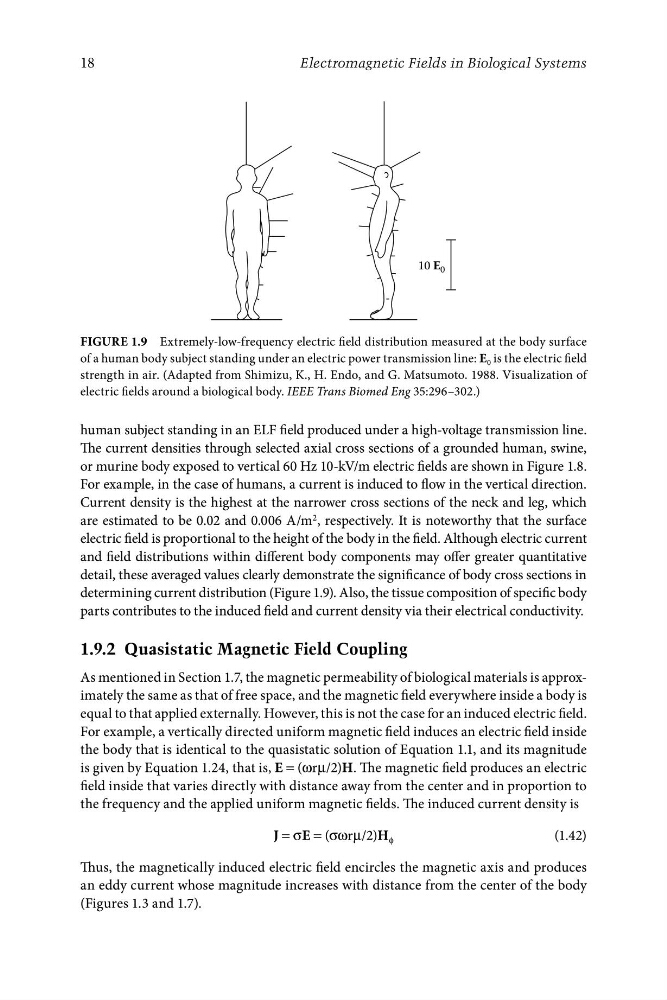
FigurE 1.9 Extremely-low-frequency electric field distribution measured at the body surface
of a human body subject standing under an electric power transmission line: E 0 is the electric field
strength in air. (Adapted from Shimizu, K., H. Endo, and G. Matsumoto. 1988. Visualization of
electric fields around a biological body. IEEE Trans Biomed Eng 35:296–302.)
human subject standing in an ELF field produced under a high-voltage transmission line.
The current densities through selected axial cross sections of a grounded human, swine,
or murine body exposed to vertical 60 Hz 10-kV/m electric fields are shown in Figure 1.8.
For example, in the case of humans, a current is induced to flow in the vertical direction.
Current density is the highest at the narrower cross sections of the neck and leg, which
are estimated to be 0.02 and 0.006 A/m 2 , respectively. It is noteworthy that the surface
electric field is proportional to the height of the body in the field. Although electric current
and field distributions within different body components may offer greater quantitative
detail, these averaged values clearly demonstrate the significance of body cross sections in
determining current distribution (Figure 1.9). Also, the tissue composition of specific body
parts contributes to the induced field and current density via their electrical conductivity.
1.9.2 Quasistatic Magnetic Field Coupling
As mentioned in Section 1.7, the magnetic permeability of biological materials is approximately the same as that of free space, and the magnetic field everywhere inside a body is
equal to that applied externally. However, this is not the case for an induced electric field.
For example, a vertically directed uniform magnetic field induces an electric field inside
the body that is identical to the quasistatic solution of Equation 1.1, and its magnitude
is given by Equation 1.24, that is, E = (ωrμ/2)H. The magnetic field produces an electric
field inside that varies directly with distance away from the center and in proportion to
the frequency and the applied uniform magnetic fields. The induced current density is
J = σE = (σωrμ/2)H ϕ
(1.42)
Thus, the magnetically induced electric field encircles the magnetic axis and produces
an eddy current whose magnitude increases with distance from the center of the body
(Figures 1.3 and 1.7).
Electromagnetic Fields in Biological Systems
10 E 0
FigurE 1.9 Extremely-low-frequency electric field distribution measured at the body surface
of a human body subject standing under an electric power transmission line: E 0 is the electric field
strength in air. (Adapted from Shimizu, K., H. Endo, and G. Matsumoto. 1988. Visualization of
electric fields around a biological body. IEEE Trans Biomed Eng 35:296–302.)
human subject standing in an ELF field produced under a high-voltage transmission line.
The current densities through selected axial cross sections of a grounded human, swine,
or murine body exposed to vertical 60 Hz 10-kV/m electric fields are shown in Figure 1.8.
For example, in the case of humans, a current is induced to flow in the vertical direction.
Current density is the highest at the narrower cross sections of the neck and leg, which
are estimated to be 0.02 and 0.006 A/m 2 , respectively. It is noteworthy that the surface
electric field is proportional to the height of the body in the field. Although electric current
and field distributions within different body components may offer greater quantitative
detail, these averaged values clearly demonstrate the significance of body cross sections in
determining current distribution (Figure 1.9). Also, the tissue composition of specific body
parts contributes to the induced field and current density via their electrical conductivity.
1.9.2 Quasistatic Magnetic Field Coupling
As mentioned in Section 1.7, the magnetic permeability of biological materials is approximately the same as that of free space, and the magnetic field everywhere inside a body is
equal to that applied externally. However, this is not the case for an induced electric field.
For example, a vertically directed uniform magnetic field induces an electric field inside
the body that is identical to the quasistatic solution of Equation 1.1, and its magnitude
is given by Equation 1.24, that is, E = (ωrμ/2)H. The magnetic field produces an electric
field inside that varies directly with distance away from the center and in proportion to
the frequency and the applied uniform magnetic fields. The induced current density is
J = σE = (σωrμ/2)H ϕ
(1.42)
Thus, the magnetically induced electric field encircles the magnetic axis and produces
an eddy current whose magnitude increases with distance from the center of the body
(Figures 1.3 and 1.7).