

40 cm
20 cm
dB scale
0 dB = 0.44e-3 W/kg
−6 −12 −18 −24
0
dB scale
0 dB = 0.54e-3 W/kg
0 −6 −12 −18 −24
(a)
(b)
5 cm
1 m
3 cm
dB scale
dB scale
0 dB = 0.12e-3 W/kg
0 dB = 0.135 W/kg
0 −6 −12 −18 −24
0 −6 −12 −18 −24
(c)
(d)
311
Mobile Communication Fields in Biological Systems
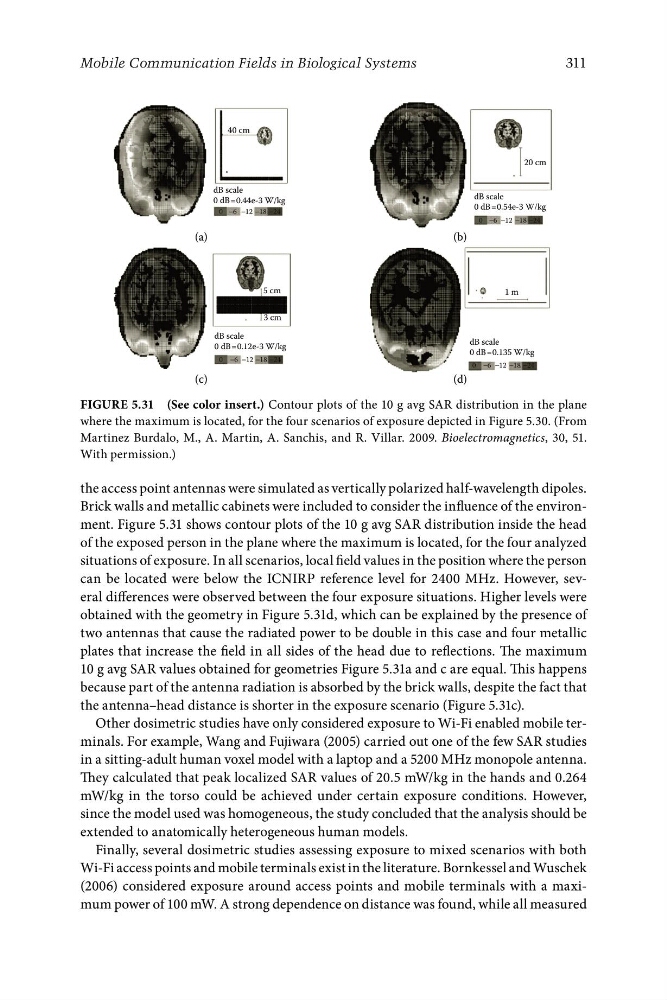
Figure 5.31 (See color insert.) Contour plots of the 10 g avg SAR distribution in the plane
where the maximum is located, for the four scenarios of exposure depicted in Figure 5.30. (From
Martinez Burdalo, M., A. Martin, A. Sanchis, and R. Villar. 2009. Bioelectromagnetics, 30, 51.
With permission.)
the access point antennas were simulated as vertically polarized half-wavelength dipoles.
Brick walls and metallic cabinets were included to consider the influence of the environment. Figure 5.31 shows contour plots of the 10 g avg SAR distribution inside the head
of the exposed person in the plane where the maximum is located, for the four analyzed
situations of exposure. In all scenarios, local field values in the position where the person
can be located were below the ICNIRP reference level for 2400 MHz. However, several differences were observed between the four exposure situations. Higher levels were
obtained with the geometry in Figure 5.31d, which can be explained by the presence of
two antennas that cause the radiated power to be double in this case and four metallic
plates that increase the field in all sides of the head due to reflections. The maximum
10 g avg SAR values obtained for geometries Figure 5.31a and c are equal. This happens
because part of the antenna radiation is absorbed by the brick walls, despite the fact that
the antenna–head distance is shorter in the exposure scenario (Figure 5.31c).
Other dosimetric studies have only considered exposure to Wi-Fi enabled mobile terminals. For example, Wang and Fujiwara (2005) carried out one of the few SAR studies
in a sitting-adult human voxel model with a laptop and a 5200 MHz monopole antenna.
They calculated that peak localized SAR values of 20.5 mW/kg in the hands and 0.264
mW/kg in the torso could be achieved under certain exposure conditions. However,
since the model used was homogeneous, the study concluded that the analysis should be
extended to anatomically heterogeneous human models.
Finally, several dosimetric studies assessing exposure to mixed scenarios with both
Wi-Fi access points and mobile terminals exist in the literature. Bornkessel and Wuschek
(2006) considered exposure around access points and mobile terminals with a maximum power of 100 mW. A strong dependence on distance was found, while all measured
20 cm
dB scale
0 dB = 0.44e-3 W/kg
−6 −12 −18 −24
0
dB scale
0 dB = 0.54e-3 W/kg
0 −6 −12 −18 −24
(a)
(b)
5 cm
1 m
3 cm
dB scale
dB scale
0 dB = 0.12e-3 W/kg
0 dB = 0.135 W/kg
0 −6 −12 −18 −24
0 −6 −12 −18 −24
(c)
(d)
311
Mobile Communication Fields in Biological Systems
Figure 5.31 (See color insert.) Contour plots of the 10 g avg SAR distribution in the plane
where the maximum is located, for the four scenarios of exposure depicted in Figure 5.30. (From
Martinez Burdalo, M., A. Martin, A. Sanchis, and R. Villar. 2009. Bioelectromagnetics, 30, 51.
With permission.)
the access point antennas were simulated as vertically polarized half-wavelength dipoles.
Brick walls and metallic cabinets were included to consider the influence of the environment. Figure 5.31 shows contour plots of the 10 g avg SAR distribution inside the head
of the exposed person in the plane where the maximum is located, for the four analyzed
situations of exposure. In all scenarios, local field values in the position where the person
can be located were below the ICNIRP reference level for 2400 MHz. However, several differences were observed between the four exposure situations. Higher levels were
obtained with the geometry in Figure 5.31d, which can be explained by the presence of
two antennas that cause the radiated power to be double in this case and four metallic
plates that increase the field in all sides of the head due to reflections. The maximum
10 g avg SAR values obtained for geometries Figure 5.31a and c are equal. This happens
because part of the antenna radiation is absorbed by the brick walls, despite the fact that
the antenna–head distance is shorter in the exposure scenario (Figure 5.31c).
Other dosimetric studies have only considered exposure to Wi-Fi enabled mobile terminals. For example, Wang and Fujiwara (2005) carried out one of the few SAR studies
in a sitting-adult human voxel model with a laptop and a 5200 MHz monopole antenna.
They calculated that peak localized SAR values of 20.5 mW/kg in the hands and 0.264
mW/kg in the torso could be achieved under certain exposure conditions. However,
since the model used was homogeneous, the study concluded that the analysis should be
extended to anatomically heterogeneous human models.
Finally, several dosimetric studies assessing exposure to mixed scenarios with both
Wi-Fi access points and mobile terminals exist in the literature. Bornkessel and Wuschek
(2006) considered exposure around access points and mobile terminals with a maximum power of 100 mW. A strong dependence on distance was found, while all measured