

30 cm thick concrete
Metallic wall
12 cm thick
ceiling and floor
brick walls
Antenna
40 cm
4 cm
20 cm
Antenna
4 cm
40 cm
(a)
(b)
1.4 m high
12 cm thick
metallic plates
brick wall
2.6 m
15 cm
25 cm
20 cm
1.75 m
15 cm
(c)
(d)
310
Electromagnetic Fields in Biological Systems
are also supporting a wide variety of international research into RF safety. Many of the
supported research projects also involve national and international health agencies.
While several studies present dosimetry results for animals exposed to Wi-Fi radiation (Wu et al. 2010), dosimetric studies for human beings have also been performed.
In certain studies, measurements of the Wi-Fi signals have been made by considering
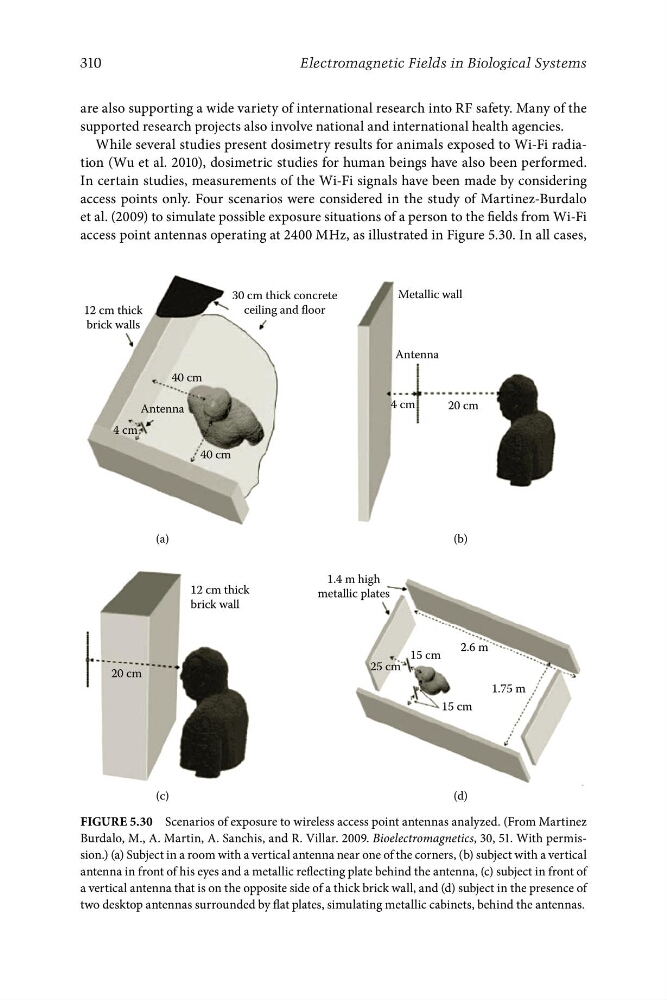
access points only. Four scenarios were considered in the study of Martinez-Burdalo
et al. (2009) to simulate possible exposure situations of a person to the fields from Wi-Fi
access point antennas operating at 2400 MHz, as illustrated in Figure 5.30. In all cases,
Figure 5.30 Scenarios of exposure to wireless access point antennas analyzed. (From Martinez
Burdalo, M., A. Martin, A. Sanchis, and R. Villar. 2009. Bioelectromagnetics, 30, 51. With permission.) (a) Subject in a room with a vertical antenna near one of the corners, (b) subject with a vertical
antenna in front of his eyes and a metallic reflecting plate behind the antenna, (c) subject in front of
a vertical antenna that is on the opposite side of a thick brick wall, and (d) subject in the presence of
two desktop antennas surrounded by flat plates, simulating metallic cabinets, behind the antennas.
Metallic wall
12 cm thick
ceiling and floor
brick walls
Antenna
40 cm
4 cm
20 cm
Antenna
4 cm
40 cm
(a)
(b)
1.4 m high
12 cm thick
metallic plates
brick wall
2.6 m
15 cm
25 cm
20 cm
1.75 m
15 cm
(c)
(d)
310
Electromagnetic Fields in Biological Systems
are also supporting a wide variety of international research into RF safety. Many of the
supported research projects also involve national and international health agencies.
While several studies present dosimetry results for animals exposed to Wi-Fi radiation (Wu et al. 2010), dosimetric studies for human beings have also been performed.
In certain studies, measurements of the Wi-Fi signals have been made by considering
access points only. Four scenarios were considered in the study of Martinez-Burdalo
et al. (2009) to simulate possible exposure situations of a person to the fields from Wi-Fi
access point antennas operating at 2400 MHz, as illustrated in Figure 5.30. In all cases,
Figure 5.30 Scenarios of exposure to wireless access point antennas analyzed. (From Martinez
Burdalo, M., A. Martin, A. Sanchis, and R. Villar. 2009. Bioelectromagnetics, 30, 51. With permission.) (a) Subject in a room with a vertical antenna near one of the corners, (b) subject with a vertical
antenna in front of his eyes and a metallic reflecting plate behind the antenna, (c) subject in front of
a vertical antenna that is on the opposite side of a thick brick wall, and (d) subject in the presence of
two desktop antennas surrounded by flat plates, simulating metallic cabinets, behind the antennas.