

299
Mobile Communication Fields in Biological Systems
In the case of wired hands-free operation, because of the presence of an RF-energycarrying conductor connecting the cellular phone to the audio earpiece, there is a need
to investigate the interaction between the cellular phone, the user, and any associated
wiring, particularly if the latter passes close to the cellular phone’s antenna. The SAR
in the head is generally found to depend on the output power of the cellular phone, the
coupling between the antenna and cable, the external attenuation, and the potential
cable specific attenuation (Bit-Babik et al. 2003; Kuhn et al. 2009; Manning and Gabriel
2000; Troulis, Scanlon, and Evans 2003). No significant differences in performance
between the various models of hands-free cable have become apparent, even though the
microphones are in different places on different cables and some contain push buttons
(Manning and Gabriel 2000).
Bit-Babik et al. (2003) and Kuhn et al. (2009) reported on measured and simulated
SAR results within the user’s head for a wired hands-free scenario at GSM 900/1800 and
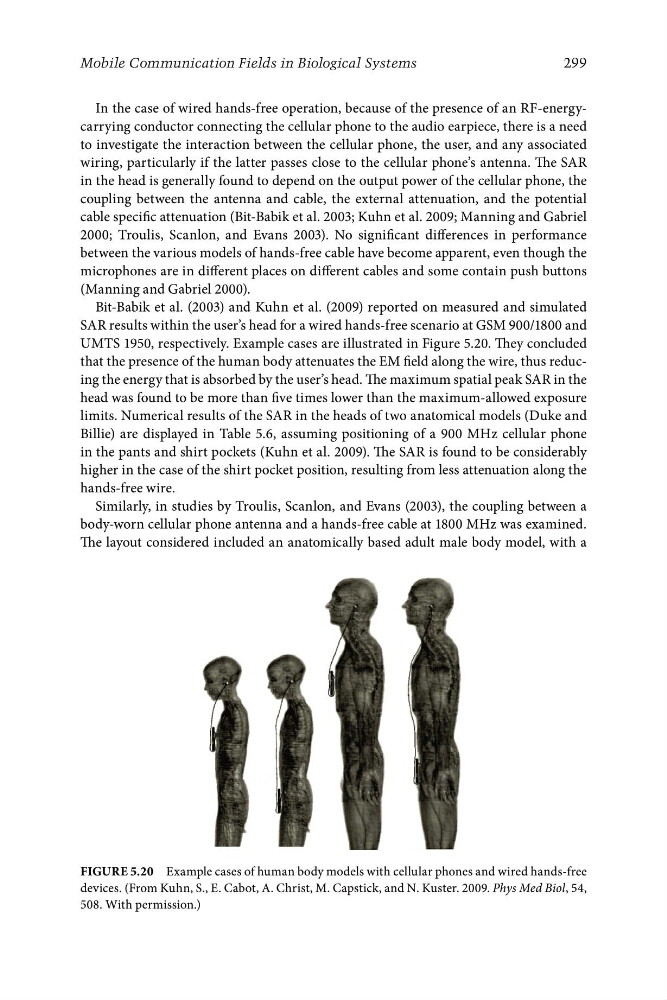
UMTS 1950, respectively. Example cases are illustrated in Figure 5.20. They concluded
that the presence of the human body attenuates the EM field along the wire, thus reducing the energy that is absorbed by the user’s head. The maximum spatial peak SAR in the
head was found to be more than five times lower than the maximum-allowed exposure
limits. Numerical results of the SAR in the heads of two anatomical models (Duke and
Billie) are displayed in Table 5.6, assuming positioning of a 900 MHz cellular phone
in the pants and shirt pockets (Kuhn et al. 2009). The SAR is found to be considerably
higher in the case of the shirt pocket position, resulting from less attenuation along the
hands-free wire.
Similarly, in studies by Troulis, Scanlon, and Evans (2003), the coupling between a
body-worn cellular phone antenna and a hands-free cable at 1800 MHz was examined.
The layout considered included an anatomically based adult male body model, with a
Figure 5.20 Example cases of human body models with cellular phones and wired hands-free
devices. (From Kuhn, S., E. Cabot, A. Christ, M. Capstick, and N. Kuster. 2009. Phys Med Biol, 54,
508. With permission.)
Mobile Communication Fields in Biological Systems
In the case of wired hands-free operation, because of the presence of an RF-energycarrying conductor connecting the cellular phone to the audio earpiece, there is a need
to investigate the interaction between the cellular phone, the user, and any associated
wiring, particularly if the latter passes close to the cellular phone’s antenna. The SAR
in the head is generally found to depend on the output power of the cellular phone, the
coupling between the antenna and cable, the external attenuation, and the potential
cable specific attenuation (Bit-Babik et al. 2003; Kuhn et al. 2009; Manning and Gabriel
2000; Troulis, Scanlon, and Evans 2003). No significant differences in performance
between the various models of hands-free cable have become apparent, even though the
microphones are in different places on different cables and some contain push buttons
(Manning and Gabriel 2000).
Bit-Babik et al. (2003) and Kuhn et al. (2009) reported on measured and simulated
SAR results within the user’s head for a wired hands-free scenario at GSM 900/1800 and
UMTS 1950, respectively. Example cases are illustrated in Figure 5.20. They concluded
that the presence of the human body attenuates the EM field along the wire, thus reducing the energy that is absorbed by the user’s head. The maximum spatial peak SAR in the
head was found to be more than five times lower than the maximum-allowed exposure
limits. Numerical results of the SAR in the heads of two anatomical models (Duke and
Billie) are displayed in Table 5.6, assuming positioning of a 900 MHz cellular phone
in the pants and shirt pockets (Kuhn et al. 2009). The SAR is found to be considerably
higher in the case of the shirt pocket position, resulting from less attenuation along the
hands-free wire.
Similarly, in studies by Troulis, Scanlon, and Evans (2003), the coupling between a
body-worn cellular phone antenna and a hands-free cable at 1800 MHz was examined.
The layout considered included an anatomically based adult male body model, with a
Figure 5.20 Example cases of human body models with cellular phones and wired hands-free
devices. (From Kuhn, S., E. Cabot, A. Christ, M. Capstick, and N. Kuster. 2009. Phys Med Biol, 54,
508. With permission.)