

283
Mobile Communication Fields in Biological Systems
human model, while in the research of Kuhn et al. (2009), the novel vacuum phantom
of Figure 5.9d was developed. Several other homogenous phantoms can be found in
Balzano, Garay, and Steel (1978), Olsen and Griner (1989), and Schmid, Egger, and
Kuster (1996).
To provide realism for experimental modeling, several investigators have developed
realistically shaped, heterogeneous models that are filled with several different tissuesimulant liquids/gels to represent specific parts of the human body (e.g., skin, skull,
eyes). These models do not have the anatomical details of anatomically based numerical
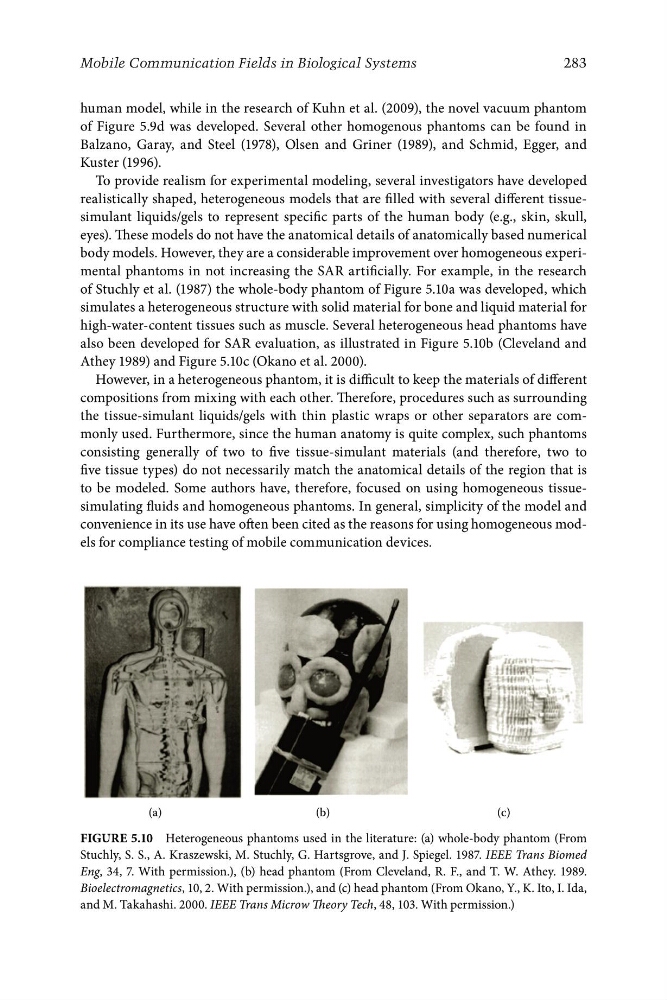
body models. However, they are a considerable improvement over homogeneous experimental phantoms in not increasing the SAR artificially. For example, in the research
of Stuchly et al. (1987) the whole-body phantom of Figure 5.10a was developed, which
simulates a heterogeneous structure with solid material for bone and liquid material for
high-water-content tissues such as muscle. Several heterogeneous head phantoms have
also been developed for SAR evaluation, as illustrated in Figure 5.10b (Cleveland and
Athey 1989) and Figure 5.10c (Okano et al. 2000).
However, in a heterogeneous phantom, it is difficult to keep the materials of different
compositions from mixing with each other. Therefore, procedures such as surrounding
the tissue-simulant liquids/gels with thin plastic wraps or other separators are commonly used. Furthermore, since the human anatomy is quite complex, such phantoms
consisting generally of two to five tissue-simulant materials (and therefore, two to
five tissue types) do not necessarily match the anatomical details of the region that is
to be modeled. Some authors have, therefore, focused on using homogeneous tissuesimulating fluids and homogeneous phantoms. In general, simplicity of the model and
convenience in its use have often been cited as the reasons for using homogeneous models for compliance testing of mobile communication devices.
(a)
(b)
(c)
Figure 5.10 Heterogeneous phantoms used in the literature: (a) whole-body phantom (From
Stuchly, S. S., A. Kraszewski, M. Stuchly, G. Hartsgrove, and J. Spiegel. 1987. IEEE Trans Biomed
Eng, 34, 7. With permission.), (b) head phantom (From Cleveland, R. F., and T. W. Athey. 1989.
Bioelectromagnetics, 10, 2. With permission.), and (c) head phantom (From Okano, Y., K. Ito, I. Ida,
and M. Takahashi. 2000. IEEE Trans Microw Theory Tech, 48, 103. With permission.)