

282
(a)
(b)
(c)
(d)
Electromagnetic Fields in Biological Systems
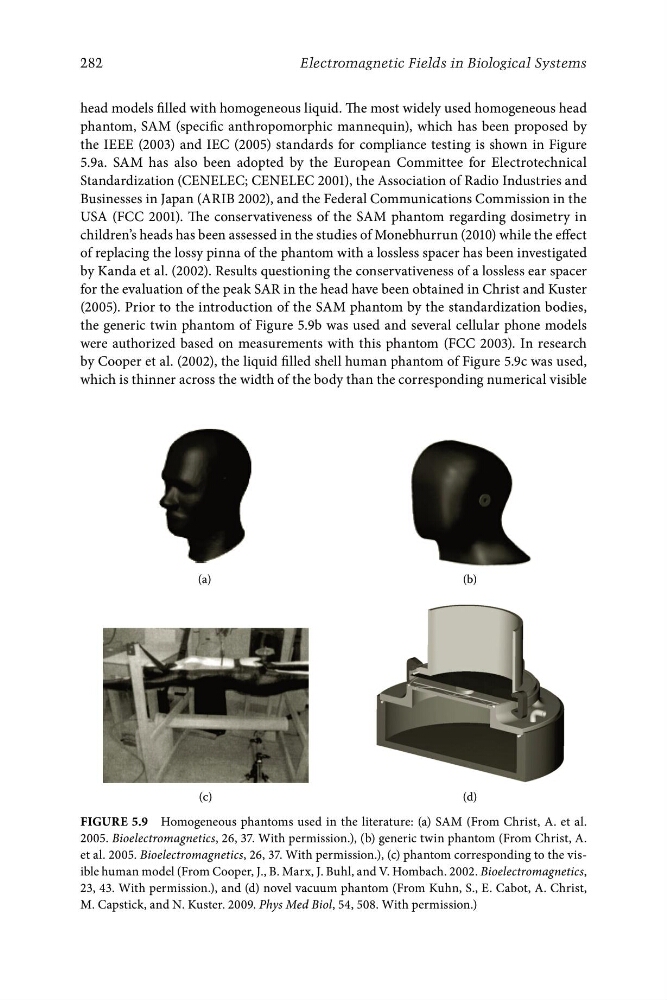
head models filled with homogeneous liquid. The most widely used homogeneous head
phantom, SAM (specific anthropomorphic mannequin), which has been proposed by
the IEEE (2003) and IEC (2005) standards for compliance testing is shown in Figure
5.9a. SAM has also been adopted by the European Committee for Electrotechnical
Standardization (CENELEC; CENELEC 2001), the Association of Radio Industries and
Businesses in Japan (ARIB 2002), and the Federal Communications Commission in the
USA (FCC 2001). The conservativeness of the SAM phantom regarding dosimetry in
children’s heads has been assessed in the studies of Monebhurrun (2010) while the effect
of replacing the lossy pinna of the phantom with a lossless spacer has been investigated
by Kanda et al. (2002). Results questioning the conservativeness of a lossless ear spacer
for the evaluation of the peak SAR in the head have been obtained in Christ and Kuster
(2005). Prior to the introduction of the SAM phantom by the standardization bodies,
the generic twin phantom of Figure 5.9b was used and several cellular phone models
were authorized based on measurements with this phantom (FCC 2003). In research
by Cooper et al. (2002), the liquid filled shell human phantom of Figure 5.9c was used,
which is thinner across the width of the body than the corresponding numerical visible
Figure 5.9 Homogeneous phantoms used in the literature: (a) SAM (From Christ, A. et al.
2005. Bioelectromagnetics, 26, 37. With permission.), (b) generic twin phantom (From Christ, A.
et al. 2005. Bioelectromagnetics, 26, 37. With permission.), (c) phantom corresponding to the visible human model (From Cooper, J., B. Marx, J. Buhl, and V. Hombach. 2002. Bioelectromagnetics,
23, 43. With permission.), and (d) novel vacuum phantom (From Kuhn, S., E. Cabot, A. Christ,
M. Capstick, and N. Kuster. 2009. Phys Med Biol, 54, 508. With permission.)
(a)
(b)
(c)
(d)
Electromagnetic Fields in Biological Systems
head models filled with homogeneous liquid. The most widely used homogeneous head
phantom, SAM (specific anthropomorphic mannequin), which has been proposed by
the IEEE (2003) and IEC (2005) standards for compliance testing is shown in Figure
5.9a. SAM has also been adopted by the European Committee for Electrotechnical
Standardization (CENELEC; CENELEC 2001), the Association of Radio Industries and
Businesses in Japan (ARIB 2002), and the Federal Communications Commission in the
USA (FCC 2001). The conservativeness of the SAM phantom regarding dosimetry in
children’s heads has been assessed in the studies of Monebhurrun (2010) while the effect
of replacing the lossy pinna of the phantom with a lossless spacer has been investigated
by Kanda et al. (2002). Results questioning the conservativeness of a lossless ear spacer
for the evaluation of the peak SAR in the head have been obtained in Christ and Kuster
(2005). Prior to the introduction of the SAM phantom by the standardization bodies,
the generic twin phantom of Figure 5.9b was used and several cellular phone models
were authorized based on measurements with this phantom (FCC 2003). In research
by Cooper et al. (2002), the liquid filled shell human phantom of Figure 5.9c was used,
which is thinner across the width of the body than the corresponding numerical visible
Figure 5.9 Homogeneous phantoms used in the literature: (a) SAM (From Christ, A. et al.
2005. Bioelectromagnetics, 26, 37. With permission.), (b) generic twin phantom (From Christ, A.
et al. 2005. Bioelectromagnetics, 26, 37. With permission.), (c) phantom corresponding to the visible human model (From Cooper, J., B. Marx, J. Buhl, and V. Hombach. 2002. Bioelectromagnetics,
23, 43. With permission.), and (d) novel vacuum phantom (From Kuhn, S., E. Cabot, A. Christ,
M. Capstick, and N. Kuster. 2009. Phys Med Biol, 54, 508. With permission.)