

265
Muscle
Bone
(a)
(b)
Mobile Communication Fields in Biological Systems
approximation of the human head has also been obtained by using homogeneous
or layered dielectric box models (Okoniewski and Stuchly 1996; Pan, Bahrwas, and
Wolff 1997). In studies by Kuhn et al. (2009), the human torso was modeled as a
rectangular structure filled with standard (IEC 2005) tissue emulating material
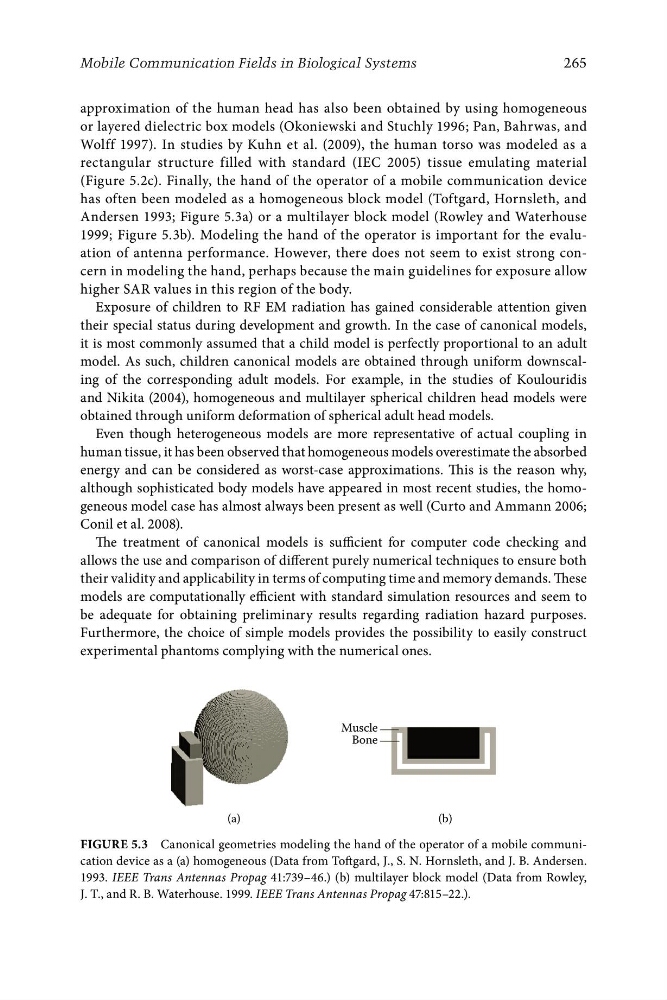
(Figure 5.2c). Finally, the hand of the operator of a mobile communication device
has often been modeled as a homogeneous block model (Toftgard, Hornsleth, and
Andersen 1993; Figure 5.3a) or a multilayer block model (Rowley and Waterhouse
1999; Figure 5.3b). Modeling the hand of the operator is important for the evaluation of antenna performance. However, there does not seem to exist strong concern in modeling the hand, perhaps because the main guidelines for exposure allow
higher SAR values in this region of the body.
Exposure of children to RF EM radiation has gained considerable attention given
their special status during development and growth. In the case of canonical models,
it is most commonly assumed that a child model is perfectly proportional to an adult
model. As such, children canonical models are obtained through uniform downscaling of the corresponding adult models. For example, in the studies of Koulouridis
and Nikita (2004), homogeneous and multilayer spherical children head models were
obtained through uniform deformation of spherical adult head models.
Even though heterogeneous models are more representative of actual coupling in
human tissue, it has been observed that homogeneous models overestimate the absorbed
energy and can be considered as worst-case approximations. This is the reason why,
although sophisticated body models have appeared in most recent studies, the homogeneous model case has almost always been present as well (Curto and Ammann 2006;
Conil et al. 2008).
The treatment of canonical models is sufficient for computer code checking and
allows the use and comparison of different purely numerical techniques to ensure both
their validity and applicability in terms of computing time and memory demands. These
models are computationally efficient with standard simulation resources and seem to
be adequate for obtaining preliminary results regarding radiation hazard purposes.
Furthermore, the choice of simple models provides the possibility to easily construct
experimental phantoms complying with the numerical ones.
Figure 5.3 Canonical geometries modeling the hand of the operator of a mobile communication device as a (a) homogeneous (Data from Toftgard, J., S. N. Hornsleth, and J. B. Andersen.
1993. IEEE Trans Antennas Propag 41:739–46.) (b) multilayer block model (Data from Rowley,
J. T., and R. B. Waterhouse. 1999. IEEE Trans Antennas Propag 47:815–22.).